
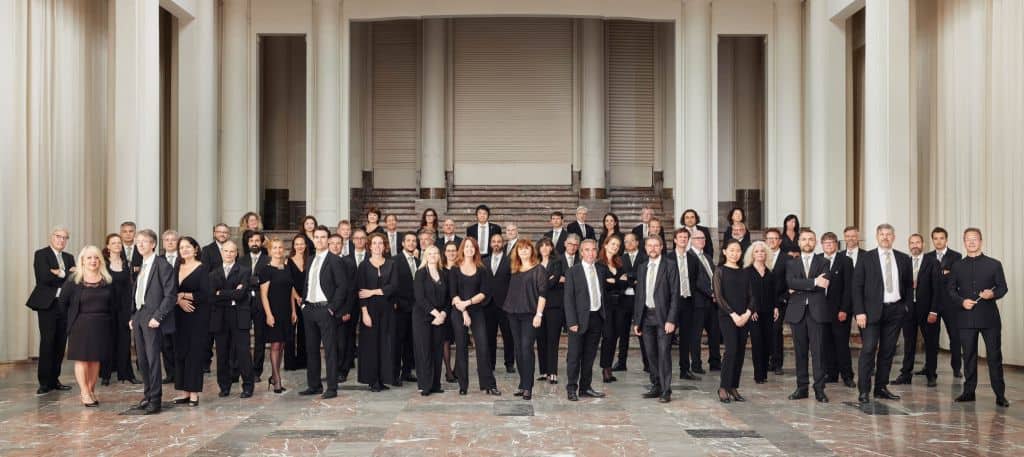
Between sparkling rhythms and melancholic dances, the Belgian National Orchestra set the season opener First Dance in a performance that sought the boundaries between bravura and contemplation. Under the direction of Antony Hermus and with violin virtuoso Augustin Hadelich as soloist, the orchestra brought a program to BOZAR that ranged from American rhythm to Slavic depth. Not every composition was equally convincing, but the evening ended in pure rapture.
More noise than depth
The evening opened with Fountain of Youth (2019) by American composer Julia Wolfe (°1958). This composition, often praised for its vitality and drive, proved to be more of an explosion of repetitive patterns and rhythmic muscle-flexing language. Wolfe's post-minimalist style, with its motor-like pulse and erratic accents, lacked above all emotional depth here. The audience remained visibly unmoved and limited themselves to polite applause.
The fault did not lie with the performance, however: Hermus kept the tempo firmly under control, the orchestra's precision was exemplary, and the balance remained clear despite the sonic onslaught. In an opening concert, things can certainly bang, but this fountain mainly sprayed around without really touching.
Hadelich shone in Dvořák
What was lacking in Wolfe, Augustin Hadelich brought abundantly in the Violin Concerto in A major, Op. 53 by Antonín Dvořák (1841-1904). From the first entrance, it became clear: this would be no demonstration of virtuosity, but of musical imagination. Hadelich's tone – bright, round, lived-in – made his Stradivarius sing with a naturalness that is rarely heard. Dvořák's concerto – not easy for soloist and orchestra – received an interpretation that shone with naturalness and suppleness.
In the opening movement (Allegro ma non troppo), Hadelich sounded virtuosic without showiness, always in service of the musical line. The Adagio was breathtaking: lyrical and intimate, with phrasings that sang like breath. And in the final movement (Allegro giocoso), he showed his rhythmic flair, light-footed and playful, without falling into routine.
The interplay with the BNO was particularly tight. Hermus accompanied with great care: he gave the soloist space without pushing the orchestra into the background. The dialogues between violin and woodwinds in particular were beautifully worked out. Dvořák's warmth and refinement came fully into their own.
A long standing ovation followed, after which Hadelich brought an intriguing jazzy encore. The audience was visibly over the moon. Hadelich proved once again this evening why he belongs among the absolute elite of his generation.
Rachmaninov: grand, broken and rhythmically inspired
After the interval came the Symphonic Dances, Op. 45 by Sergei Rachmaninov (1873-1943), a work that rarely appears on concert programs, but was brought to life here with full conviction. Written at the end of his life, in exile in the United States, this piece is simultaneously reflective and monumental, elegiac and rhythmic – a complex state of mind translated into music.
The BNO showed what it is worth. Hermus chose broad breathing in the first movement (Non allegro), with a careful build-up to the dramatic climax. The second movement (Andante con moto), a ghostly waltz, sounded lightly ironic and full of finesse. The woodwinds excelled here in colour and character.
In the third movement (Lento assai – Allegro vivace), in which Rachmaninov intertwines the Dies Irae theme with Russian folk motifs, the orchestra played with impressive energy. Massive, but never ponderous; with crystal-clear articulation in the strings and a powerful, precise percussion section.
Hermus allowed the many layers of the score to breathe beautifully – the underlying threat, the melancholy, the eruptions of violence, the outburst of zest for life: everything came together in a performance full of dramatic tension and musical clarity.
Only a pity that some of the audience felt the need to applaud immediately at the final gong strike. After such an inward journey, the music deserves its silence. Those who truly listened will wait – and let the echo of that final sound resonate a little longer.
A season start with flair and substance
With First Dance, the Belgian National Orchestra once again proved that under the direction of Antony Hermus it dares to choose contrast, renewal and substance. Wolfe's work remained somewhat superficial as an opener, but in Dvořák and Rachmaninov the evening found its full depth and significance.
Augustin Hadelich delivered a world-class solo performance: technically flawless, but above all musically felt. The BNO sounded vital, versatile and engaged – an ensemble in top form. What had begun hesitantly grew into a layered, memorable season opener.
We wish the Belgian National Orchestra and Antony Hermus a successful tour through South Korea, and look forward eagerly to the next concert in October.