
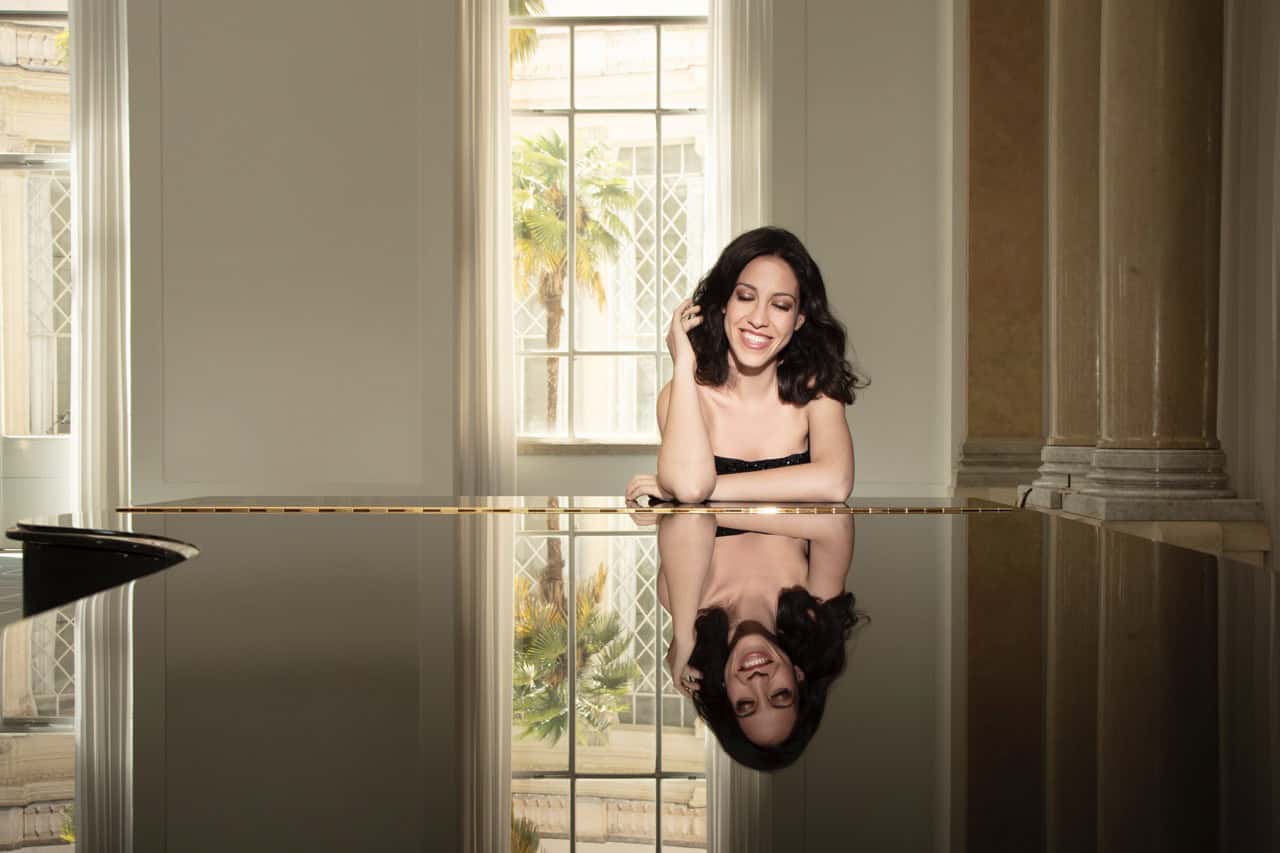
Beatrice Rana sought the human in Beethoven, Paavo Järvi found the world in Sibelius – together they brought the Concertgebouworkest to rare clarity.
The expectation of silence
There was something in the air that afternoon in Amsterdam. Not the noise of protesters or the bustle of the city, but an expectant atmosphere in the Grand Hall of the Concertgebouw. The light fell softly over the gold of the balconies. The audience, remarkably quiet during the concert, seemed to be waiting for something greater than sound alone. Beatrice Rana – the Italian pianist who in recent years has stood out for both her intellect and emotional depth – would play the Third Piano Concerto by Ludwig van Beethoven (1770-1827), conducted by Estonian top conductor Paavo Järvi. A meeting of temperaments: Rana's southern fire against Järvi's northern clarity. We would then effectively venture to the Far North with the Second Symphony by Jean Sibelius (1865-1957).
What followed was an afternoon in which Beethoven and Sibelius found each other across the boundaries of time and geography – two worlds, one breath. An afternoon in which storm and stillness met: first the inner struggle, then the horizon.
The first breath of the storm
From the first measures of the orchestra, Järvi captured attention. No pompous grandeur, no exaggerated pathos, but a Beethoven that breathed. The opening of the Third Piano Concerto sounded tense and measured: the strings muscular, the woodwinds light and sharply articulated. Järvi gave the Concertgebouworkest the freedom to speak in sentences, not in statements. His Beethoven was of flesh and blood, not of marble.
When Beatrice Rana struck her first chord, the atmosphere changed from expectation to concentration. The tone – velvety soft yet with palpable depth – cut through the air like a memory. Her Beethoven was not heroic, but existential: the struggle unfolded within. Her touch remained transparent, her phrasing natural and meaningful. Where others seek shine, she let simplicity speak.
The struggle within
In the Allegro con brio, tension remained beneath the surface. Rana's cadenza was a moment of stillness: not display, but reflection. Each chord posed a question. The silence gained musical force, so that the orchestra in its return did not sound triumphant, but reconciling.
The Largo was pure beauty – a moment in which time stood still. Järvi painted light and air; Rana sang. Her playing was detached, almost vocal, as if she were not playing the keys, but breathing itself.
In the Rondo, vitality returned, lively but never hurried. Their interplay had the precision of chamber music. The finale sounded not like victory, but like liberation – a human being who had endured his own storm.
The encore – Pletnev's arrangement of Tchaikovsky's Nutcracker intermezzo – offered a moment of tender melancholy and fittingly concluded the first part of the afternoon.
The earth sings – Sibelius awakens
Where Beethoven describes the inner world, Sibelius unfolds the world around him – the infinite landscape in which man is small but not insignificant. For Järvi – son of the legendary Neeme Järvi and born in Estonia, on the threshold between East and North – this language is almost mother tongue.
The first movement of the Second Symphony did not begin — it emerged. From small, pulsating movements grew a larger organism, like a wind that swells without knowing it will become a storm. The strings of the Concertgebouworkest sounded smooth and translucent, like a field gently moved by air. The woodwinds drew small patches of light, and Järvi held the whole in an almost breathing balance. He avoided any false heroism; everything flowed organically.
The storm and the open field
In the second movement — the deep core of the work — the music withdrew into the earth. The cellos began darkly, like a prayer rising from the depths. The sound was not heavy, but full: it went straight inward. The basses laid foundations, the woodwinds sang above with raw humanity. The famous bassoon line gained an almost vocal intensity under Järvi. His tempo was deliberate, but never slow; he did not let the music drag, he let it grow.
The orchestra reached here a breadth that was not loud, but deep. The brass remained warm and human; nowhere bombast. When the melody finally broke free from the depths, it sounded not like liberation, but like insight – as if nature recognized itself.
The third movement burst forth like a storm of rhythm. Yet everything remained clear, though I would have liked it somewhat more tempestuous. The precision with which the Concertgebouworkest played was stunning: strings like a single heartbeat, woodwinds with an almost chamber-musical clarity. In Järvi's hands, this movement became not an outburst, but a transition – a passage into light.
And then the Finale, one of the most overwhelming pages in symphonic literature.
And there Järvi showed his mastery. He refused the ease of the heroic gesture. No bombast, no pseudo-triumph. Instead: a slow opening of sound, a growth that comes from within. The melody rose, not as folk song, but as human breathing. The brass shone with brilliance, but remained part of the whole; the strings glimmered with warmth, the timpani did not strike, they breathed along. The thematic development – from the small gesture to the great embrace – gained under Järvi a rare logic.
The moment of ultimate release – that radiant, broad climax in which Sibelius' entire world unfolds – was not presented by Järvi as a goal, but as a consequence. As if nature itself briefly attained self-awareness. The tempo, indicated by the timpani, was phenomenal. Never had I experienced that climax so intensely.
Where human and music converge
What made this afternoon exceptional was the coherence. Rana's Beethoven and Järvi's Sibelius formed not two worlds, but one cycle: humanity in the making – from inner turmoil to outer peace.
The Concertgebouworkest played with its characteristic velvety strings and warm woodwinds in perfect balance. Järvi did not conduct over the sound, but within the sound.
Beatrice Rana proved herself a pianist of rare depth – intellect and intuition in perfect balance. She did not seek grandeur, but meaning.
As the audience left the hall, something hung in the air that no applause can express: not euphoria, but quiet emotion. As if something within us had been touched, but not yet come to rest.
The concert of this Sunday afternoon was no series of works, but a circle: from restlessness to acceptance, from self to we, from fate to light.
A Sunday of truth in sound – and of rare harmony between human, music and moment.