
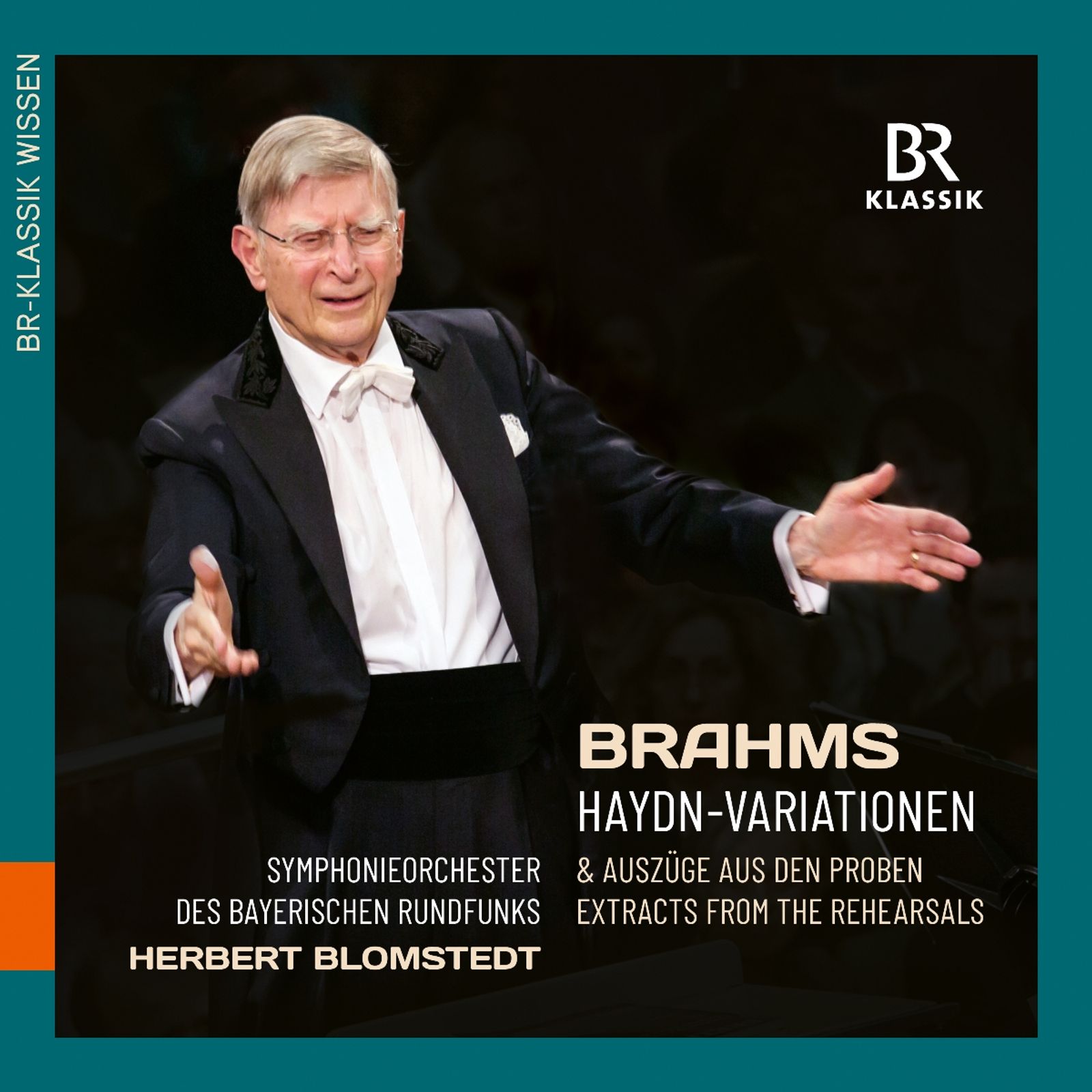
There exists a curious paradox in the work of Johannes Brahms (1833-1897): his third orchestral work, the Variations on a Theme of Haydn op. 56a, carries a title that is historically inaccurate. The theme, the so-called Chorale St. Antoni, is in fact not by Joseph Haydn. Today musicologists assume that it is probably an anonymous folk song that Brahms came across through Haydn expert Carl Ferdinand Pohl in a wind divertimento that was then attributed to Haydn. And yet – what a blessing this persistent misunderstanding is. It seems to have given Brahms precisely what he needed: a form in which construction and imagination do not exclude each other, but strengthen each other. It became a crucial turning point in his difficult development as a symphonist.
This layered genesis receives an unexpected additional dimension in this release. BR-Klassik now brings the work out in the series BR-Klassik Wissen, not only as a document of a concert, but as a dual track of performance and preparation. The CD contains a live recording of the Symphonieorchester des Bayerischen Rundfunks under Herbert Blomstedt from the Munich Herkulessaal (13–14 February 2014), alongside nearly an hour of rehearsal fragments (in German) recorded a few days earlier and previously circulated in the series Dirigenten bei der Probe. Twelve years later, this material is brought together as a whole: not as a curiosity, but as insight into the genesis of interpretation.
Brahms' laboratory idea
When Brahms completed the variations in 1873, he had not yet written a symphony. He was forty and lived under the long shadow of Beethoven. To Hermann Levi he is said to have declared that he "would never write a symphony" because he continually felt that "giant" marching behind him. The Haydn Variations thus became an in-between space: an aesthetic laboratory in which he could escape the symphonic compulsion and at the same time reconsider its foundations.
The result is a series of nine variations on a strictly defined theme of 25 measures, in which Brahms increases the tension from the serene Andante to the propulsive Presto non troppo of the eighth variation. The work rests on an idea that he himself formulated tersely to Adolf Schubring: in a variation theme, for him "almost only the bass means something". That bass functions as an immovable structure, as an undercurrent above which the entire architecture unfolds. The finale, a passacaglia, ultimately returns to the chorale in its original form: not as repetition, but as regained order.
Blomstedt: authority without gesture
Anyone who knows Herbert Blomstedt immediately recognizes why this release is so much more than a recording document. His conducting is rarely visible as gesture, but all the more audible as thought. What makes these rehearsal recordings particularly exceptional is the natural humanity with which that thinking takes shape. Blomstedt conducts not from aloof authority, but from an almost natural collegiality. He consistently addresses orchestra members by name, thanks them for small corrections, praises a beautifully played phrase or a successful balance, and does so without any form of emphasis. His remarks are brief, friendly, and often accompanied by a smile that seems audible even without the image. This creates a working atmosphere in which respect is not imposed, but grows out of an atmosphere of mutual trust.
In rehearsals he speaks, sings, corrects briefly and precisely: a ritardando that should be a bit broader, an articulation that should breathe more lightly. He almost never formulates in commands; rather, he invites the musicians to listen differently. When a passage immediately sounds better, there invariably follows a genuine "Danke" or a discreet compliment. It is precisely these small human gestures that make clear why his authority is accepted so naturally. They are not interventions of authority, but of conviction. Perhaps that is Blomstedt's greatest art: to intervene only when the music itself calls for it.
Striking is how quickly the orchestra responds. Not out of obedience, but out of shared insight. That speed seems to stem not only from the exceptional standard of the BRSO, but also from the atmosphere that Blomstedt creates: musicians feel themselves addressed as partners in a collective search process. The BRSO sound thereby acquires something exceptionally transparent: a collective breath in which every intervention has structural consequences. Blomstedt himself situates that approach in a broader artistic stance that also characterizes his Bruckner interpretations: not the will to impose form, but trust in the internal logic of the score.
From rehearsal to sound image
What makes the rehearsal fragments so fascinating is their efficiency. A single indication suffices to reconsider the phrasing in the fourth variation; a brief remark about the rocking character of the Siciliano in the seventh immediately shifts the entire breath of the passage. Music appears here not as a result of repetition, but of precision.
In the concert recording, this is audible in a performance that never forces anything. The first variation (Poco più animato) gains weight without heaviness; the horns in the sixth variation sound warm and noble, but remain completely transparent in the texture. Even the moment when the triangle enters in the finale – a detail that in less thoughtful readings quickly becomes effect-seeking – remains here integrated as a structural signal in the return to the chorale.
The BRSO plays with a discipline that never stiffens. On the contrary: the transparency makes an almost chamber-music precision possible within a large symphonic apparatus. Whoever first listens to the rehearsals will recognize in the performance numerous decisions that have their origin there. This gives the concert recording something exceptionally organic: as if the music is not being performed, but unfolds of its own accord. The result is a reading in which detail and architecture do not stand opposed to each other, but continually strengthen each other.
The art of non-intervention
Gustav Mahler already recognized in these variations how Brahms could let an entire world emerge from a single motif. This recording makes that idea not illustrative, but tangible: as something that takes place in time, under the hands of a conductor who forces nothing.
The great quality of this release lies in its restraint. Blomstedt seeks no interpretative effect, but a form of audibility in which the music seems to organize itself. What thereby emerges is a rarely coherent sound image in which every decision flows from the structure itself.
Thus this CD becomes more than a document or reference. It lets us hear how Brahms can still sound "in the making" – precisely because here no one rounds him off, but lets him speak. And perhaps that is ultimately also the portrait that this release draws of Herbert Blomstedt: not only a great Brahms conductor, but an exceptionally human musician, for whom listening to each other has always been more important than conducting.