
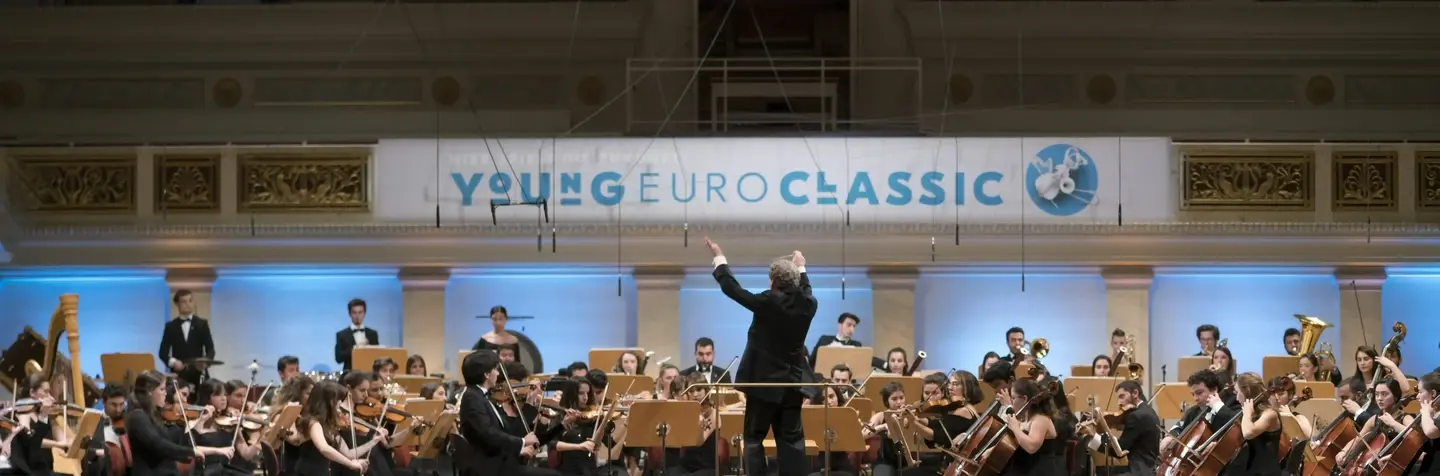
Some concert programmes can be summarised as a series of composer names, while others tell a story from the first note onwards. The programme with which the National Youth Orchestra of Turkey came to Berlin during Young Euro Classic clearly belonged to the second category. Magic was the motto on Saturday 8 August, and from Hänsel und Gretel by Engelbert Humperdinck (1854-1921) via the First Piano Concerto by Pyotr Tchaikovsky (1840-1893) and the Berlin premiere of Je ne sais quoi by Emre Şener (°2001) to Ma mère l'oye by Maurice Ravel (1875-1937) and L'Apprenti sorcier by Paul Dukas (1865-1935), the musical journey led through worlds in which wonder and imagination constantly took on different forms.
Before the concert, I spoke with three musicians from the orchestra: Ateş Varol (violin), Akasya Günsa (horn) and Levent Ege Çakmak (viola). Akasya described the programme as a kind of magical film, in which each piece forms a different chapter: one cheerful, another almost frightening, and only at the end does everything come together into one story.
But ultimately, the magic of this evening was not only in the music. It was on stage, with conductor Cem Mansur, likeable and charismatic, who urges his musicians on with a smile. You saw young people who were not only concentrated, but visibly enjoyed making music together. For Ateş, that experience begins as soon as he steps on stage, even before the first note sounds – in being together with the audience, with the conductor and with his colleagues. "We have fun, we play joyfully and our maestro is always happy," Levent told me, to which Ateş added: "And we show that to the audience, and the audience feels that." For Akasya, there is another layer: if she focuses purely on technique, she feels nothing special, but if she seeks the magic in the music itself, she feels it for real, and according to her, she also becomes a better musician.
After the customary short festival hymn by Iván Fischer (°1951), which this time was performed by the leaders of the different string sections and thus took on something of a Bartók string quartet, Humperdinck's Vorspiel from Hänsel und Gretel opened the evening dreamily, with themes that were gradually and beautifully developed. From the first minutes on, it was striking how strong each orchestra section was individually – and how well the musicians listened to each other: not a collection of soloists, but a tight ensemble.
Two faces of virtuosity
The orchestra was able to convince very strongly in Tchaikovsky's First Piano Concerto, with particularly beautiful orchestra solos in the second movement. Pianist Özgür Ünaldı, however, clearly opted for the side of the show: fast, loud and with a finger dexterity that was undoubtedly stunning. In a piece full of bravura, that is certainly fitting, but Ünaldı seemed to constantly want to show his virtuosity to the audience, as if every passage had to prove how well he mastered it. In the lyrical moments, where the concerto calls for poetry, breath and tone colour, his playing remained more superficial: technically impeccable, but without the depth that the orchestra allowed itself there.
Tellingly, the orchestra members themselves told me this concerto was their favourite piece of the programme. Akasya described it as the work that contains the most diverse feelings: "When the music is soft, I feel so happy, but suddenly it becomes heavy." That very emotional unpredictability makes the concerto her most complete piece of the evening. The contrast with Ünaldı's playing was therefore striking: where he faultlessly executed the bravura of the piece, he seemed to let the vulnerability of it pass him by somewhat. The youth orchestra, which you might easily consider the vulnerable partner of this concerto beforehand, proved to be the most mature partner in the most intimate moments: it was the orchestra, not the soloist, that allowed the softness to resound where Akasya spoke of it. In the finale, the ensemble opened all the registers with great fire. In terms of interpretation, this performance was perhaps classical and unsurprising, but that need not be a shortcoming. It can also simply be beautiful.
Youth in search of the unspeakable
After the interval came Je ne sais quoi by Emre Şener, whom I had already spoken with that same afternoon. Cem Mansur introduced him as one of the most intriguing composers of his generation and invited him to tell the audience himself in German what his work is about: how differently youth is experienced, not captured in a linear story but in musical fragments.
These fragments also constantly prompted musical reflection. Sometimes the music burst into hard, almost aggressive sound eruptions, only to fall back into much more intimate moments; the work seemed not so much to unfold as a continuous story, but as a series of impressions and experiences that exist alongside each other and sometimes unexpectedly interrupt one another. The orchestra and Mansur brought that alternation with full commitment, so that the Berlin premiere did not feel like an obligatory excursion into contemporary music, but as an essential part of the programme.
The musicians had already anticipated that shock on the audience themselves – after the classical line of Tchaikovsky, they expected the hall to be startled when switching to Şener's modern sound world, and they actually liked that. "That little shock effect is part of it," said Akasya, "we want the audience to feel what we feel." For her, this was also a form of wonder, albeit quite different from that of Tchaikovsky or Dukas: music that you don't often encounter in everyday life and that therefore takes you out of your familiar listening world for a moment. Moreover, they wanted more than just the music: by playing their own composers, they made audible a musical culture that is still new to many listeners. "It is good that people get to know our music through us," Ateş told me.
And although the music was sometimes dark and restless, the cheerful turn at the end ensured that you didn't leave with only heaviness. Still, the work continued to echo in your head a little longer. Perhaps that is the strength of a good new composition: it doesn't immediately give all the answers, but continues to raise questions even when the last note has long sounded. The long applause proved that I was not the only one who felt that way.
Colour and unleashed chaos
After the contemporary sound world of Şener, the orchestra returned to French repertoire. In Ravel's Ma mère l'oye, the musicians were able to show their rich colour palette again, with beautiful solos and great attention to the transparency of the whole. The final movement, Le Jardin féerique, was taken wonderfully broadly and caused goosebumps. Dukas' L'Apprenti sorcier formed an appropriately mischievous finale: brought with full commitment, with an orchestra that seemed to enjoy Goethe's sorcerer's apprentice as much as the audience. When the chaos broke loose, the whole thing still held together – only the horns were occasionally drowned out by the rest of the brass, but above all it was a pleasure to see these young musicians at work.
That pleasure was evident not only during the concert, but also in the conversation I had beforehand with Ateş, Akasya and Levent. They spoke about the childhood dream of one day being able to play in a hall like this, about "the fire of youth" as Levent called it – for him not the first visit to Berlin, he was also here in 2024. What particularly moves him about this festival, he told me, is the encounter with other young orchestras from all over Europe: the healthy rivalry, and the feeling that they get to know each other not only as competitors, but also as colleagues.
What they hoped the audience would take home was not only that fire, but above all peace. Music, Akasya said, is a way to let your worries go for a moment and find serenity – perhaps because magic is so strongly connected to childhood for her, with the stories you heard as a child before you fell peacefully asleep.
And to the idea that classical music is considered something from the past by young people, they had a clear answer. "These days young people sometimes say classical music is dead," Akasya told me, "but we don't think that, because we make real music here. And I hope that when they go home, they say: this is real music." They are not bringing a museum piece here, but something that lives today and that, according to them, also has a future.
The feeling of coming home
After the official programme, two more encores followed. First came the Russian Dance from Tchaikovsky's Nutcracker, played with full commitment, with precisely that carefree suppleness with which a youth orchestra can make this repertoire its own – a cheerful nod after an evening of variety.
Also special was Köçekçe by Ulvi Cemal Erkin (1906-1972), who belongs to the so-called "Turkish Five" – the generation of composers who in early twentieth-century Turkey combined the Western orchestral language with Turkish folk music. Köçekçe, built on rhythms and melodies from traditional köçek dances, is still considered one of the best-known and most beloved orchestral works from that tradition in Turkey. For these young musicians, it was clearly more than a nice encore; it felt like coming home.
You could hear that too. While the evening had already shown throughout how at home this orchestra feels in diverse European repertoire, the inspiration in Köçekçe gained an extra layer: a kind of effortlessness and ownership that you cannot learn, only bring with you. With an orchestra that sounds so convincingly in its own musical heritage, a greater share of Turkish repertoire on a future programme would be very welcome.
Because precisely that – that matter-of-factness, that pleasure, that connection – is what characterized the entire evening, from the first note of Humperdinck to the last bars of Erkin. Perhaps that is ultimately the most beautiful interpretation of the theme Magic: young musicians who listen to each other and to their conductor, strengthen each other and visibly enjoy doing so. The smile of Mansur, which was repeatedly echoed, perhaps sums it up best.