
Our reviewer: Lucrece Maeckelberg wrote this review of the same piece earlier.
With a little imagination, it seemed as if the audience flowed out of the great hall of the Chassé Theater in Breda dancing and hopping. Faces looked cheerful and people spoke to each other about the wonderful apotheosis that the music ensemble had given the Breda audience.
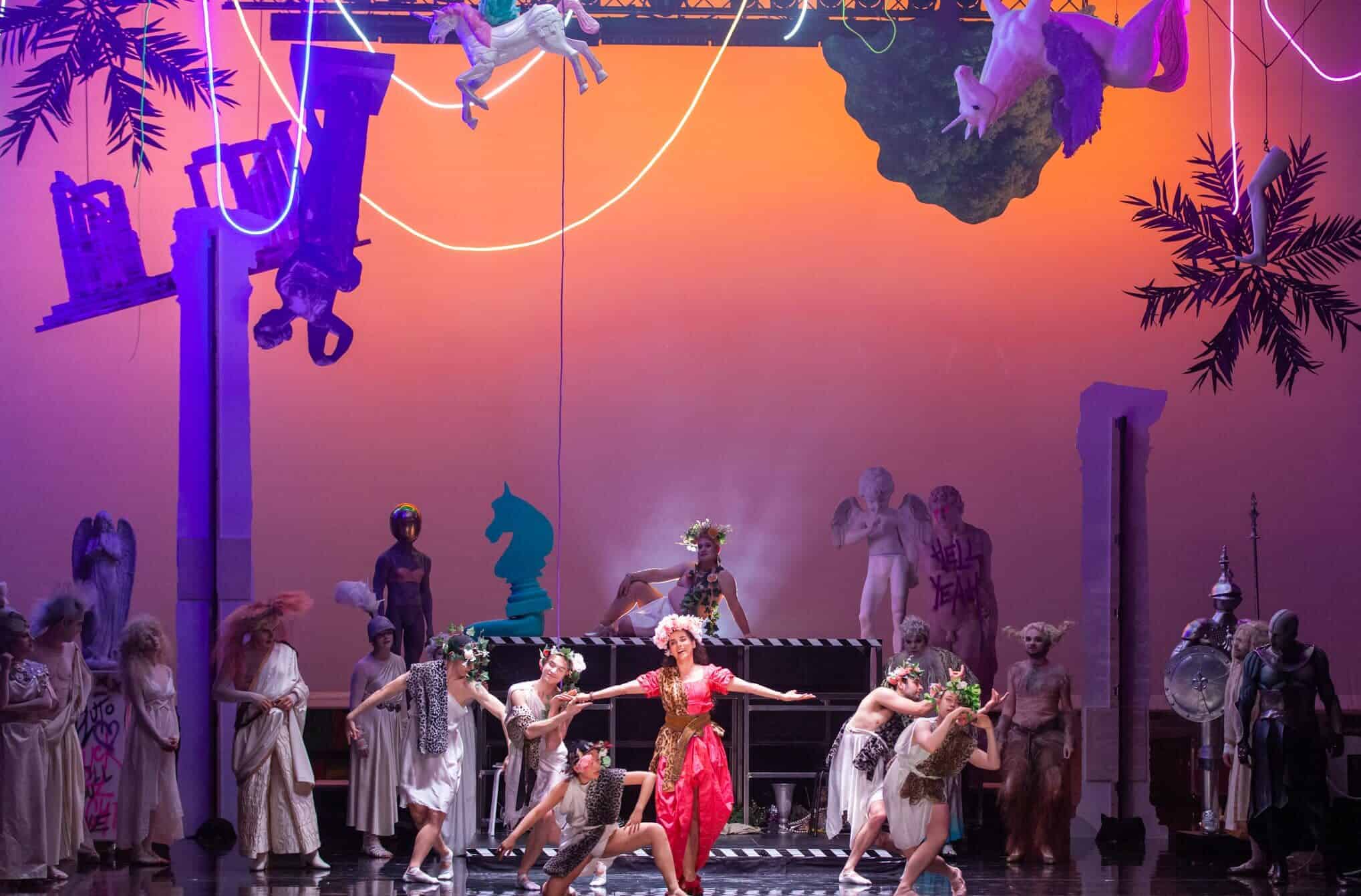
Was carnival being celebrated inside? Or was something else going on? The answer is not easy to guess: the visitors had watched an opera. An opera? Carnival? Celebration? Perhaps you can already guess, because which opera ends as a dancing celebration? Orphée aux enfers by Jacques Offenbach (1819-1880). You know, the one with that famous Cancan. And Opera Zuid made this opera in the Chassé theater a real party.
In the foyer I met several people from Opera Barok, an initiative I started ten years ago to watch complete baroque operas (sometimes three hours long) on dvd together with interested parties, which I introduced myself. They were all surprised. One of them even asked me if this opera was original. The story and especially the staging seemed quite exaggerated to her. She was used to a baroque version of the Orpheus myth. Often I would start the season with a baroque opera about Orpheus and Eurydice: L'Orfeo by Claudio Monteverdi, La morte d'Orfeo by Stefano Landi, Orfeo by Luigi Rossi, La descente d'Orphée aux enfers by Marc-Antoine Charpentier, or a contemporary version such as the Reisopera (with moving scenery) or Orfeo underground by Holland Opera which takes place in an underground parking garage.
In all those operas, the same themes constantly come up, such as musicality but also the vanity and arrogance of Orpheus, the victim role he assumes, the question of why he looks back as well as the question of why he is not allowed to look back in the first place, and the questionable role of the gods in this myth. And what is the role of Eurydice in this? Up to the present day, this has occupied countless writers and composers, think of the Sonnets to Orpheus by Rainer Maria Rilke, The mask of Orpheus and The Corridor by Harrison Birtwisle who passed away last year, and even a rock opera by Tito Schipa Jr. Since the creation of opera by a group of intellectuals in Florence (the so-called Camerata Fiorentina), who wanted to breathe new life into Greek tragedies by singing them, according to Wikipedia some 75 Orpheus operas have been written! And almost all of them are based on the original myth as it has been handed down by Ovid and Virgil. But not Jacques Offenbach! He apparently wanted to make short work of all those mystifications surrounding Orpheus and Eurydice. He decided to reverse the matter: not a love affair but a hate affair. Eurydice wants to get away from Orpheus and allows herself to be willingly seduced by Aristaeus who turns out to be the god Pluto in reality, who takes her to the underworld. Orpheus feels elated and liberated, but has not reckoned with the innkeeper of Public Opinion. He thinks Orpheus should behave like a spurned lover and sends him to the gods to account for himself.
And then the real spectacle begins, which Opera Zuid stages in a particularly beautiful way. We find ourselves at the top of Olympus where the gods are terribly bored and have had enough of ambrosia and nectar. They want something different. An uprising breaks out in which the supreme god Jupiter is tactfully reminded of his escapades, in which he constantly transforms into a swan, a bull or some other animal. Moreover, he is blamed for the abduction of Eurydice. That doesn't have to be said twice to Jupiter. He decides to go to the underworld to prove his innocence. The whole bunch of gods decide to go with him. They feel like such an outing!
Meanwhile, Eurydice is also bored in the underworld. She is locked up by Pluto so that the gods cannot find her. But then he has not reckoned with Jupiter's tricks, who transforms himself into a fly and still manages to get through the keyhole to the cellar where Eurydice is imprisoned. As in all his escapades, he seduces her and together they decide to leave the underworld. But then they encounter Public Opinion again, who says they must adhere to the norms and values that apply to all people and also to the gods. Orpheus belongs with Eurydice. Whereupon Jupiter decides that the two must leave the underworld together on one condition: Orpheus must not look back before he has reached the upper world. Of course everyone expects that he will, as the myth tells. But Offenbach comes up with a trick and lets Orpheus go upward without looking back. Much to Jupiter's horror, who sees his love slip away. Quickly he grabs his lightning and sends it after the disappearing couple. Orpheus is startled and looks back! Eurydice flees back to the underworld where the party really begins now. Together with the gods, a real feast is arranged in which Eurydice reveals herself as a bacchante, while Orpheus and Public Opinion retreat disappointed to the upper world.
All this is brought to the stage with verve by Opera Zuid. The singing voices are excellent, the choir sings whirlingly, the dancers constantly move everywhere in between, and the direction is overwhelming. Offenbach would have fully enjoyed this. So did the audience in the Chassé Theater in Breda.
WHAT: Orphée aux enfers,opéra bouffe in four acts by Jacques Offenbach (1819-1880) with libretto by Hector Crémieux (1828-1893) and Ludovic Halévy (1834-1908). Version Mixte (1858/1874) by Jean Christophe Keck commissioned by Boosey & Hawkes.* With adapted dialogue by Benjamin Prins.
WHERE: Chassé Theater Breda
WHO: Opera Zuid, Theaterkoor Opera Zuid, Philharmonie Zuidnederland conducted by Enrico Delamboye
To be seen until: 26 June 2023
Website: https://operazuid.nl/events/orphee-aux-enfers/