
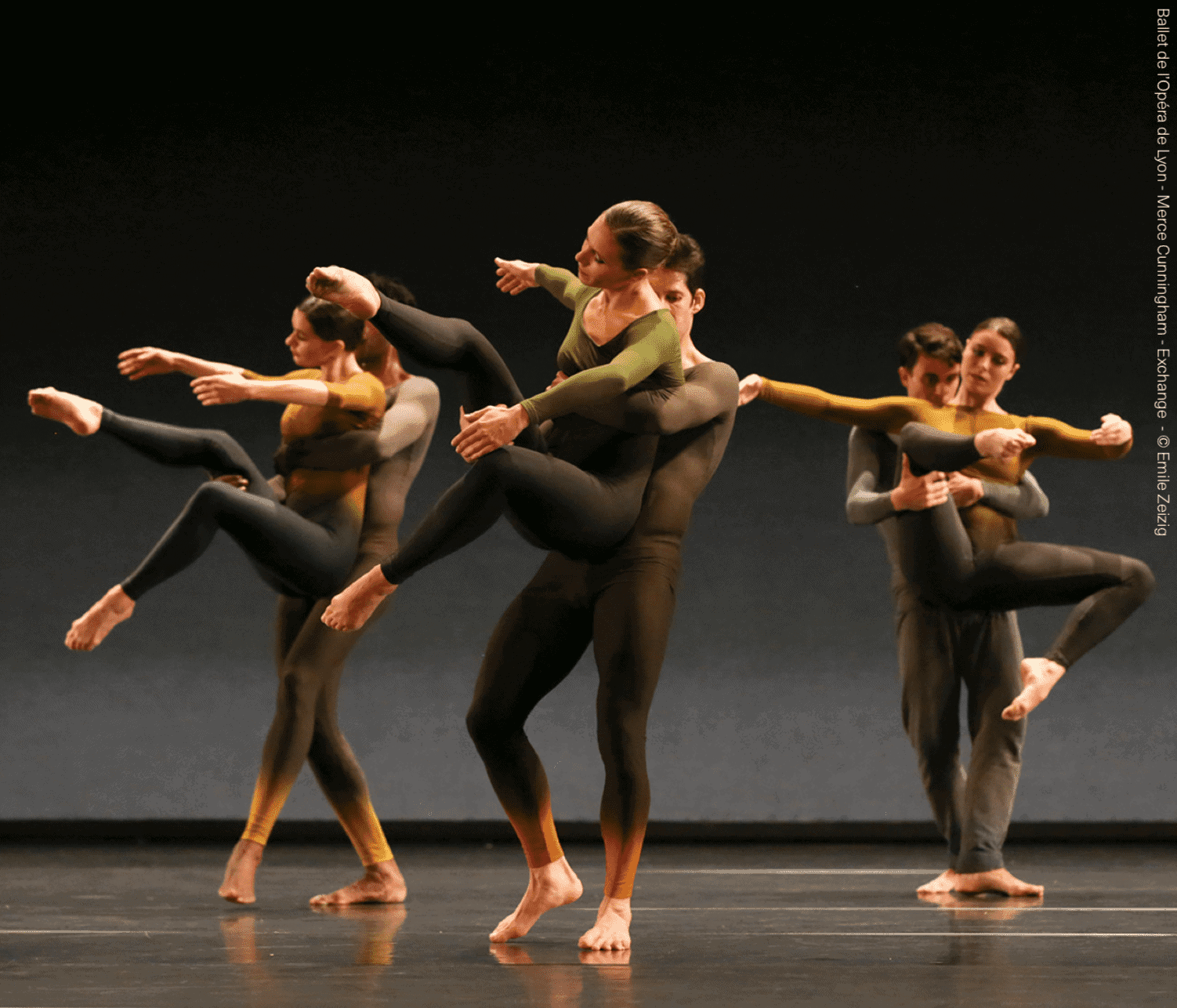
The Ballet de L'Opéra de Lyon regularly visits deSingel. This time the company was programmed for three consecutive days with high-quality repertoire by William Forsythe and a creation by Greek choreographer Ioannis Mandafounis. There is a match. He himself once danced in Forsythe's company. A well-balanced triple bill of contemporary ballet.
'BIS N. S.' (AS USUAL) choreography Ioannis Mandafounis
Where do artists draw their inspiration from? Sometimes the most bizarre things are the trigger to set the imagination in motion. Based on an encore (Bis) by Nina Simone after her concert at the Montreal Jazz Festival in 1979, he created his choreography. On the immensely large stage stands only a microphone and centrally a grand piano. Ioannis Mandafounis immediately draws the audience into the performance. A colorfully dressed group of excited young people storm the stage cheering and applauding after Nina Simone's impressive performance. Their hunger is not yet satisfied. They want MORE. The presenter thanks Nina Simone and yes…. An encore is inevitable. The youngsters hang devotedly around and on the piano. Before responding to the audience's wishes, stage beast Nina Simone tightens the bonds with her fans and enters into dialogue. She tells some anecdotes, is even somewhat mischievous and asks if David Bowie is really a man?! Then sings in her inimitable way 'Stars' by Ian Janis and 'Feelings' by Albert Morris. Meanwhile, the viewer gets a glimpse behind the scenes. The dancers prepare to perform: shake out their muscles, warm up, a dancer is poorly caught during a jump and gets injured. Everyone rushes over. There is some teasing… The viewer can follow two parallel worlds. Partly auditory: Nina Simone; partly visual: the dancer collective. "The use of space, and the resulting play of perspectives is a reflection of the ambiguous duality between the inner and outer personality of the artist" is stated in the program booklet. The starting point is interesting. Distilling that from what happens on stage is rather thin. The whole lacks body and sparkle for that.
'N.N.N.N'. choreography William Forsythe
In this work (world premiere 21 Nov. 2002) William Forsythe explicitly investigated the geometric possibilities of the body with focus on the upper limbs. Choreography that has been on the repertoire of Ballet L'Opera de Lyon since 2021. Four men explore lines, points, curves, diagonals in space on an empty stage. They have something of robots that are not in control of the impulses sent to their arms. They sometimes move separately, two by two, or cling together as four. They lock into each other like paperclips. Entanglement from which they free themselves in contortions. But after a while they cling together again. There is also clever floorwork to see. The whole has many facets: then it looks mechanical, hilarious, naive or thoughtfully composed. A quartet that received much applause from the audience.
'Quintett" choreography William Forsythe
'Quintett" (1993) where William Forsythe poured his heart and soul, is one of his most guarded dance works and is widely regarded as one of his greatest and most integral achievements. The loss of a loved one has always been an important source of inspiration for artists. With this lyrical waltz for five dancers, Forsythe wrote a tribute, a final love song to his terminally ill wife, dancer Tracy-Kai Maier. It is an exorcism of death. Unfortunately, she did not make the premiere. She was barely 32 years old!
French psychologist and author Jeanne Siaud-Facchin once expressed it poignantly as follows: "Creativity is the concrete, magical connection of intelligence, clarity and emotional receptiveness."
'Quintett' is the cerebral synthesis of love transformed into movement. A visual and mental journey that immerses the viewer in a world of sound and form, joy and pain, resignation and resistance, introspection and expressivity… The pain of having to say goodbye becomes physically palpable. Forsythe combines traditional ballet techniques with a powerful and wild form of movement. Technically brilliant, refined and breathtaking.
'Quintett' shows five dancers, three men and two women in an empty space with only an old-fashioned light box and a mirror positioned in front of an opening in the dance floor. In every relationship there are moments of harmony and tenderness, but also moments of friction. These atmospheres: soft and delicate but also attraction and repulsion, bodies colliding and pushing each other away are heartwarming processed in this choreography. Forsythe is guided by the captivating music of British composer Gavin Bryars 'Jesus Blood Never Failed Me'. An iconic piece of music that carries the themes: loss, hope, fear and trust within it. He heard this refrain from a religious song by chance at Waterloo Station sung by an old tramp and discovered that this sentence connected with one of his compositions. The thirteen bars formed a perfect combination. Assembled as a loop it has an almost hypnotic effect. The grainy male voice repeats the text over and over while the music builds: very quiet at the beginning, but increasing in volume, like a perpetuum mobile. The choreography shows the dancers in a seamless stream of solos, duets and trios moving in counterpoint with Gavin Bryars' music. Dancers fall, fly in the blink of an eye into the arms of their partner, trusting that the arms will be there to catch and hold them. Regularly protagonists disappear into the depths, come back, participate again in what is happening. Towards the end the light box flickers on and a light spot with shadows appears on the background like a transitional world. In a final sequence one of the dancers lets herself fall backwards multiple times full of trust into the opening. Surrendering to the inevitable. Each time she is caught by strong male arms that push her back and want to keep her alive.
'Quintett' holds up a mirror: as humans we seek balance, have tremendous resilience but essentially we are so very vulnerable.
'Quintett' described in a few words: virtuoso, extremely physical and emotional. The choreography is intense but never dark and heavy. The music has a soothing quality. Once the curtain has fallen you are left somewhat forlorn and heartbroken.
What: Ballet de L'Opera de Lyon
Where: deSingel
When: 25 March 2022
Production: Ballet de L'Opera de Lyon
Choreography: William Forsythe / Ioannis Mandafounis