
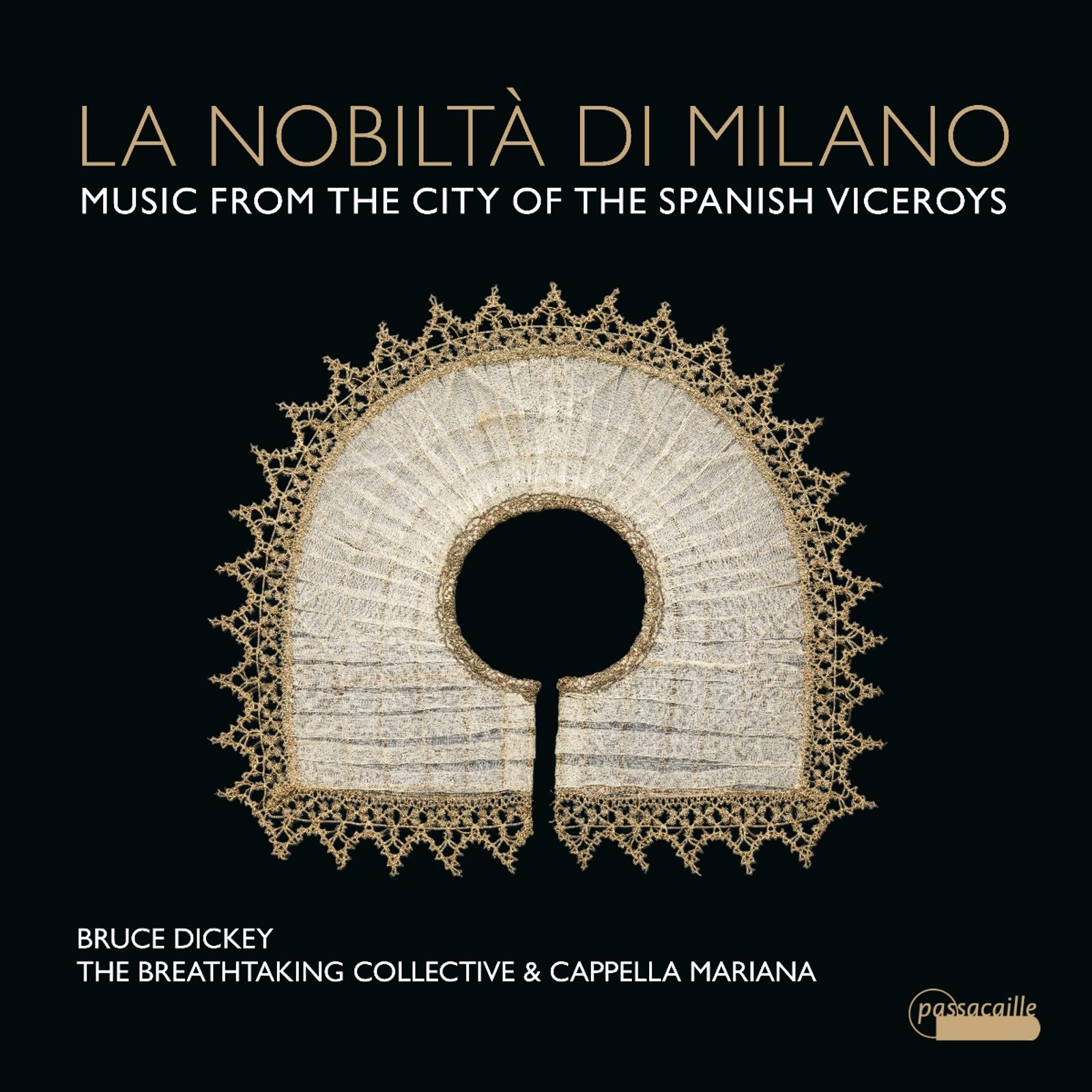
Sixteenth and early seventeenth-century Milan rarely receives the attention it deserves. When people think of Italy during that period, they spontaneously think of Venice, Rome or Ferrara, but Milan under Spanish viceroys – squeezed between the plague epidemics of 1576 and 1630 and strongly influenced by Archbishop Federico Borromeo – generally remains out of view. It is precisely this forgotten musical landscape that this new Passacaille release aims to make audible again. Not as a collection of curiosities, but as a portrait of a city with a distinctive musical identity of its own. The result is a recording that effortlessly combines historical insight with pure musical listening pleasure.
Bruce Dickey – for decades one of the greatest advocates of the cornetto and North Italian music around 1600 – compiled a programme that takes the listener through composers who barely resonate today, but played an important role in Milan's musical life at the time. Giovanni Paolo Cima, Andrea Cima, Francesco Rognoni Taeggio, Giovanni Domenico Rognoni Taeggio, Agostino Soderini, Giuseppe Gallo and Cesare Gussago together form a fascinating musical mosaic in which madrigals, instrumental canzonas, canzon-motets and religious motets continually alternate with each other.
One of the most interesting discoveries is undoubtedly the canzon-mottetto, a genre unique to Milan and unknown in comparable development elsewhere in Italy. It combines vocal and instrumental elements in a way that continually blurs the boundaries between the two. Voices and instruments do not stand opposed to each other, but seem to continually engage in dialogue, answer each other, mirror themselves and sometimes even adopt each other's rhetoric. It is precisely this continuous dialogue that forms the common thread throughout this alternating CD and gives it a completely distinctive sound world that clearly distinguishes itself from the monumental Venetian polychoral style.
This dialogue receives an ideal interpretation by Cappella Mariana and The Breathtaking Collective. The five singers – Hana Blažíková, Barbora Kabátková, Vojtěch Semerád, Tomáš Lajtkep and Martin Schicketanz – merge into a single breathing whole, yet maintain their own colour at the same time, so that the voices continually complement and reinforce each other. The flawlessly pure intonation, the natural phrasing and the exemplary text intelligibility make every polyphonic line effortlessly audible. Nobody steps into the foreground; it is precisely the perfect balance between the voices that gives this music its refined significance and makes the polyphonic textures remarkably transparent. Bruce Dickey himself once again proves why he is among the absolute references in this repertoire. His cornetto never sounds like a virtuosic outsider, but as a fully-fledged singing voice that effortlessly blends with the human voices. The instrumental ensemble also plays with admirable precision and audible joy in playing. The instruments do not merely accompany the voices, but join them seamlessly: they answer, support and complete each other, allowing the musical lines to unfold as a single cohesive whole. Each phrase breathes with naturalness; nowhere is virtuosity an end in itself.
The carefully constructed programme contributes significantly to the persuasiveness of this release. Secular madrigals by Francesco Rognoni Taeggio are alternated with religious compositions, while instrumental intermezzos make the transition between the two worlds almost self-evident. The whole therefore never feels like a loose miscellany, but like a considered musical journey in which the different facets of Milanese musical life around 1600 continually complement each other. It is precisely the alternation between the refined text expression of the madrigal and the spiritual depth of the religious works that gives the recording its special dramatic arc.
There are highlights in abundance. In Quemadmodum desiderat by Francesco Rognoni Taeggio, voices and wind instruments depict in an almost tangible way the deer that yearns for the water streams. The flowing lines of the instruments seem to actually make little brooks flow, while the vocal lines make the intensity of longing palpable. Equally impressive is the festive yet simultaneously intimate Ipse sum desponsata by Agostino Soderini, to a text from the Song of Songs, in which the interplay between the voices continually captivates without the intelligibility of the text being lost for a single moment. These works immediately demonstrate the particular power of the Milanese canzon-mottetto: music in which text, voice and instrument do not exist alongside each other, but continually enter into dialogue. Beyond the canzon-mottetto, the recording continues to surprise. Very different in character, but equally convincing, are the two madrigals by Francesco Rognoni Taeggio. In the first, he manages to make the joy of the word gioia almost tangibly felt, while in the second the certainty of E sicuro evokes a more contemplative atmosphere. Against this stands the restrained power of Saule, Saule by Agostino Soderini, in which Christ's call for Paul's conversion takes shape especially in the compelling setting of surge. It is precisely the emphasis on that one word that gives Christ's call a particular rhetorical and musical intensity.
After so much variation, Dickey chooses a surprisingly intimate conclusion with the Magnificat by Giuseppe Gallo. Anyone expecting an exuberant finale with festive splendour and overwhelming sound may be surprised. But it is precisely this restrained ending that turns out to be the completely natural choice. The crystal-clear singing, the perfect balance and the serene atmosphere once again summarize what this entire recording is about: not outward splendour, but refinement, text expression and an almost contemplative beauty. It feels like the quiet end of an exceptionally engaging musical journey.
The release itself also deserves praise. As we have come to expect from Passacaille, the booklet is exemplarily produced, with clear and informative notes by Bruce Dickey on the historical context, the development of Milanese musical culture and the unique place of the canzon-mottetto. The recording at AMUZ in Antwerp furthermore benefits from a warm yet transparent acoustics in which voices and instruments are given all the space without losing detail.
La Nobiltà di Milano is ultimately much more than an introduction to unknown composers. This release restores an almost forgotten chapter from Italian music history and demonstrates how a vibrant and refined musical culture could flourish in Milan even under Spanish rule. It convincingly shows that Milan around 1600 possessed its own musical voice: less exuberant than that of Venice, but all the more intimate, more refined and rhetorically more deeply felt. Those unfamiliar with this world will find an ideal gateway here; those who already know it will discover a recording that easily stands alongside the best in this repertoire.