
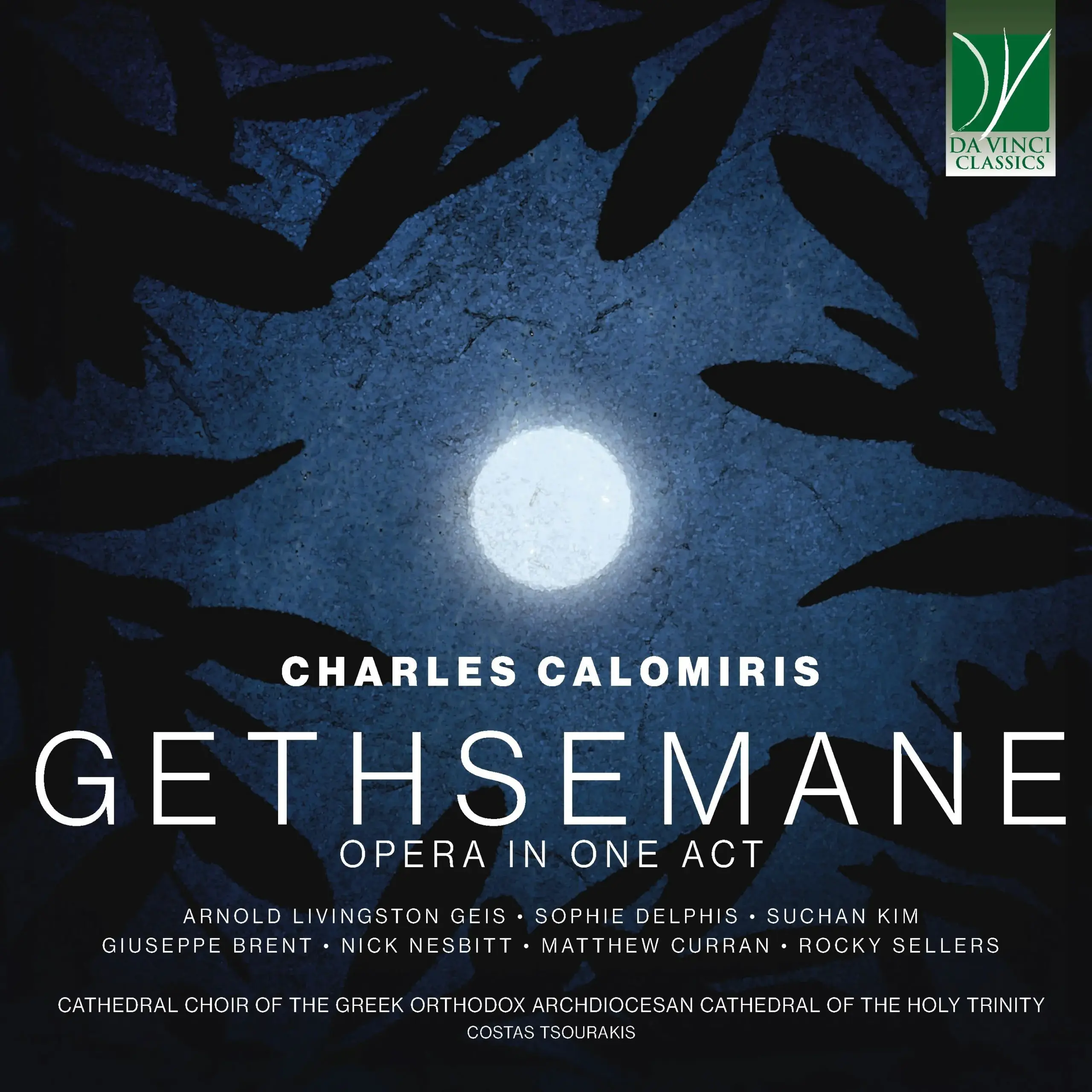
There are operas that want to be drama first and foremost, and there are operas that sound primarily like prayer. Most composers who venture into the Passion choose resolutely for one of these two registers – Bach for contemplation, Penderecki for existential drama – and leave it to the listener to build the bridge themselves. Charles Calomiris (°1957) refuses to make that choice in his one-act Gethsemane, released by Da Vinci Classics. Precisely in that refusal lies the uniqueness of this work.
Calomiris wrote Gethsemane for the Pano Hora Ensemble from Colorado, the same company with which he had previously realized Evlogía for Da Vinci Classics. Both works start from the Orthodox liturgical tradition, in which Holy Week is not merely commemorated, but is relived anew each time. Anyone who has ever experienced an Orthodox Easter liturgy or a ritualistic Passion play tradition knows how thin the line is there between liturgy and theater. Calomiris consciously aligns with that tradition. His opera does not want to be an illustrated gospel narrative, but a contemporary meditation in which religious ritual and musical theater meet.
The libretto, by the composer himself, chooses a remarkable approach. The evangelists tell us very little about what unfolds during the silent hours in Gethsemane, when Peter, John, and James fall asleep twice. Precisely that gap Calomiris fills. When Peter, after his second awakening, asks if Jesus can keep them awake by expounding his teaching once more, the aria Pray and Watch with Me follows. Meanwhile, Satan mingles almost unnoticed in the thoughts of the disciples. Not a theatrical seducer with thunder and lightning, but a voice that employs reason, fatigue, and apparent common sense. In arias such as Easy for Him and The Only Sensible Choice, that insinuation takes on an almost utilitarian logic: why make a sacrifice that no one understands? Why hold on to a love that gives itself away?
With this, Calomiris touches on the central idea of his opera. Self-sacrificing love proves unimaginable to anyone before the Crucifixion. Not to Satan, who interprets it as weakness, but nor to the apostles, who are mainly concerned with preserving Jesus' message. Only the deed itself makes its meaning visible. Thus Gethsemane takes on not only the character of a Passion, but equally that of a philosophical reflection on the limits of human reason.
Remarkable is how strongly this dramaturgical vision is also supported musically. Anyone expecting a dark, heavy, and decidedly tragic Passion narrative will be disappointed. Calomiris writes surprisingly melodious and often almost cheerful music. This seems paradoxical at first glance, but works wonderfully. The composer, after all, does not concentrate on Golgotha, but on the final hours before the arrest, in which hope, doubt, and human closeness continue to exist side by side. The music thus breathes a warm accessibility without losing its seriousness.
Beneath that contemporary, lyrical language, a clear Orthodox idiom remains perceptible. Not because Calomiris continually quotes liturgical melodies, but through the contemplative calm of the phrasing, the almost iconic simplicity of some vocal lines, and the way the music continually lets the text breathe. The result lies somewhere between contemporary oratorio and chamber opera: modern without wanting to be avant-garde, spiritual without locking itself into liturgical seriousness.
This approach is convincingly realized by the Pano Hora Ensemble and the five soloists. The singing is homogeneous, refined, and remarkably text-focused. None of the voices attempts to place itself prominently in the foreground; rather, the tight ensemble sound underscores the sense of community that is so essential to this opera. The characters remain people of flesh and blood; nowhere do they lapse into bombast or exaggerated operatic effects. Precisely this natural delivery strengthens the credibility of Calomiris' psychological development of the narrative. The ensemble also plays with audible conviction. The instrumental accompaniment supports the dramatic development without ever lapsing into effect-seeking or crude dramatics. This keeps the contemplative atmosphere, which carries the work from beginning to end, continually intact.
The recording itself leaves sufficient space for the voices and maintains a nice balance between ensemble and soloists, so that word and music remain continually intelligible. That is no small achievement in a work where textual comprehension and spiritual concentration are at least as important as musical tension.
Gethsemane does not pretend to rewrite the great Passion tradition. For that, the work is too modest in scale and too concentrated in its conception. But it is precisely this modesty that proves to be a strength. Calomiris does not opt for monumental religious rhetoric, but for a human approach to the decisive moment before the Passion narrative unfolds. His greatest invention may well be that he depicts temptation not as a demonic spectacle, but as the soft voice of fatigue, pragmatism, and compromise. With this, he also deliberately blurs the boundary between opera, oratorio, and liturgical meditation, precisely as the composer intended.
That makes Gethsemane more than a curiosity. It is a contemporary Passion that does not disown its spiritual roots, but translates them into an accessible, melodious musical language. Without seeking to overshadow tradition, Calomiris adds to it a surprisingly personal page.