
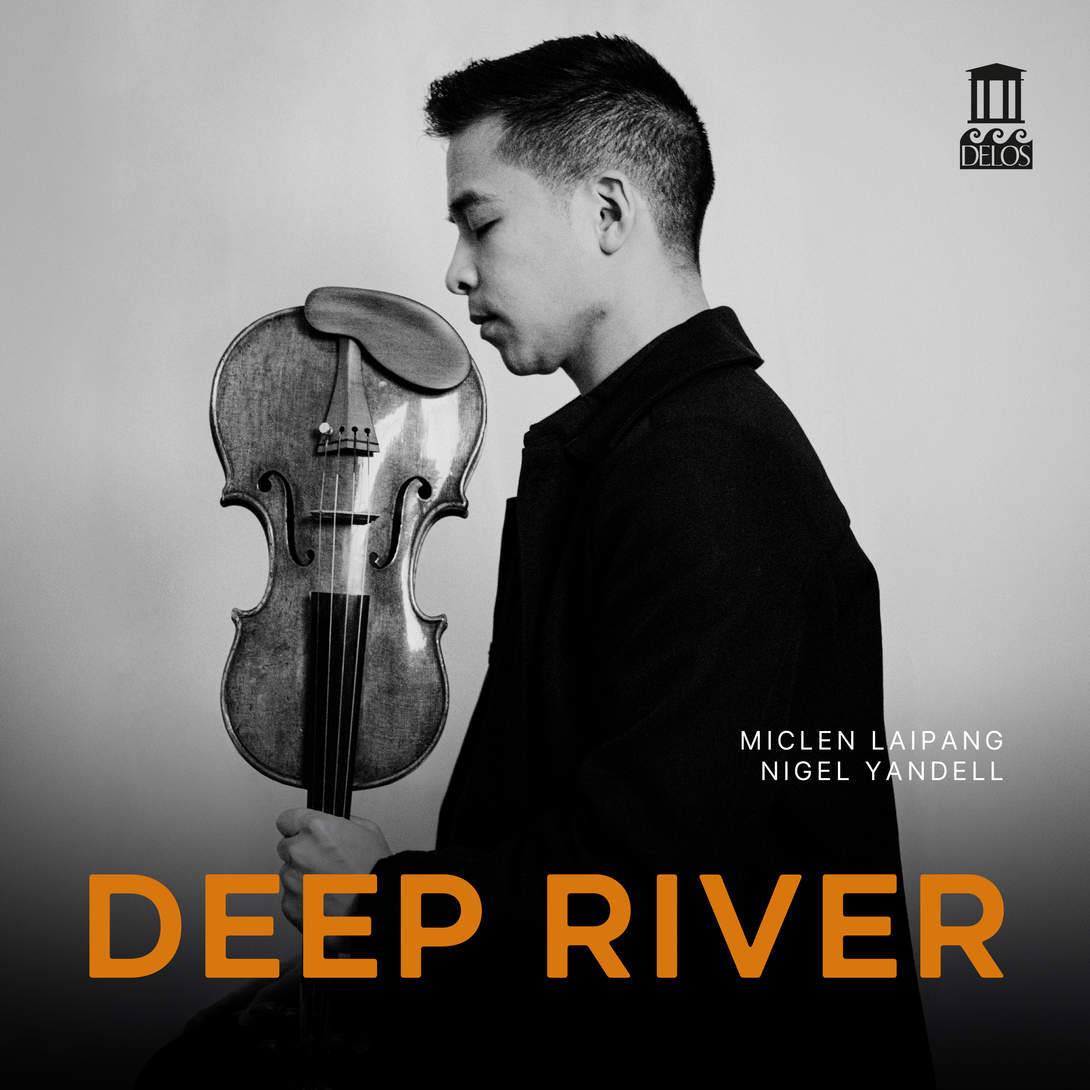
A debut album as autobiography: this is how violinist Miclen LaiPang presents his first solo recording for Delos. Deep River is not a casual showcase of technical possibilities, but a carefully constructed musical self-portrait. A river serves as the guiding image – simultaneously a spiritual symbol and life metaphor – that makes its way from the American spiritual tradition through Russia, Germany, Vienna and Paris, ultimately flowing back into an distinctly American sound. That concept is ambitious and potentially dangerous: such narrative programs risk quickly sinking into sentimentality or programmatic excess. LaiPang and pianist Nigel Yandell do not avoid these pitfalls so much through an explicit display of control, but because the entire program seems to flow naturally from one and the same musical confidence, in which refinement and stylistic insight merge effortlessly into one another.
LaiPang meanwhile belongs to the generation of young violinists who move effortlessly between continents and traditions. He has performed at Carnegie Hall, the Wiener Musikverein and the Berliner Philharmonie, while his arrangement of Beethoven's Kreutzer Sonata for violin and strings received broad international recognition. On Deep River, however, he reveals himself primarily as the musician behind the virtuoso: a player who uses repertoire not as demonstration material, but as a carrier of memory and identity.
A river of memories
The opening with Jascha Heifetz's (1901-1987) arrangement of Deep River immediately sets the tone. LaiPang does not opt for grand romantic gestures, but for a broad, breathing simplicity that works all the more powerfully. The Stradivarius "Charles Castleman" from 1707 – generously made available by the Muziekkapel Koningin Elisabeth – sounds rich and substantive, especially in the middle register, without ever becoming heavy. The phrasing has something contemplative about it: as if the music is not played but remembered.
In Adoration by Felix Borowski (1872-1956) and Nobody Knows the Trouble I've Seen by Clarence Cameron White (1880-1960), the same restrained concentration prevails. White in particular – still too seldom present on recital programs – receives here a reading that avoids any inclination toward sentimental exoticism. LaiPang plays this music with respectful directness, while Nigel Yandell keeps the harmonic space open with an almost vocal suppleness.
Fractures and detours
With Lenski's aria from Evgeny Onegin by Peter Tchaikovsky (1840-1893), the temperature of the recital changes. In Leopold Auer's (1845-1930) violin arrangement, the music easily takes on something exaggerated and melancholic, but LaiPang keeps the line taut and avoids effect-seeking. Precisely because of this, the playing strikes all the harder: beneath the lyricism, a feeling of unrest and inevitability constantly simmers. Yandell proves himself here unmistakably as more than an accompanist; his playing gives the music breath and psychological depth.
The subsequent European stages show how flexibly both musicians shift stylistically. Widmung by Robert Schumann (1810-1856), in an arrangement by LaiPang and Yandell themselves, retains the intimate core of the original song without lapsing into exaggerated romantic rhetoric. The violin line sings freely, but always remains embedded in Schumann's harmonic tensions.
Liebesleid by Fritz Kreisler (1875-1962) seems on paper the most conventional part of the program, but LaiPang does not treat it as a nostalgic salon piece. His rubato sounds organic and unforced, everything is beautifully and elegantly measured, but behind all Viennese charm there always remains a hint of melancholy. It is precisely this balance between lightness and seriousness that elevates this performance above routine.
An absolute highlight is Vása Příhoda's (1900-1960) arrangement of the Der Rosenkavalier waltzes by Richard Strauss (1864-1949). Reducing Strauss' orchestral excess to violin and piano requires not only technical mastery, but also a fine sense for harmonic color and the ambiguity that characterizes this work. LaiPang and Yandell succeed remarkably well at this. The high passages remain clear without harshness, the double stops retain their vocal quality, and Yandell lets the harmonies shine without playing the texture densely. Behind the Viennese elegance, something bitter and transient always plays along – and that is precisely what Strauss intended.
Paris as focal point
The Romance, Op. 23 by Amy Beach (1867-1944) – a work too rarely heard in the concert hall – deserves more than the function of a transition. Beach's ability to connect an unmistakable American idiom with the harmonic language of late European Romanticism sounds here like a subtle reflection of LaiPang's own artistic hybridity: rooted in a tradition, but not captive to it. Yandell gives the piano part precisely the space it needs. It is precisely here that the recital reaches one of its most poignant moments, and perhaps reveals the true revelation of the album.
In Violin Sonata No. 2 by Maurice Ravel (1874-1937), LaiPang and Yandell reach their interpretive peak. This sonata allows no excess: every phrase must remain light, however complex the underlying structure. Both musicians understand this perfectly. The first movement breathes an effortless elegance, the blues section has just enough nonchalance without becoming caricature, and the finale unfolds with an impressive combination of precision and apparent spontaneity. The duo's rhythmic alertness impresses in particular: the music constantly moves forward without anything sounding forced.
Virtuosity Without Empty Display
The recital ends with the Concert Fantasy on Themes from George Gershwin's Porgy and Bess by Igor Frolov (1937-2013), a work that can easily degenerate into mere virtuosic fireworks. LaiPang avoids that trap by always keeping the theatrical flair musically directed. Of course, the spectacle is not absent – the lightning-fast passages and acrobatic double stops are played with stunning control – but more importantly, the music retains its dancing vitality.
Coda
Deep River is a carefully constructed debut, convincing in both intention and execution. The project seeks meaning rather than effect, and that yields a coherent artistic profile. Occasionally the autobiographical concept is underlined somewhat more emphatically, but the musical quality and the genuine commitment of both performers carry the whole effortlessly.
Miclen LaiPang presents himself here not only as an exceptionally gifted violinist, but as a musician with a clear artistic vision. Nigel Yandell proves to be an ideal partner in this: alert, stylistically sensitive and essential to the dramatic coherence of the programme.
That this label – Delos, rooted in the American tradition of the committed solo recording – gives this project a home feels not accidental, but rather like a self-evident affinity between concept and performance practice.
Deep River has become an intriguing debut that does not seek effect, but meaning.