
E.T.A. Hoffmann wrote the fairy tale 'Der Sandmann' in 1816. It all revolves around little Nathanael who believes that his father's death is connected to the sandman, about whom his mother often tells. He is said to scatter sand in the eyes of children who refuse to sleep, until they roll out bloody from their sockets. Despite the tropical temperature and the beginning of the summer holidays, deSingel had a full house for the performance of Der Sandmann.
With his stories, Hoffmann finds himself in a development of the spirit of the times in which the demonic threat of ghosts and other horrors shifts from the supernatural twilight world to the human inner self. This story, and the human psyche, offers a broad range of interpretive approaches. A feast for inspired theatre makers.
Direction
Robert Wilson, the avant-garde theatre maker, a regular guest at deSingel, needs no introduction. His age is steadily approaching 80, but mentally nimble, he continues to astound with his formal experiments. A man of many talents. He studied business administration, then interior design, after which he started his own experimental theatre group. A self-made man in the theatre world, who like no other knows how to fill a space with his extreme imagination and different elements, set design, costumes, makeup, music, merging them into a strong composite. Hoffmann's oeuvre is very much to his liking with hallucinations, humour, the supernatural and demonic, elements with which he juggles.
Music
Wilson was assisted by the Italian-British rock artist Anna Calvi, a particularly versatile woman. She studied violin but now creates a stir with her guitar playing. For her debut album in 2011 she immediately received the European Border Breakers Award and many other prizes. Moreover, she possesses a powerful, versatile opera voice. She composed new music for this dark musical. The result is a capricious soundscape: sometimes thunderously loud and then as soft as a lullaby. The energy and creativity of both artists create a hallucinatory concept.
Scenography
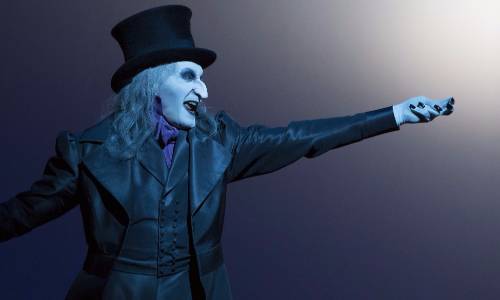
The first part before the interval is engaging, holds the attention. Wilson drags the audience, right upon entering the hall, into the story. On the almost bare stage, on the left stands a kind of gnarled tree with a bed underneath it with an old man on it. He seems to be counting down the last minutes of his life and occasionally lets out a blood-curdling scream, next to him stands a dwarf. On the right an actress. Yi-An Cheng plays the lifelike wind-up doll Olimpia, key in her back, she turns silently on her axis. All actors are made up white. Only the eyes are heavily lined, and the mouth too has colour. The style of clothing refers to the 19th century.
The actors' movement language is stylized, strongly mimetic and has something of puppet theatre with angular movements. Light and dark are strongly played out. Through carefully designed lighting, the characters appear like cut-out dark profiles as they move across the stage (in the 18th and 19th centuries, before photography was introduced, making silhouette portraits was particularly popular). Wilson creates image after image and lets the pieces flow over each other in his imagination, so he can fit them together and make light, colour, sound and structure form one coherent whole. He shows what lies beneath the surface, the spark of colour in the deepest core. At times it seems like molecular diffusion. Here this, there that. He manages to capture every moment in motion, adding time and space to the stage. An exceptional artistry bursts from the whole.
The performance is full of visual stimuli. The audience is immersed in a delirium of colour: poison green, emerald green, blood red, midnight blue with black streaks according to the emotion. All these effects require precision work from the actors. One scene flows effortlessly into the next. Christian Friedel, who plays Nathanael, performs with brilliance the wilful little boy who doesn't want to go to bed and comes up with all sorts of excuses to delay going to sleep a little longer. Then 'Der Sandmann' comes up. The back cloth becomes a collection of children's eyes. When Der Sandmann leaves without success, the borrowed song 'Twee ogen zo blauw' rings out. Mother and son dance a waltz. They have beautiful voices with a lovely timbre that can colour both tenderly and fiercely.
Second part
After the interval, however, it moves less smoothly. Nathanael has grown up and is engaged. Humour peeks around the corner from time to time when he writes a letter to his beloved with an enormous feather that, while writing, resembles the wagging tail of a dog. He receives a telescope from Der Sandmann, but doesn't pay him sufficiently, and discovers Olimpia: a beautiful woman, but stiff and lifeless. Then the action drags on at moments. The first transformation of the stage for the mirror hall for the ball is caught in a playful way by the orchestra members.
The ball is organized by Olimpia's father to present his creation, a technical masterpiece. The rotating mirrors create a luxurious effect. She is allowed to sing a song, but falls silent halfway through. She is wound up again and continues. Nathanael declares his love. Der Sandmann comes by and takes revenge on the mechanical doll. He tears out her eyes to Nathanael's dismay. Then the mirror hall has to be dismantled and the magician comes to place a tap dance number. This is dragged in by the hair, causing the rhythm of the performance to take a second hard blow. The staging slips a bit too much into cleverness, causing Wilson to lose grip. A distraught Nathanael wants to murder his fiancée, but is just barely stopped in time. He ends up in a bed in an insane asylum? The performance could stop here for me. But then a choral number is added by the entire cast: 'Open a window in your room'.
Altogether, 'Der Sandmann' is primarily a scenographic tour de force through dark energy. What the actors achieve is fascinating and deserves all respect. Everyone brings authenticity to his role. The actors of the Düsseldorfer Schauspielhaus do honor to the noble art of theater and song. The music is okay but not overwhelming. It lacks maturity and enchanting intensity. The orchestra plays with the required rhythmic panache.
Despite these critical remarks, Der Sandmann could count on much acclaim.
- WHAT: E.T.A. Hoffmann 'Der Sandmann'
- WHO: Düsseldorfer Schauspielhaus
- DIRECTOR: Robert Wilson
- MUSIC: Anna Calvi
- WHERE & WHEN: deSingel Antwerpen, 30 juin 2018
- PHOTOS: deSingel