
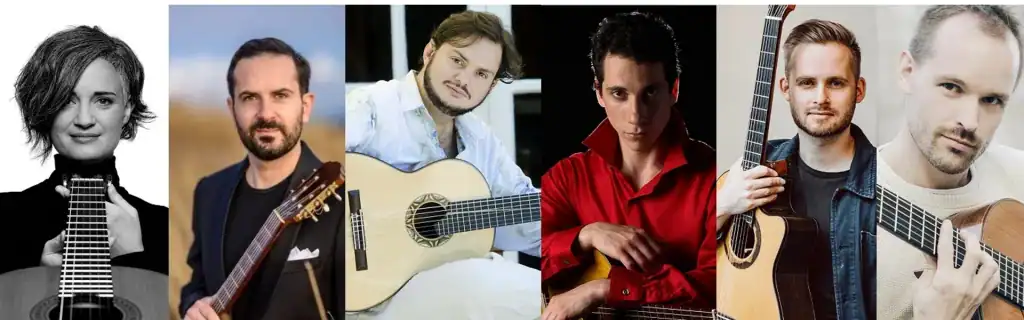
An Evening at the Antwerp Guitar Festival 2025
Despite the massive traffic jams on the Antwerp Ring, guitar lovers from home and abroad found their way to De Klap in Deurne, where Jan Depreter organized the Antwerp Guitar Festival for the fourteenth year in a row. The festival distinguishes itself through the unique combination of international stars and the versatility of guitar styles, from classical to fusion and flamenco.
A Warm Home for International Stars
On Saturday, November 8, Klassiek Centraal was there. We enjoyed the special, almost familial atmosphere that makes this festival so unique: musicians without airs who attended each other's concerts, visitors and artists who chatted at the bar about their shared passion for the guitar. The combination of professionalism and hospitality, made possible by an enthusiastic group of volunteers, ensured that both musicians and the public felt at home immediately.
Jan Depreter (with whom you can read an interview on Klassiek Centraal) had promised beforehand, with a nod to Julian Bream, to think "outside the box" with the programming. And he succeeded wonderfully. During three recitals, we heard a sample of the enormous versatility of the instrument: from the refined classical lyricism of Florian Palier, through the creative fusion of Sönke Meinen, to the fiery flamenco of Grisha Goryachev.
These performances not only showcased the virtuosity of the guitarists, but also their ability to captivate the audience, each in their own way.
Florian Palier: Serene Splendor of Color and Poetic Lyricism
The evening was opened by Florian Palier, an Austrian guitarist and composer who set the tone immediately with his Belgian debut. You can also read an interview with him on Klassiek Centraal.
His recital was one for the connoisseurs: restrained, colorful and imbued with musical intelligence. What a rich and refined palette of colors he conjured from his guitar! No grand gestures or virtuosic showiness, but a serene, integral way of making music. During his recital, he repeatedly struck the right note and touched his audience with a rare musicality and inner peace.
The works of Agustín Barrios Mangoré (1885-1944) formed an ideal opening. In pieces such as Oración para Todos, Mazurka Apasionada, Julia Florida and País de Abanico, warmth and melancholy resounded, rooted in the rich South American tradition that Barrios elevated to art with his poetic sensitivity. Palier let that musical splendor shine without losing the intimacy of the music.
Before he performed some works by Emilio Pujol (1886-1960), Palier explained why this composer is so close to his heart at this moment. Ten months ago, his little son was born – coincidentally also named Emilio. Until then, Palier focused mainly on contemporary works, but after the birth, he felt spontaneously drawn to Pujol's warm lyricism. His interpretations of the Impromptu, the Romanza and the Tres Piezas Españolas breathed genuine tenderness. Especially the Romanza and the Guajira, I have now happily added to my own playlist.
Then came his own composition, the Sonatina (Hommage à Rainer Maria Rilke) – a work in which Florian Palier (°1987), inspired by his favorite poet, reflects on our time and on humanity's quest for meaning. The first movement sounded rushed and restless, as if the soul were adrift. In the second movement, he alluded to Rilke's symbolism of the "yellow" – a color that in the poet's work is often associated with death and transience. The third movement brought that existential restlessness of Rilke even more to the fore: the eternal quest for a home, for inner peace.
The piece, written in 2018, seems almost visionary in retrospect. Back then, no one could have foreseen what turbulent years the world still had to face. Great artists carry that quality within them: they sense the spirit of the times ahead. In that respect, Palier's Sonatina proved to be an unexpected mirror of the later social unrest – a musical preview of the agitation and uncertainty that has come to characterize our world since then.
To conclude, he treated us to a delightful Gavotte by Barrios, leaving the audience with a smile. Light, elegant and perfectly placed after the intensity of his own work – an airy ending to a recital that was inspired and thoughtful from beginning to end.
Sönke Meinen: Virtuosity with Humor and Narrative Power
Next it was the turn of Sönke Meinen (°1991), about whom you could also read an interview on Klassiek Centraal in the run-up to the festival. He has already completed an impressive tour of no less than fifty concerts in North America this year, and was now visiting Belgium for the first time. That he hasn't missed his entry here is beyond question. A principled musician of the highest order, who is at the same time an entertaining storyteller – both verbally and through his instrument.
During his recital, he performed exclusively his own work, in which playful compositions were repeatedly alternated with more meditative, sometimes melancholic pieces. The result was a rich and layered recital in which virtuosity and emotion went hand in hand. For each piece, he took time to introduce the audience to its origins with a touch of humor.
With Fake Forgery, he immediately set the tone. The piece arose after a curious incident: Meinen was once held for five hours at a police station because they thought he had paid with counterfeit money – the note simply had been washed too much. The irony and playfulness of that story were reflected in the rhythmic, light-footed character of the music.
Mirror of Water, on the other hand, was a restrained homage to his grandfather, who worked in shipping in Northern Germany and whom Meinen never knew. In the piece, the swell of the sea resonated – a poetic tribute, further strengthened by the fact that Meinen later found an image of his grandfather with a guitar in an old photo album. A moving thought: that his love for the instrument might after all have been passed down through the family. The hall listened breathlessly, in a restrained silence that said much.
But Meinen loves contrasts. With Sparklemuffin – a virtuoso and playful work inspired by the Australian "peacock spider" that became famous on YouTube for its mating dance – he immediately lifted the atmosphere again. Where the original video had the spider dancing to the Bee Gees, Meinen wrote his own soundtrack, energetic, funny and technically stunning.
Alpacalypse was another highlight: born from a failed walk with an alpaca. The nervous gait of the animal and the composer's stress were transformed into brilliant syncopations and surprising rhythms – humor and virtuosity in one.
With La Ciudad Soñada Meinen also proved his worth in flamenco, while Heartland formed a warm ode to his current home Hamburg, his "old, new home". Finally, with A Night in Tunisia he paid homage to jazz legend Dizzy Gillespie, not without mentioning that he was sorry he hadn't written it himself.
After deafening applause, he gave the audience an encore: a tender, surprisingly intimate arrangement of Let It Be – a beautiful, hushed ending to a recital that exuded charm, humor and musical mastery from start to finish.
The audience reacted unanimously enthusiastically: we heard an artist who managed with apparent ease to combine technical virtuosity with disarming human warmth.
Grisha Goryachev: fireworks with nuance only at the end
Whereas the previous recitals offered a thoughtful and varied program that captivated from beginning to end, Grisha Goryachev's recital unfortunately disappointed somewhat in terms of programming. Yet expectations were high: in 2017 he already brought the house down here, and now he had come specially from the United States for this festival again. Goryachev is praised worldwide as one of the few guitarists who authentically interpret the Andalusian solo flamenco tradition, with stunning technique and rhythmic insight.
That Goryachev is a phenomenon is beyond question. It remains utterly astounding how his fingers storm across the strings with a precision that seems almost superhuman. At first that's impressive to watch: the sheer power, the lightning-fast picados and the virtuoso rasgueados – as if a hurricane sweeps through the hall. But as time went on, that constant intensity began to dominate, causing the program to lack the much-needed variety in color, rest and tension.
His playing had something of an F-16 flamenco player about it: technically brilliant, but sometimes too tight and explosive to fully capture the poetic soul of flamenco. In works such as Malagueña de Lecuona (arr. Paco de Lucía), Ímpetu by Mario Escudero (1928-2004) and Los Caireles by Esteban de Sanlúcar (1943-2022) he demonstrated his finger dexterity and virtuosity, but the emotional core – the melancholy and the singing line of the cante – remained somewhat in the background.
Only towards the end did more depth and nuance come into his playing. With works including Ventanas al Alma by Vicente Amigo (°1967) he suddenly revealed another side of himself: warmer in tone, with refined phrasing that finally gave the music the necessary breathing room. In Monasterio de Sal by Paco de Lucía (1947-2014) too, something of introspection sounded for the first time – the kind of restraint that truly brings flamenco to life. Had he alternated these works earlier with his virtuoso showpieces, the recital would undoubtedly have been more balanced.
The audience in the well-filled hall, however, paid little attention to this: the reactions were exuberant, and the standing ovation spoke volumes. For many, this was undoubtedly a spectacular highlight. Yet after the previous recitals, I was left a bit hungry. Technically masterful, but the soul – the duende, that elusive mystical element that elevates flamenco to something timeless – truly came alive only in the final pieces.
Three worlds, one instrument: a festival to cherish
Looking back on the day, I got to know three intriguing and disparate facets of the guitar: the refined and poetic classical style of Florian Palier, the inventive and virtuoso fusion of Sönke Meinen, and the fiery, rhythmic intensity of Grisha Goryachev. Together they formed a fascinating palette that fully showed the versatility of the instrument, from introspective lyricism and subtle colors to spectacle and rhythmic power.
The Antwerp Guitar Festival is a music festival that Antwerp can be proud of. Thanks to Jan Depreter's international network, world-class artists come to the city, making the festival an important meeting point for enthusiasts from home and abroad. Antwerp became the guitar capital of Europe this weekend, and for that very reason the festival deserves a strong foothold in the city's rich cultural landscape. It brings not only world-class music, but also creates a warm, welcoming atmosphere where audience, artists and volunteers meet and inspire each other.
Next year we'll definitely be back, because this festival left us wanting more: an intriguing mix of virtuosity, passion and connection around one of the most beautiful instruments in the world.