
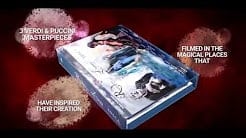
*** It is indeed enjoyable to see an opera performed at the locations where the story takes place. Producer Andrea Andermann chose three operas whose specific settings lend themselves perfectly to film. Moreover, they are top-drawer repertoire pieces: Verdi's La Traviata and Rigoletto and Puccini's Tosca. But one film is considerably more successful than the other, for various reasons.
Rigoletto: stunningly masterful
When a film is made as Verdi's Rigoletto by Marco Bellocchio, then it hits the mark, especially because the true opera requirements are perfectly respected. Rigoletto in the historic locations of the Palazzo Ducale and Palazzo Te in Mantua has something special thanks to the wealth of interiors and costumes. A duke with his court including a jester in the rich context of a Renaissance palace: it gives you the chance to transport yourself for a moment to the sixteenth century, in which Victor Hugo's play (Le roi s'amuse) and Verdi's opera are set. The film is made in such a way that the drama is propelled forward, with interludes that offer just a moment to catch one's breath thanks to the soothing scenes on the lakes around Mantua.
The dramatic acting is supremely strong, naturally aided by singers who are accomplished actors. A more moving Rigoletto than Plácido Domingo is scarcely conceivable. His mimicry grins as a jester and when he mocks the courtiers, but equally his face contorts with pain and horror at his tragic fate as a father. Vocally he commands the role magnificently. His aria Cortiggiani vil razza dannata is both an expression of sharp satire and profound pain. The discovery of Gilda's death pierces to the bone. The abduction with the frightening masks, the appointment with Sparafucile and the scene with Maddalena are forewarnings of horror. The storm in the third act is chillingly staged. Sparafucile is performed, incidentally, by another legendary singer, Ruggero Raimondi.
Julia Novikova is a touching Gilda, naive and simple, dreamy, in short a tender figure with a beautiful voice and coloratura tone. Vittorio Grigolo, in turn, delivers an impressive Duke. His voice is expressive with sometimes too much vibrato and too little resonance in the pianissimo passages. But his aria at the beginning of the second act (Parmi veder le lagrime) is genuinely very beautiful, and he performs magnificently.
Zubin Mehta conducts an engaged and meticulously playing orchestra at the Teatro Scientifico Bibiena in Mantua, the Orchestra Sinfonica Nazionale della Rai.
La Traviata: contrived
La Traviata in Paris unfortunately yields a different result. The locations are certainly chosen with care and are indicated at the beginning of each act. The celebration in the salon at Violetta's in the first act is at L'Hôtel Boisgelin, the second act in Versailles' Le Hameau de la Reine, the celebration at Flora Bervoix's at Le Petit Palais and the apartment where Violetta dies on L'Îsle Saint-Louis. But while Rigoletto comes across so convincingly, the staging that Giuseppe Patroni Griffi made of La Traviata seems to me contrived, with exaggerated and laboured poses and gestures and festivities that come across as dated. The evening scenes furthermore take place in daylight. Strange. The dramatic acting gets caught up in clichés, such as hands seeking each other under a sheer tablecloth or a plate breaking as a pseudo-symbol of the fragile love that Alfredo and Violetta discuss in the duet in the first act. The duet between Violetta and father Germont also lacks force, with the two wandering about in the (admittedly beautiful) garden of the country house. The play with the matador at Flora's celebration is also excessively laboured and pointless, just like the ridiculous oriental costumes. The director wanted to portray the "gypsies" from the libretto directions with too much imagination. One successful passage is when Alfredo humiliates Violetta as a prostitute and is corrected by his father. In the fourth act the staging avoids showing faces – everything remains in shadow tones, which also gives an artificial aspect to the portrayal, and the sublime aria Addio del passato thus lacks pathos. Waltzing gently to the music of the two lovers in Parigi, o cara, noi lasceremo offers one of the most beautiful and tender moments of the film. Somewhat strange, but certainly original, is that Violetta falls dead against the window. Atmospheric is the tolling of the death bells over the Seine.
Even more unfortunate is that the singers disappoint. Eteri Gvazava is shrill and sings with unintelligible diction. In the second act she sounds weak and absolutely lacks conviction in defending her love. In the death scene she seems to control her voice somewhat better and she does move with a beautiful pianissimo, but overall she is certainly not a Violetta to look forward to. José Cura has never been a favorite singer of mine and that is confirmed here. He sounds tight, lacks all brilliance in the voice and his opening aria is downright monotonous. Rolando Panerai's voice is worn, lacks legato and moreover he acts woodenly. Both Siccome un angelo and his otherwise beautiful aria Di provenza il mar are a disaster. This on-location La Traviata thus shows how film is no guarantee of a fine performance.
Tosca: seductive and determined
Fortunately, in Puccini's Tosca we get a film that does justice to the operatic quality. Here too it has been filmed "nei luoghi e nelle ore di" (in the places and at the times of). In the first act we see the magnificent space of the church Sant'Andrea della Valle, with the chapel where Angelotti hides. In the second act we enter the grandiose halls of the Palazzo Farnese. And in the third act clever use is made of the images of the angels on the fortress, which sometimes seem to take Cavaradossi in their arms. Castel Sant'Angelo also offers a fine view of Rome and Saint Peter's. A major plus here is especially that we again get to see three grandiose singer-actors. Plácido Domingo lets his radiant tenor voice be heard as Mario Cavaradossi and overwhelms from the first aria Recondita armonia. Catherine Malfitano, with her dramatic voice and superlative acting talent, is an ideal Tosca: all seduction and determination. Ruggero Raimondi is a cruel Scarpia. The three singers have strong expressivity and convincing acting talent. The emotions of love and hate are magnified to extremes, but always moving verismo. The gestures sometimes dare to be exaggerated, to the point of pathos, but they contribute to the breathtaking tension of the story and fit into the overwhelming spaces. The third act opens with a beautiful peaceful prelude of the horns as an introduction to the gloomy accompaniment of the soldiers to the execution. The lighting creates an atmosphere of fear and unrest. Tosca is here once again her pathetic self and the final image of the angel with the sword is striking.
A fine film that tips the balance of the three DVDs toward the positive, all the more so because through the combination of Rigoletto and Tosca we get a fantastic spectrum of the dual talent of one of the most sublime opera singers of the past fifty years: Plácido Domingo as tenor and as baritone. Recordings, then, that can appeal both to the "die hard opera lover" and serve as a compelling introduction to opera.
- WHAT: Giacomo Puccini (1858-1924) – Tosca | Giuseppe Verdi (1813-1901) - Rigoletto & La Traviata
- PRODUCER: Andrea Andermann
- DIRECTION: Marco Bellocchio (Rigoletto) | Giuseppe Patroni Griffi (La Traviata & Tosca)
- VOICES: Plácido Domingo, Ruggero Raimondi, Catherine Malfitano (Tosca) - Plácido Domingo, Julia Novikova, Vittorio Grigolo (Rigoletto) - Eteri Gvazava, Rolando Panerai, José Cura (La Traviata)
- MUSIC: Orchestra Sinfonica Nazionale della Rai conducted by Zubin Mehta
- RELEASE: Rada Film Group (4 DVDs)