
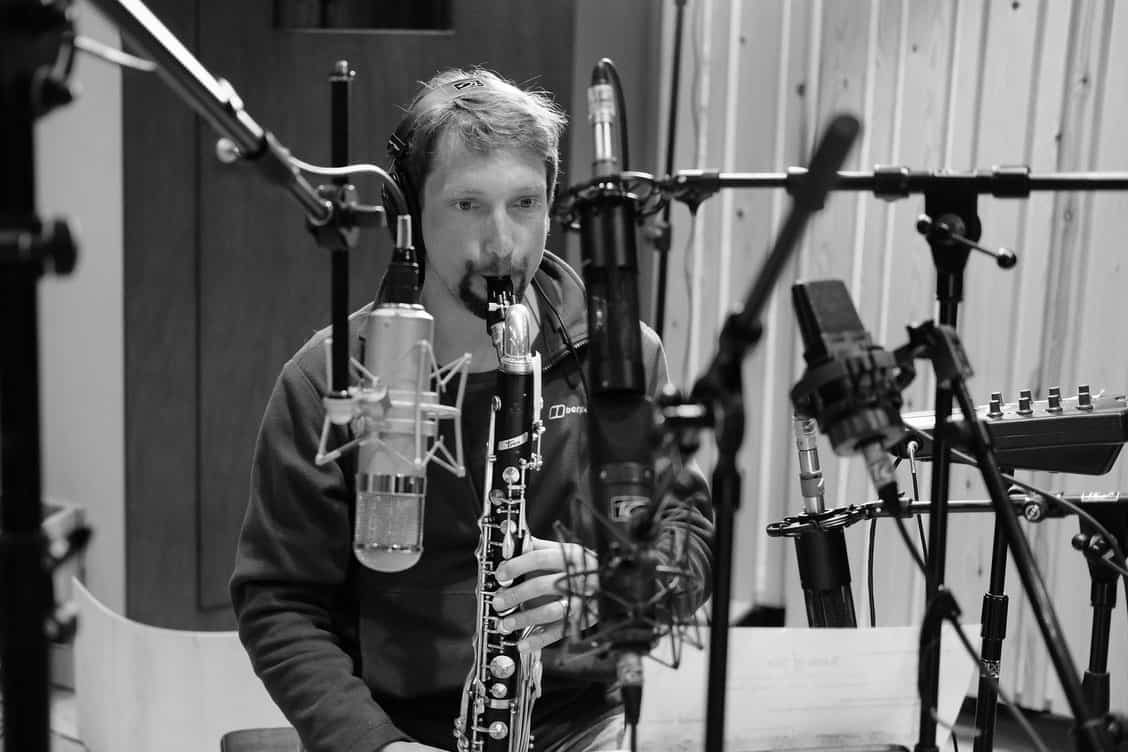
Clarinetist Dries Tack performs in various contemporary music ensembles: Odysseia Ensemble, Nadar Ensemble, Curious Chamber Players and STYX. Last month he released his first solo album. Adjacent Spaces explores the new sound possibilities of the clarinet through six composers. Each with a unique style and a unique sound, they bring a different tonal aspect to the fore.
Over the years you build up a repertoire as a musician. Were there certain works that you really wanted to include on the cd?
It has indeed grown over the years. In ensemble settings I also encountered solo pieces and with some pieces you just click. Slowly the idea of a cd began to grow and thanks to the pandemic — which prevented us from playing together — a solo album came to the fore.
At first I had the idea of doing everything myself: recording myself, editing myself, playing myself. But after recording lessons and a few attempts it turned out not to be so easy. You need more materials and experience than you initially thought. So I sought help for that.
The pieces themselves, many I already knew. But besides that, I also contacted composers to write a composition for this project. Those are the works by Stefan Prins (°1979) and Michael Maierhof (°1956). In the early spring of 2020 I had contacted Michael to see if he wanted to write something and he immediately mailed me back: "it's already done". He thought it was such a great idea that he immediately started composing. Stefan's composition took a bit longer since at that time he was still working on a commission.
Is there a common thread running through the programme?
The cd opens with a work by Salvatore Sciarrino (°1947). That is a classic in contemporary clarinet repertoire. It is also one of my favourite works. I often play it as a warm-up before I study other things. It is one of the first clarinet works in which no normal note is used. It completely departs from the normal way of playing. And that became the starting point of this album.
Let me die before I wake (1982) is based on the book of the same name by Derek Humphry. It is a book about euthanasia and physical decline. Sciarrino translates this by creating sounds with resistance. Aesthetically this is very beautiful.
In the programme notes it says that for the recording of this work you looked for a specific clarinet.
The work was originally written for the Voll-Böhm clarinet — an instrument that can play a semitone lower than the ordinary B-flat clarinet. In the 1870s they tried to make this clarinet the new standard but after about 100 years it fell out of use. Now they are no longer manufactured as standard and can only be obtained from a few small workshops.
I myself have a very good Voll-Böhm clarinet but for this piece I found it too good. It played too easily. The idea of Let me die before I wake is to create resistance. So that did not fit the concept. I happened to have a student who came to lessons with such an instrument. So I asked if I could use his instrument and on that instrument I finally made the recording. In order to explore the limits of the physical in that way.
With the piece the composer mentions a poem stating that the night is most fertile for thoughts. So we recorded this work at night. Also with the idea that there would be no noise. But that turned out differently. We made the recording in the chapel in Asse and it is located along the road to the industrial park in Mollem. At night there was the supply of the industry and there were trucks passing by all the time. The whole ground shook. And then it sounded: "That was a good take but there was a truck. Let's do it again."
We started recording at 11 pm and stopped at 4 am. Because I was exhausted and you can hear that throughout the piece. A weariness creeps in. In hindsight I am happy with that because it fits perfectly with the message of the composition. It became a real ordeal.
Just as illness is accompanied by suffering, this recording was also ordeal.
Yes, and the traditional clarinet sound also dies in this work. At the same time it is reborn in a different way. With new playing techniques and new timbres to explore. That became the common thread throughout the album.
The next work offers a stark contrast. Sciarrino balances on the edge of the audible. It is very quiet. On the cd the dynamics are naturally evened out. But the next piece refLEction refRAction difFRAction (2016/2019) by Hunjoo Jung (°1982) is normally very loud and in-your-face.
I have worked regularly with Hunjoo. We are also good friends with each other. Hunjoo experienced a lot during his military service in South Korea and he also processes that in his music. He has created a very distinctive and characteristic musical language.
While I play bass clarinet, my sound is recorded and goes directly to his computer. In real time Hunjoo encodes the software to change my sound. In a live performance you see him typing away on his computer.
So Jung was present at the recording?
Yes, he actually plays along. It is chamber music. When I play a sound that he finds interesting, he picks it up and plays it later in the piece. And in turn I sometimes imitate his sound. You no longer know which sounds come from me and which come from him.
So each performance is unique because everything happens in the moment itself.
He did create a foundation. It is not free improvisation. There is a score with a defined structure based on modules that I can combine. Within the modules there is a lot of freedom but parameters such as dynamics or certain sounds are fixed. It is almost co-composing. It is a completely different way of collaborating.
After Jung's work comes an interesting mirroring that occupies the middle of the cd. In the composition Splitting 47 (2020) by Michael Maierhof you play only with the mouthpiece. While in the work that follows, a reworked version of Split Rudder(2016/2019) by Malin Bång (°1974) the exact opposite happens and you use only the body. Very interesting to place these two compositions back to back as the middle of the cd.
The third work is one of the compositions specially written for this project. Michael's piece uses only the mouthpiece and the neck. Michael often makes his own preparations and he did so here as well. He works with plastic cups with nails glued to them. He also gave me a glass ball on a stick (like a magic wand) and I also use a tuning fork. I blow through the mouthpiece into the cups which causes them to resonate. So in addition to the basic sound of the clarinet there is also a second sound source.
Michael experimented extensively with the sounds he wanted to create. He tested different types of cups for their resonating qualities. He also sent me various ones to see how differently they responded to my way of playing.
The way Michael composes is completely the opposite of Hunjoo's. Michael didn't send me a score but a wave graph with the sound waves. It was composed of his own recorded improvisations that he then cut and pasted together. The recording he sends you then has to be reproduced as well as possible. You then record yourself and compare with the recording he sent.
It is almost conceptual. Identical can of course never be because you're in a different space, using a different microphone, etc. At first I tried to get as close as possible but we eventually abandoned that. Ultimately the score became a video score with a kind of karaoke line. Dynamics, timing and techniques are defined in this way.
Malin is again completely different in her composing. She has a natural and flowing flow. In Split Rudder (2016/2019) she actually takes away the identity of the instrument — namely the mouthpiece. Much attention goes to the air. You hear a person playing. In that respect somewhat similar to Sciarrino.
Originally the piece was written for Paetzold, a contrabass recorder, and is based on the Swedish ballad Det var Blue Bird av Hull by Evert Taube. Malin doesn't interpret the song literally but captures the atmosphere of the story, which is about a storm on the. In this recording we focused mainly on the energy of the air stream as well as the details in the sound, such as the gradations of noise, pitches and articulations.
There is actually a microphone in the lower part of the instrument. When you play a wind instrument without closing the keys, the air goes upwards and doesn't reach the microphone. When you play in the low range, you create a sound bomb.
There is also a little bit of electronics involved. That works with a live looper, where you record fragments and can then play them back later. She had originally integrated it so you could easily turn pages. That was the basic idea, but it subsequently grew into a full musical element.
And how did the interaction with the composer go to create the version for bass clarinet?
I know Malin very well. She has a group in Sweden, the Curious Chamber Players, and I also play with them. During a portrait concert of hers Split Rudder was played on Paetzold. I found that piece so wonderful that I asked her if she wanted to make a version for bass clarinet. And then we experimented together to translate the techniques of the Paetzold recorder to clarinet. It is a piece that I have already played several times since.
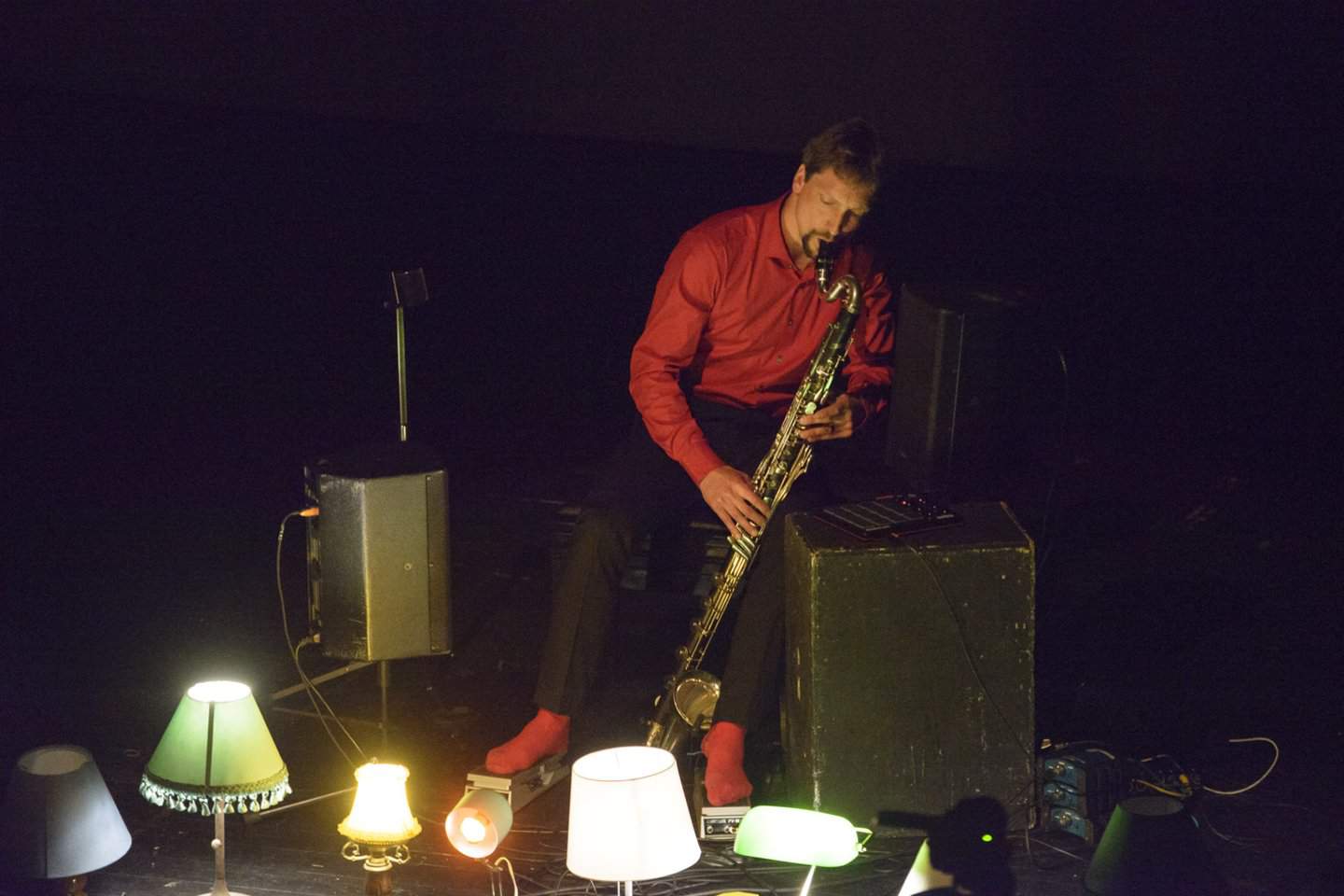
After Split Rudder comes again a completely different sound world with Inhibition Space #2 (2021) by Stefan Prins.
Stefan had already written a piece Inhibition Space #1 (2020) for a trio of bass clarinet, bass flute and bass oboe. Each musician has a microphone in the instrument and a speaker next to them. This creates feedback that (fortunately) first goes through a computer so it stays under control. I found that a very nice piece and had discussed it with Stefan. He said he wanted to make a series of them, including a version for bass clarinet solo. Since I was working on the cd idea, I asked him if he wanted to write that version first.
At that time Stefan was still busy with his concerto for electric guitar but I couldn't wait and started experimenting with the concept.
The original idea was one microphone and one speaker but I thought that was a bit limited. So it became two microphones and two speakers. This way there could be one microphone high and one low in the instrument, with the speakers always at the same height and facing each other. This way one feedback group influences the other. It creates a kind of ecosystem where the slightest movement provokes a reaction. It's a butterfly effect. Even a pressure change from my fingers on the keys brings about a change in sound. You can barely move without generating a sound.
After I had built the instrument, I experimented with movements and actions. Stefan would then say what he found interesting and pushed me in other directions. Based on that, the score came about. Just before the creation, Stefan made a first score backstage. It consisted of drawings with the actions we had agreed upon.
The last work is again by a South Korean composer. You end the cd with AS LONG AS you LOVE ME(2014/2015) by Ui-Kyung Lee (b.1984).
It is purely coincidental that two Korean composers are featured on this cd. I absolutely wanted this work on the cd because with it the circle is actually complete. The instrument is completely taken apart here. The work consists of six parts where each part is played on a different part of the clarinet. It starts on the barrel and even ends in the last part without an instrument. The part on the barrel is somewhat reminiscent of Helmut Lachenmann.
It does indeed sound like the playful and humorous style that typifies Lachenmann. But when you then read the text in the program notes, there is actually a serious and political meaning behind it.
That is somewhat difficult to say since the language barrier played a role in this collaboration. I don't speak Korean and Ui-Kyung speaks little English. Based on his explanation it seemed to be about that but I myself am also not completely sure.
The work was originally written for clarinet and keyboard. On the album it is a version for clarinet and tape where sounds and samples are played in stereo from a computer. So in the last part without an instrument, sounds of kisses and fish sounds are heard — the same sounds that I make at that moment too. It is a dialogue between man and machine.
This work is actually a condensed version of moving away from the traditional clarinet sounds.
Indeed. It starts, as mentioned, on the barrel. The second part also still contains clarinet sounds because of the mouthpiece. From the third part onwards the traditional sound is completely gone. In this part the middle section of the instrument is clamped between two vices and you play the keys like a typist. In each part you basically move one step further away. It ends in the humorous last part where I play completely without an instrument but instead I make playful and childish sounds with my mouth. And it is precisely this reduction to seemingly banal, but idiosyncratic material with a positive connotation that can create space for the emergence of new ideas.
Each work on this cd is characterized by a completely different sound world and a completely different compositional process.
That is what is interesting about the contemporary compositional process. Every composer has his or her own method which leads to a unique sound result that so typifies them. Michael Maierhof who records everything or Hunjoo Jung who codes live: two extremes with everything in between. That was also the intention of the cd. These are all separate spaces. They are all Adjacent Spaces.

WHO: Dries Tack [clarinet, bass clarinet]
WHAT: Adjacent Spaces
RELEASES: Orlando Records OR0046
ORDER: JPC