
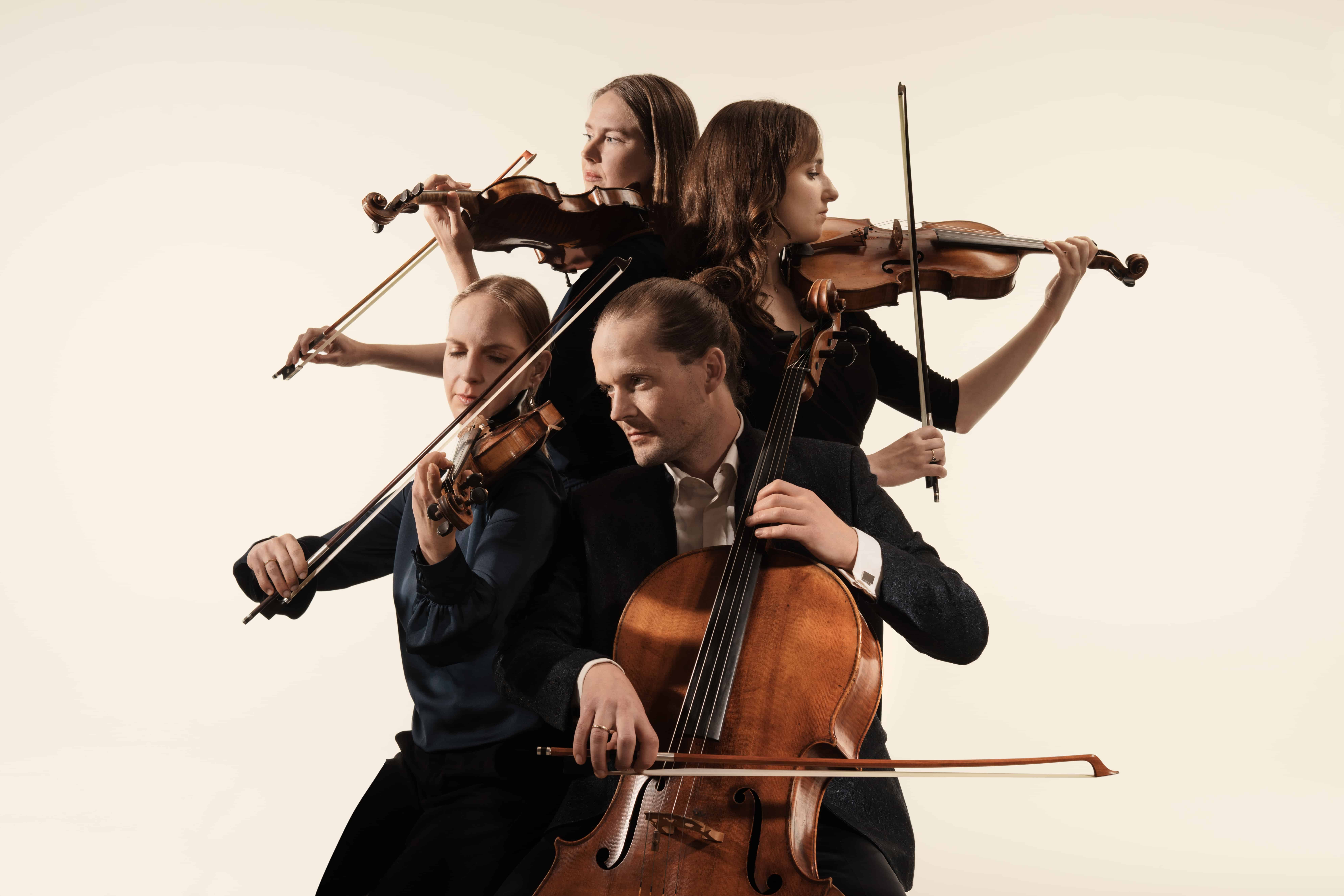
On his new CD What Remains, the Dudok Quartet Amsterdam presents four different perceptions of the concept of time. Motoristic and misty (Roukens), religious and deathly (Machaut, Perotineus and Gesualdo), torment and war (Reich), time and timelessness (Messiaen) – thus a new branch on the already richly decorated stem of this ensemble.
The opening consists of the fourth string quartet What Remains by Amsterdam composer Joey Roukens (°1982), also the title piece of the CD. In Strange Oscillations, the first of two parts, the string players tickle the listener's ears with a gentle breeze, sputtering motoristically like a small boat, including the pulsating lower voices. Rhythmically rolling motifs in the low registers introduce the thicker bowed second part. Glissandi form a natural caesura with a murmuring continuation that nonetheless ends abruptly in the hard pluck of a pizzicato. Engaging, amusing, touching – it all comes together.
Silent and misty
The second part is called Motectum and suggests that it is a polyphonic arrangement of a liturgical musical piece. According to the CD notes, this part involves a systematic deletion carried through the compositional process. The listener can then infer that the result consists of a dreamy lament, supported by precise harmonies. Soft playing moves on quiet feet toward a slightly trembling, misty ending.
This mysticism gains relief on the CD through three short, but iconic pieces from early music history: The Kyrie from the Messe de Nostre Dame by Guillaume de Machaut (1300-1377), the madrigal Deh, come invan sospiro by Carlo Gesualdo (1566 – 1613) and the crystal-clear Viderunt Omnes by Perotinus (1200).
Steve Reich is present with Different trains for string and tape. The tape part consists of recordings of the Dudok Quartet, several human voices and locomotive sounds, resulting in a total of four times four string parts. In three movements, Reich and Dudok show how the Second World War was experienced in the United States and Europe. The approach to WWII in the US is American-rushed, with repetitive patterns and pattern fragments, and tape features station announcers and steam whistles. Modulations and tempo changes keep the listener alert. The second part is the experience of the war in Europe, where the train played a role in transporting (prisoners of war) and the Holocaust. Here the tempo is lower and the speaking voices are aimed at reporting the systematic destruction. Here therefore no steam whistles but more air raid alarms. The finale (After the war) consists of light short melodies and optimistic sounds (the war is over!) from professional presenters.
Timeless
The CD concludes with the fourth part of Messiaen's Fête des belles eaux (1937). Originally it was written for ondes Martenot, one of the first electronic musical instruments with a monotone but warm timbre. A few years later, Messiaen arranged this part for the fifth movement (Louange à l'Éternité de Jésus) of his Quatuor pour la fin du temps. From there it was a small step to, after its own arrangement, come onto the repertoire of the Dudok Quartet. In any case, that has not harmed the interpretation. By using vibrato sparingly, the bareness of the sonority reduced to the bone remains intact. What remains ("What remains") is respect and a form of humility that is timeless.
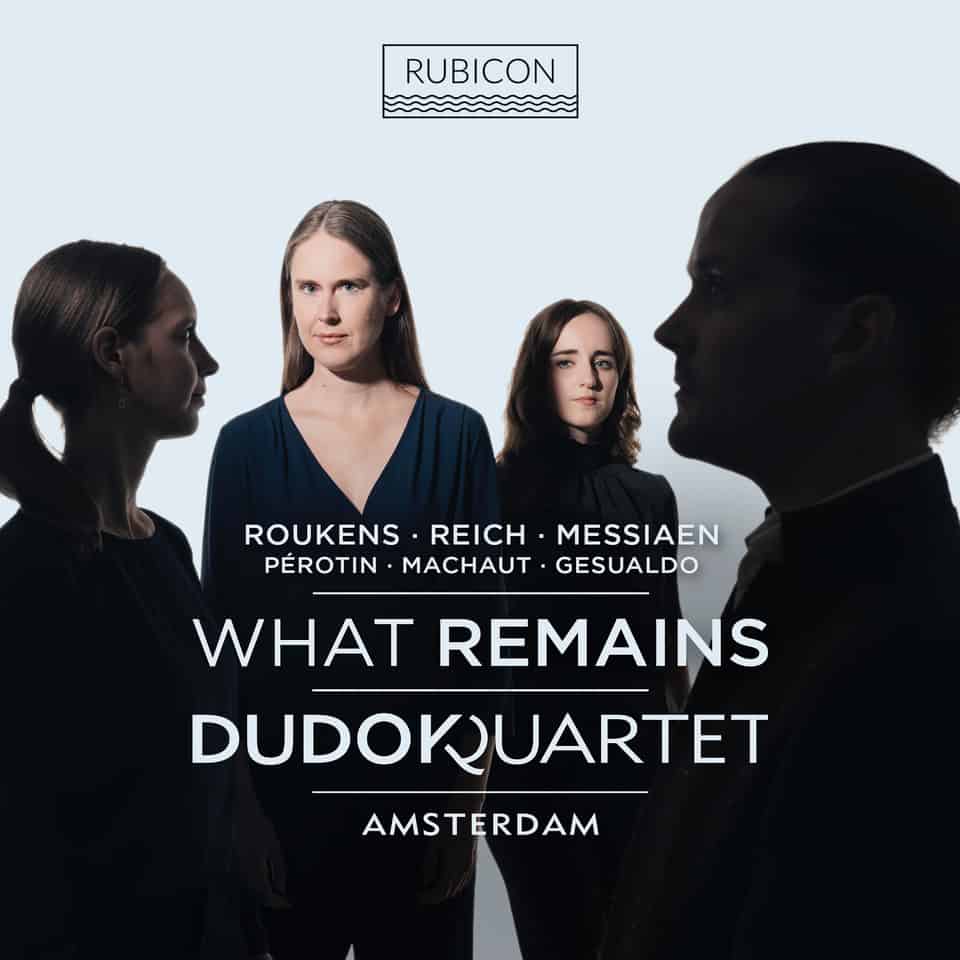 WHAT: What Remains
WHO: Dudok Quartet Amsterdam
RELEASE: 2023 Rubicon Classics Ltd
INFO: rubiconclassics.com and dudokquartet.com