
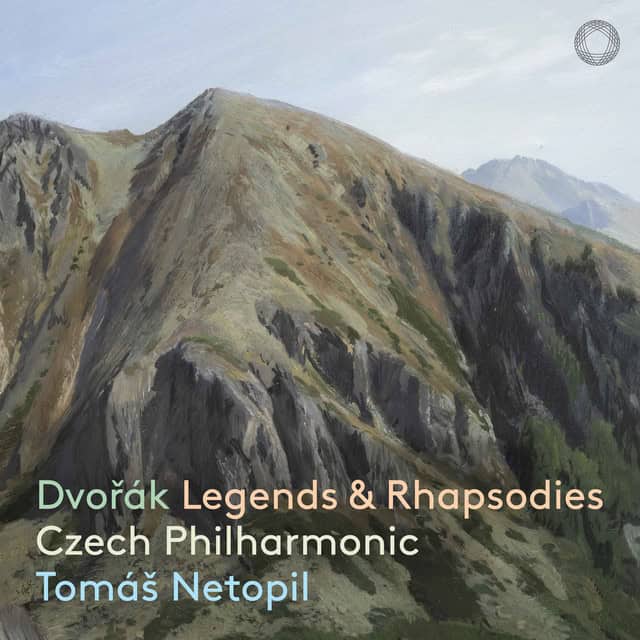
Dvořák composed the ten Legenden completed around the spring of 1881 originally for piano duet, which he orchestrated fairly shortly thereafter at the request of his music publisher Simrock, who was seeking a repeat of the success of the Slavonic Dances. However, that success did not match that of the dances, and regrettably little has changed since then, for curiously enough the Legenden do not form part of the basic repertoire of most orchestras. And to think that they really contain everything needed to bring them to popularity, for this too is music connected with Dvořák's Bohemian idiom, as evidenced among other things by the colourful and folkloristic-tinged melody and the equally imaginative instrumentation.
The three Slavonic Rhapsodies (1878) are admittedly brought together under a single opus number, but thematically they have hardly anything in common with each other, leaving aside their rhapsodic character of course. These rhapsodies too do not enjoy great fame, but they are certainly colourful, with unmistakable influences from Bedřich Smetana, who is equally rooted in the music of his homeland (Dvořák undoubtedly heard the first performance of his Má vlast between 1875 and 1877) but also from the virtuosic Liszt, who did not invent the rhapsody but certainly left an indelible mark on it.
Tomás Netopil is an excellent conductor with Czech roots, qualities that unfortunately come across less pronounced in these recordings. The cause of this lies both with Netopil and with the recording technicians.
Starting with the conductor: his interpretation of the Legenden in particular sounds rather flat from the speakers, certainly not helped by the recording which, as in the subsequent rhapsodies, pairs too little definition with a lack of transparency. As if listening through fairly thick curtains. But in terms of interpretation, Netopil's characterization here is indeed the real bottleneck, for these so pictorial Legenden can certainly be made more of, as shown by Iván Fischer, Jakub Hrůša, Charles Mackerras and Rafael Kubelik among others. Or to go back even further: the tremendous Karel Sejna with the same orchestra, albeit a mono recording from January 1956, recorded like this new album in the Dvořák hall of the Rudolfinum in Prague (I own the LP released by Supraphon). Remarkably, the observation that that mono recording yields better focusing and positioning of the orchestral apparatus than the diffuse Pentatone recording.
The three rhapsodies fortunately fare better in terms of interpretation, which may be explained by their considerably broader conception, each section lasting around thirteen minutes. The expansively set melodic lines speak for themselves and Netopil made ample use of this, but he also succeeded in giving the typically Czech folk music a more exuberant profile. The quality of the recording unfortunately remains adequate this time too, possibly due to the hall apparently being difficult to tame acoustically, although you would think Pentatone by now has more than enough experience with this. Anyway, so be it.