
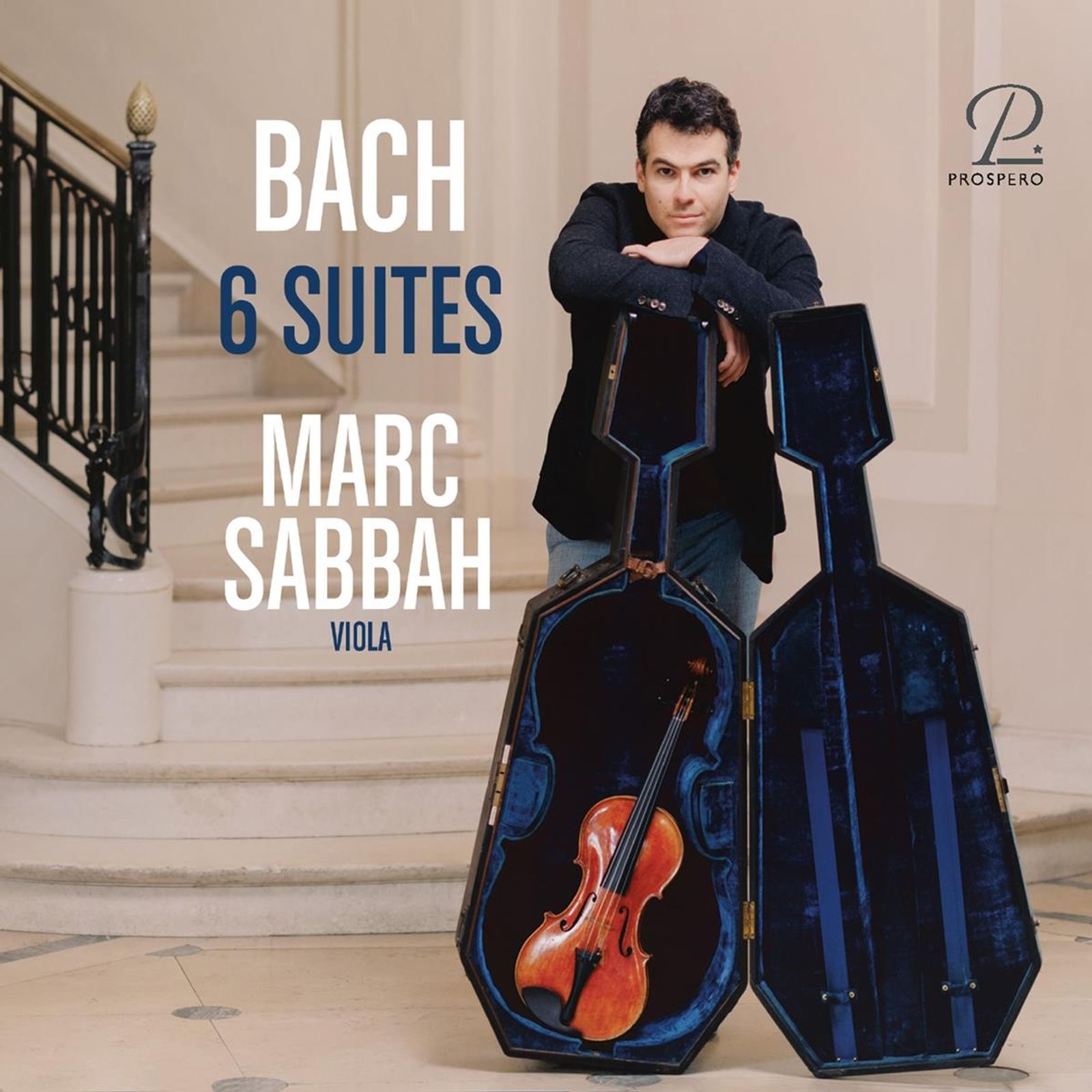
That Johann Sebastian Bach's (1685-1750) six cello suites can also be played on the viola is no longer a curiosity. Yet every new transcription must justify itself. The suites have become so closely associated with the cello that a performance on another instrument is not readily accepted as a fully valid alternative. Marc Sabbah fortunately does not choose that defensive approach. His new recording for Prospero does not seek to replace the cello, but to give the viola its own place within the performance history of this monumental cycle.
This ambition is already evident from the extensive essay that Sabbah wrote for the cd booklet. In it, he describes how at age eleven he switched almost by chance from violin to viola and immediately became attached to the instrument's dark timbre. This personal history is not a casual anecdote, but forms the thread running through his interpretation. For Sabbah, the viola is not a substitute for the cello, but an instrument that sheds its own light on Bach's music.
CD 1 contains suites 1, 3 and 5, CD 2 contains suites 2, 4 and 6 – Sabbah groups the odd and even suites, rather than offering them in their customary chronological order. This choice creates two programmatic arcs that depart less from Bach's traditional ordering than from Sabbah's own interpretive logic. As a result, the recording takes on the character of a carefully constructed recital programme, in which the interrelationship becomes more important than the familiar succession of six suites. A dramaturgy that strengthens the coherence of this recording while sharpening the portrait of the performer as curator, rather than as a mere interpreter of six separate works.
You hear this approach from the first Prelude of Suite no. 1. Sabbah does not opt for bravura or demonstrative virtuosity, but for a sober, almost contemplative approach. His tempi generally remain spacious without becoming sluggish. The phrasing breathes naturally, with much attention to the underlying harmonic movement. The warm, substantial viola sound lends the music a certain intimacy that works differently than on cello: less monumental, but strikingly near and deeply humanly present.
Also remarkable is his careful articulation. Sabbah avoids an excess of vibrato and lets the lines speak through their natural direction rather than through romantic expressivity. This ensures that the polyphony, which Bach continually suggests within a single melodic line, remains clear without sounding analytical. Those familiar with these suites through the iconic, rather extrovert readings of, for example, Pablo Casals, will find a very different – more modest – Bach here, one that convinces not so much through grandeur as through attention. The underlying dance character also remains continually felt. Sabbah keeps the rhythmic pulse alive without forcing the movement, allowing minuets, bourrées and gigues to retain their natural bounce without ever being pointedly profiled. Especially in the Sarabandes, he strikes a fine balance between stillness and tension. They never become sentimental, but retain their restrained dignity.
Not all suites benefit equally from the transcription. The Second Suite gains in introspection. The darker timbre of the viola suits the restrained character of this music particularly well, which gives especially the Prelude and Sarabande an almost vocal eloquence. Sabbah avoids any trace of melancholy and lets the melancholy speak without underlining it. The third suite gains in warmth without losing much of its open character, while the fourth – with its expansive Sarabande and stately Bourrées – sometimes sacrifices something of its architectonic grandeur.
The fifth suite, on the other hand, is among the highlights of this edition. The scordatura – the deliberate retuning of the strings differently from standard tuning – creates a darker, sometimes almost mysterious soundworld that Sabbah explores with great feeling for colour. The stark Sarabande thereby gains an almost timeless intensity. Precisely in this suite, where Bach himself already played with the instrument's boundaries, the transition to the viola feels most organic: the muted, somewhat rough tone that the scordatura produces fits almost naturally with the inherently darker timbre of Sabbah's instrument.
The greatest challenge remains, of course, the sixth suite, originally written for a five-string instrument. Sabbah chooses to transpose the suite down a fifth to G, a decision that makes both technical and musical sense. This keeps the music comfortably within the natural range of the viola and avoids the constantly strained high register in which other solutions sometimes founder. The downside is that the suite loses something of its radiant lightness, but this is offset by a remarkable homogeneity of sound. It is also remarkable how Sabbah keeps the polyphonic lines transparent here too, so that the complex voice-leading does not suffer from the technical adjustment anywhere.
What distinguishes this recording above all is its absence of effect-seeking. Sabbah nowhere seeks spectacular contrasts or grand rhetorical gestures – no sudden accelerations in the Gigues, no emphatic pauses to underline a cadence. His Bach grows organically from the melodic line and from a deep trust in the score. This may make this performance less immediately impressive than some cello versions, but it is particularly enduring. It invites repeated listening because it does not reveal its riches all at once. It is precisely in this restraint that its greatest persuasiveness lies.
The recording itself also deserves praise. The warm acoustics of the Arsonic Hall in Bergen give the viola enough space without blurring the instrument's contours. The recording remains clear and direct, with just enough resonance to let the sound breathe, without ever falling into a hazy reverberation that could obscure the finer details of Sabbah's playing.
The extensive booklet forms a valuable addition to the recording, although ultimately it is not so much Sabbah's argument that convinces as his playing. His interpretation proves that this music does not belong exclusively to the cello. Above all, it shows how much eloquence the viola possesses when a musician makes full use of its possibilities.
With his recording, Marc Sabbah does not deliver revolutionary Bach, but rather an upright, thoughtful and musically highly convincing reading. Those willing to let go of the familiar cello sound for a while will discover a performance that does not ask for originality, but deserves it as a matter of course.