
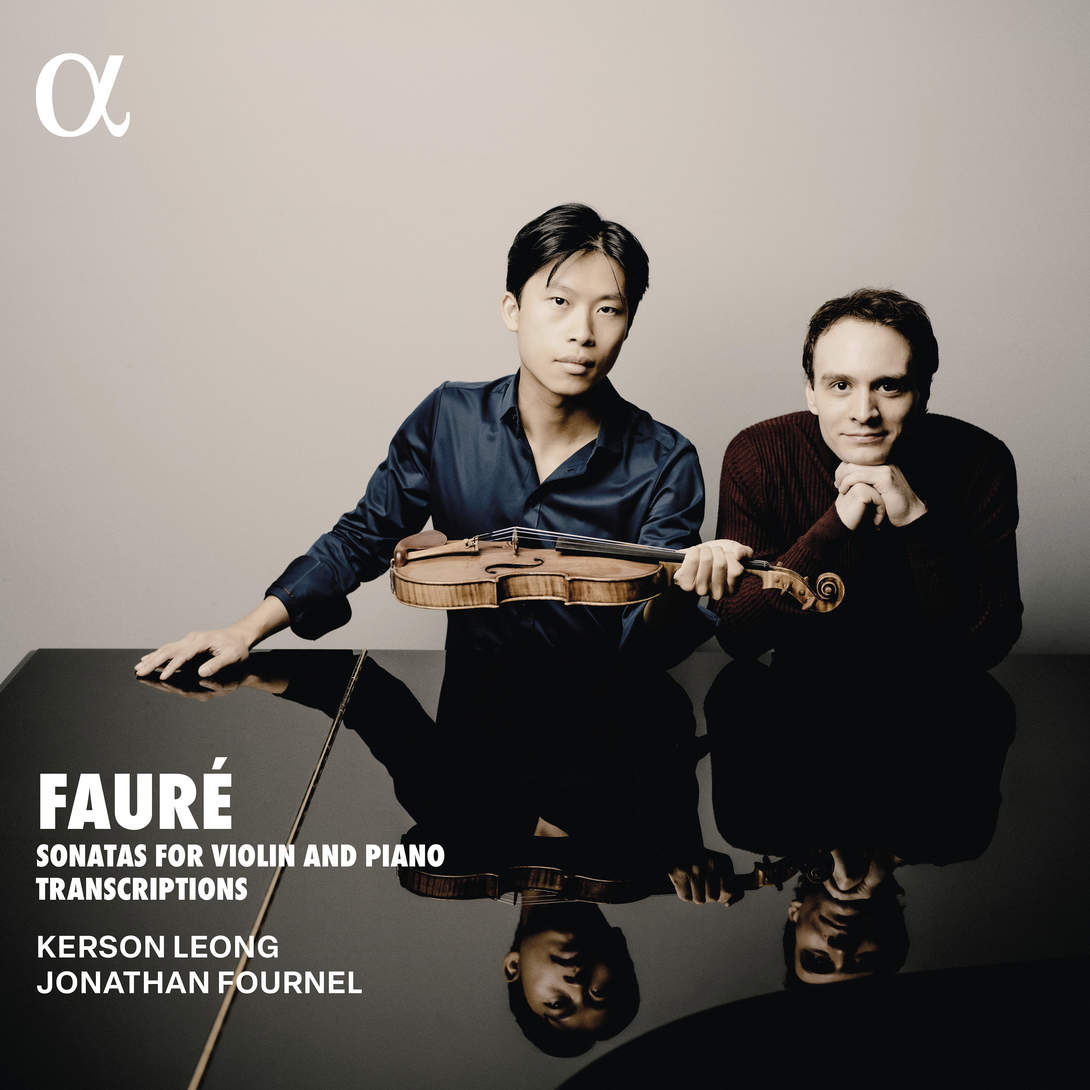
"Your soul is a chosen landscape" – Verlaine's line of verse from Clair de lune could serve as a motto for this new Alpha release. Violist Kerson Leong and pianist Jonathan Fournel combine the two violin sonatas of Gabriel Fauré (1845-1924) with a series of transcriptions of songs and character pieces. The result is more than a fine recital programme: it is a thoughtful journey through a compositional life spanning nearly sixty years. The recording was realized in September 2024 at the Domaine Forget de Charlevoix in Quebec.
Fauré occupies a remarkable position in French music history. As an organist, composer and student of Saint-Saëns, he began his career in the aftermath of the so-called "War of the Romantics", in which Wagner and Liszt were generally set against Brahms. At the end of his life, he witnessed the furore surrounding Stravinsky's Le Sacre du printemps and the rise of modernism. Between these extremes, Fauré remained remarkably true to himself: his style evolved steadily, without breaks or manifestos, from a relatively direct lyricism towards an increasingly refined and restrained expressivity – a development that coincided with his growing deafness in the final decades of his life.
These two phases of Fauré's development are sharply juxtaposed in this recording. The Violin Sonata No. 1 in A, opus 13, was written by Fauré at the age of thirty, and it is precisely that youthful energy with which Leong and Fournel identify themselves: both musicians, themselves about the same age as Fauré when he wrote the work, recognize themselves in its unbridled zest for life. This is audible. The opening section, Allegro molto, receives an eager, almost impetuous forward thrust, without the clarity of the lines suffering – no small feat in a sonata that can easily become mired in sonorous excess. The Andante, with its typically Fauréan lyrical melancholy, already hints at the later, more introspective style: Leong knows how to strike precisely the right melancholy there with a long breath and a never intrusive vibrato. The scherzo-like sections bubble with wit without becoming superficial.
Forty years later, in 1916-1917, in the midst of the First World War and plagued by concerns about his son serving at the front and by his own hearing loss, Fauré wrote the Violin Sonata No. 2 in e, opus 108, dedicated to Queen Elisabeth of Belgium. It is a work that has unjustly remained in the shadow of its more popular predecessor. Harmonically more adventurous, contrapuntally denser and emotionally harder to fathom, this sonata demands interpretive courage – and both musicians demonstrate it here in abundance. The first movement receives a nervous tension that never tips into mere effect-seeking. The Andante is sustained by an apparent serenity through which continuous underlying unrest shimmers, building to a slowly constructed climax that then dissolves again into silence. The final section breathes a serene, controlled joy that never tends toward pathos and leads the work to a hopeful, almost reconciliatory apotheosis. In this interpretation, it sounds as if Fauré, despite war, age and increasing deafness, ultimately achieved a form of inner peace.
Between the two sonatas, Leong and Fournel place seven smaller pieces and mélodie transcriptions, each illuminating a different facet of Fauré's art. The Nocturne from the Shylock suite forms a silky-soft intermezzo, adapted by Fauré himself for violin and piano, while Les Berceaux, in an arrangement by Leong, moves us with its simple, rocking motion. To a text by Sully-Prudhomme, the song celebrates the painful contrast between ships that set sail and cradles that remain behind. Fileuse, in Leopold Auer's arrangement, adds a touch of lightness with its relentless spinning motion, and the early Berceuse shows an artless, reassuring side of the composer. Clair de lune, in the version by Albert Périlhou, beautifully preserves the dreamy wonder of Verlaine's text and thus subtly echoes the motto with which this release opens, while Après un rêve reaches with finely calibrated emotion toward an unreachable happiness; the later Soir, in Albert Stoessel's arrangement, concludes the series with an autumnal, sensuous glow. Together, these miniatures form not merely an intermezzo, but – in Leong's own words – they trace "the pulse of a soul in constant motion": a brief musical biography, placed between the two great pillars of the programme.
What especially distinguishes this recording is the quality of the ensemble playing. Kerson Leong, who previously impressed with recordings of Ysaÿe and music by Britten and Bruch, plays on his Guarneri del Gesù from 1741 with a tone that can be both silvery and dark and substantive – precisely what this repertoire demands. Jonathan Fournel, winner of the Queen Elisabeth Competition of 2021, is far more than an accompanist. His pianism is refined in articulation, rich in color and always alert to dialogue with the violin. Especially in the Second Sonata, it is striking how naturally both musicians sense each other's timing and phrasing. Their ensemble playing is never directed toward virtuosic effect, but always toward letting Fauré's finely branched musical dialogue speak. Throughout the recording, however, the tightness of this musical partnership becomes evident, sustained by a shared vision of this repertoire.
Carl Talbot's recording offers warm and clear sound, with sufficient space for the piano without the violin ever losing presence. This release is without question among the most convincing Fauré recordings of recent years and at the same time makes a powerful case for the still underestimated Second Violin Sonata.