
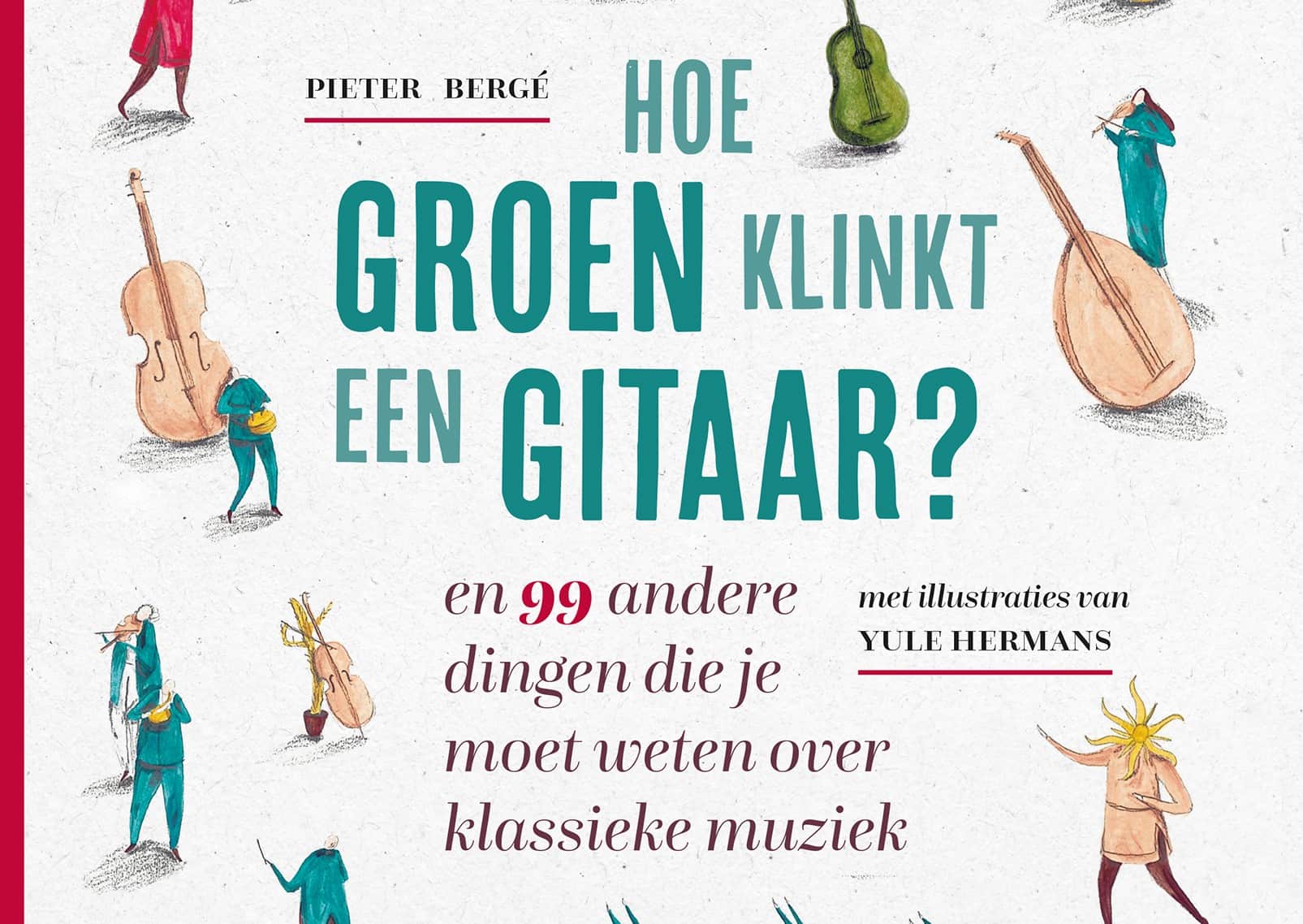
It was supposed to be a nicely illustrated music history for children. That's what the publisher asked for. But upon closer inspection, that's not quite the case. It's written for "all enthusiasts" who are young at heart, author Pieter Bergé informs us. Together with Yule Hermans, he created a 'green book' divided into 100 (main) chapters.
From the very first "chapter" you'll read here a scholar - the author teaches music history at KU Leuven. But then a scholar who can tell stories deliciously. It's hard to find big words and learned terms. The title of the first chapter? "From a very long time ago to the day after tomorrow ...". It looks like a fairy tale book that we're beginning to read. And that's how it looks, with those beautifully delicate illustrations by Yule Hermans alongside: truly an inspired drawing on every page. But don't be fooled, you'll learn an awful lot about that omnipresent reality that music is in our lives, on our earth, in nature. From the very beginning of his music history, the author urges us to listen: "Just listen to how differently snow sounds than hail, how the rustle of a pine differs from that of a birch ...". Look, that's what gets me excited, someone who uses his senses and wants to sharpen those of his readers.
What I also like about it is that he doesn't just scatter names of composers we hear daily on Klara, but also those we rarely hear there: those of now or only recently. And he does it as if it's the most normal thing in the world, quod non! That's why it's certainly useful to import the Spotify playlist that comes with the book (the extended one, with 500 works! or the "top 100") into your Spotify library before you start reading and to have YouTube at hand. That's what young people do anyway. The author also suggests the reader(s) Google, to try things out on an app-instrument (or a real instrument). "Just let yourself go", his advice is, "tinker together your own very personal piece of music."
More insight than history
Yet there's room for the traditional division: with Middle Ages, Renaissance, Baroque, Classical, Romantic. But it's especially pleasing to read so many pages about the 20th and 21st centuries, jazz and pop music included. But it's certainly not become a dry listing of names and dates. Everything you've ever read with great effort in thick books with difficult words and long chapters about music history is bundled here in an extremely accessible language, almost innocuously and naturally. It's almost 100 "columns" that you read: playful in form, serious in content. Moreover, the book gives you more insight than history, and that is undoubtedly a great plus. Also, every 'difficult' word (metronome is the first one I come across) is expertly explained, between the lines or in separate text boxes: concerto (okay, that's easy) but also consonant and dissonant, and difficult ones like dodecaphony or aleatoric, all clear and understandable. You get the impression that he's already told it all to his (grand)children, the way it flows so loosely and fluidly from his pen or is typed on his laptop. And he also finds very vivid metaphors and comparisons. One of the nicest? About those opera divas with lengthy dying arias: "If the sick lung patient sings her piece, we shouldn't worry about her lungs, we should just listen to her soul." Not only beautiful, but also correct. How does he describe impressionism in music? "It's as if you're looking at the world with tears in your eyes" and according to him, the sometimes spicy texts of the madrigalists are easily comparable with the straightforward language of today's rappers.
One (surmountable) objection ...
One "objection" though: while reading, the book slipped from my hands a couple of times. Not because I fell asleep. On the contrary, it keeps you awake! But heavy for a child's hand. A handbook for teenagers in secondary school then? But first a swipe at our education system. He agrees with the focus on sciences and languages, but there's too little attention for the arts. Couldn't be avoided in a book mainly intended to make teenagers curious about music. It's in a small section about "music at school", also with a reference to the almost forgotten Carl Orff and his teaching method to invent music yourself and to play together ... as an exercise in living together. Off to school with that book!
Illustrator Yule Hermans has drawn an appropriate picture on each of those pages with an almost unlimited imagination. Certainly a tour de force. Slender and slim, summing up in a simple or complex image what the author tells on that page. As clearly as he writes, so transparently she draws. And for each music period, she chose a different coloring for her delicate drawings: red, yellow, blue and of course also green. Because: "How green does a guitar sound" then? Bergé explains that in one of his pieces about musical concepts, the concept of timbre. In that short chapter with the same bewildering title, he claims that music is a play of colors. And attention to timbre and new timbres in music is increasing. "To put it in colors: plain green was no longer enough, a composer had to seek other shades: poison green, emerald green, olive green, moss green, all the way to Granny Smith green and applebluesesea green".
There you have it. Now you know. Looking for more color in music? Then this book is your ideal guide. And like much of the music discussed in it, this book is written in a gripping way: full of "dramatic arcs" with surprising "resolutions". I read with great pleasure a book (and learned a lot) that was undoubtedly also written with great pleasure. A history that children, teenagers and adults alike can read effortlessly and get lost in. By the way, it's a recommendation from Bergé: "If you really want to get into the world of music, don't do it in the right order, you're better off discovering all periods at the same time." Go for it!
- WHAT: Hoe groen klinkt een gitaar? En 99 andere dingen die je moet weten over klassieke muziek
- WHO: Pieter Bergé, met illustraties van Yule Hermans
- PUBLISHER: Lannoo, 2019
- COVER: © Lannoo