
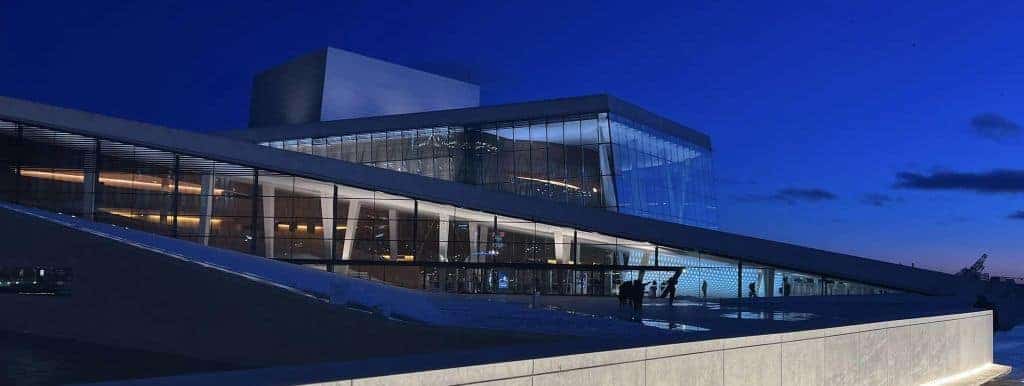
Taking a music trip with the travel organization Cimarosa to Oslo turns out to be not only a musical experience, but also an architectural one.
Our hotel is located in the station district, which at the turn of the century was still a dilapidated port area, but has now become the city's iconic architecture district with a host of new cultural facilities: a brand new opera, the angular and grey Munch Museum, 70m high, an immense National Museum with nearby a gem by Renzo Piano housing the contemporary art collection of Aestrup Fearnley, shipping magnate. That museum bears his name. Norway must be a wealthy country. Especially since the discovery of oil and gas off its coast. The state owns the operation through the company Equinor (ex-Statoil). The government deposits the proceeds in the Norwegian State Fund and every Norwegian benefits from it. That fund currently contains the staggering sum of 1.516 billion euros. Culture benefits too and boasts an overwhelming infrastructure.
Evening with Richard Strauss
It is in an older part of the city that we attend our first concert, in the Konserthus. It is the home base of the Oslo Philharmonic. For years that orchestra was led by the renowned and late Latvian conductor Mariss Jansons. Tonight it is in the capable hands of the German Marc Albrecht. He was chief conductor at Dutch Opera for ten years before choosing an international career. It is an entirely Richard Strauss programme, beginning with a short intermezzo called "Träumerei am Kamin", dreams by the fireplace. It lasts barely 5 minutes but it sounds so lovely and idyllic that you immediately understand why this intermezzo is more popular than the Strauss opera Intermezzo from which it comes. Nice to hear how you immediately recognize those orchestral turns we encounter so often in all his works. It is an unaffected symphonic piece of crescendo and decrescendo, almost ingratiating, said dramaturg Piet Devolder who travelled with the group as musical guide.
This was followed by the Horn Concerto No. 2. The orchestra had invited the first horn player of the Berliner Philharmoniker as soloist, Stefan Dohr. He played it flawlessly without a score, but you can expect that from such a star. Although, Strauss himself, a horn player, composed it for his father - also a horn player - who never played it because he found it too difficult. The second part of that concerto is a "duet" gem between the hornist and the different sections of the orchestra. A truly virtuosic horn concerto.
Main course of the evening: 22 fragments drawn straight from nature, from sunrise to sunset, brilliantly joined together into a veritable Alpine Symphony. Entirely in the tradition of his well-known other symphonic poems. The day begins soft and light until the dark night falls. Strauss musically describes his walk through the meadows and forests, gives voice to his feelings and experiences encountered during that journey. You hear danger approaching, it thunders and lightens, the entire orchestra trembles until the storm passes and the night becomes peaceful again. An ideal story for the Oslo symphony orchestra to demonstrate what it has under Marc Albrecht and that is much, deliciously much. And the composer? It seems to me that with Richard Strauss's orchestral mastery the Alps come into their own better than in the bombastic descriptions that the Austrian Alpine expert Anton Bruckner often gives them.
Norwegian writer Henrik Ibsen danced
In the Oslo opera (what a building!) we see a play by Henrik Ibsen in a ballet version, "The Wild Duck". It is a story about dealing with family secrets, about two families who share a drama of sexual abuse and how they each try to resolve it in their own way. Seeking the truth or continuing to live in lies. About this play I read somewhere that the truth is too hard to live with. The desperate abused woman ends her life. Dramatic psychological realism, the hallmark of Ibsen's work.
No Peer Gynt music accompanies this ballet, but contemporary electronics and acoustic trumpet by Norwegian composer Nils Petter Molvaer. Besides saxophonist Jan Garbarek, he is the emblematic figure of the Norwegian jazz scene and known from the famous ECM label. It gave the ballet a wondrous soundscape on which all those supple bodies of the ballet corps could express themselves in the choreography by Marit Moum Aune.
French opera with entirely Norwegian cast
"Dialogues des Carmélites" from 1957 by Henri Poulenc is said to be a religious opera. A story about nuns who were slaughtered during the Reign of Terror of the French Revolution. In the fifties, religion was still prominent in our societies. Nowadays you would quickly wonder how the self-chosen martyrdom of a group of women from 1794 could be a subject for a compelling opera. Even Poulenc doubted whether an opera without a love plot could be a success, but gradually that story grips you because it is about each of us, about making choices and how profound those can be in life. It is one long and at times impressive meditation on fear of death, forcefully supported by the orchestral power of Poulenc's music.
But be careful. We are in Oslo and that does mean a solid opera orchestra conducted by Yi-Chen Lin, (from Taiwan, but raised in Vienna since she was eight years old) with a completely Norwegian cast. That does pose a problem for a French-sung opera. Yet we hear a couple of beautiful voices: the alto Randi Stene as Madam de Croissy (the dying prioress) and the lyrical soprano Mari Eriksmoen as Blanche. And then there was that delightful choir with a splendid Ave Maria and Ave Verum, but certainly in that last moving Salve Regina, on the way to the scaffold. A sober staging in the first part, somewhat overacted in the second part. One scene stands out head and shoulders above the rest: the death scene of the first prioress, Madame de Croissy. Spine-chilling, it is not only a death struggle, but also a struggle for her faith in God, in complete surrender or disturbing pangs of conscience? Her Carmelite sisters choose death. They lose their lives, what do you gain then?
- WHAT: Richard Strauss, Träumerei am Kamin, Horn Concerto No. 2, Eine Alpensinfonie. Henrik Ibsen. The Wild Duck, ballet version with music by Nils Petter Molvaer. Henri Poulenc, Dialogues des Carmélites
- WHO: Oslo Symphony Orchestra conducted by Marc Albrecht with Stefan Dohr, horn soloist Norwegian Opera and Ballet Company, ballet director Marit Moum Aune. Norwegian Opera in a production by Barrie Kosky, Norwegian Opera Orchestra conducted by Yi-Chen Lin. Featuring among others Mari Erksmoen, soprano - Marita Solberg, soprano - Randi Stene, alto,
- WHERE: Konserthus and Opera of Oslo
- WHEN: respectively 11, 13 and 14 April 2024
- PHOTOS: © Erik Berg, Marco Borggreve, Tore Sætre