
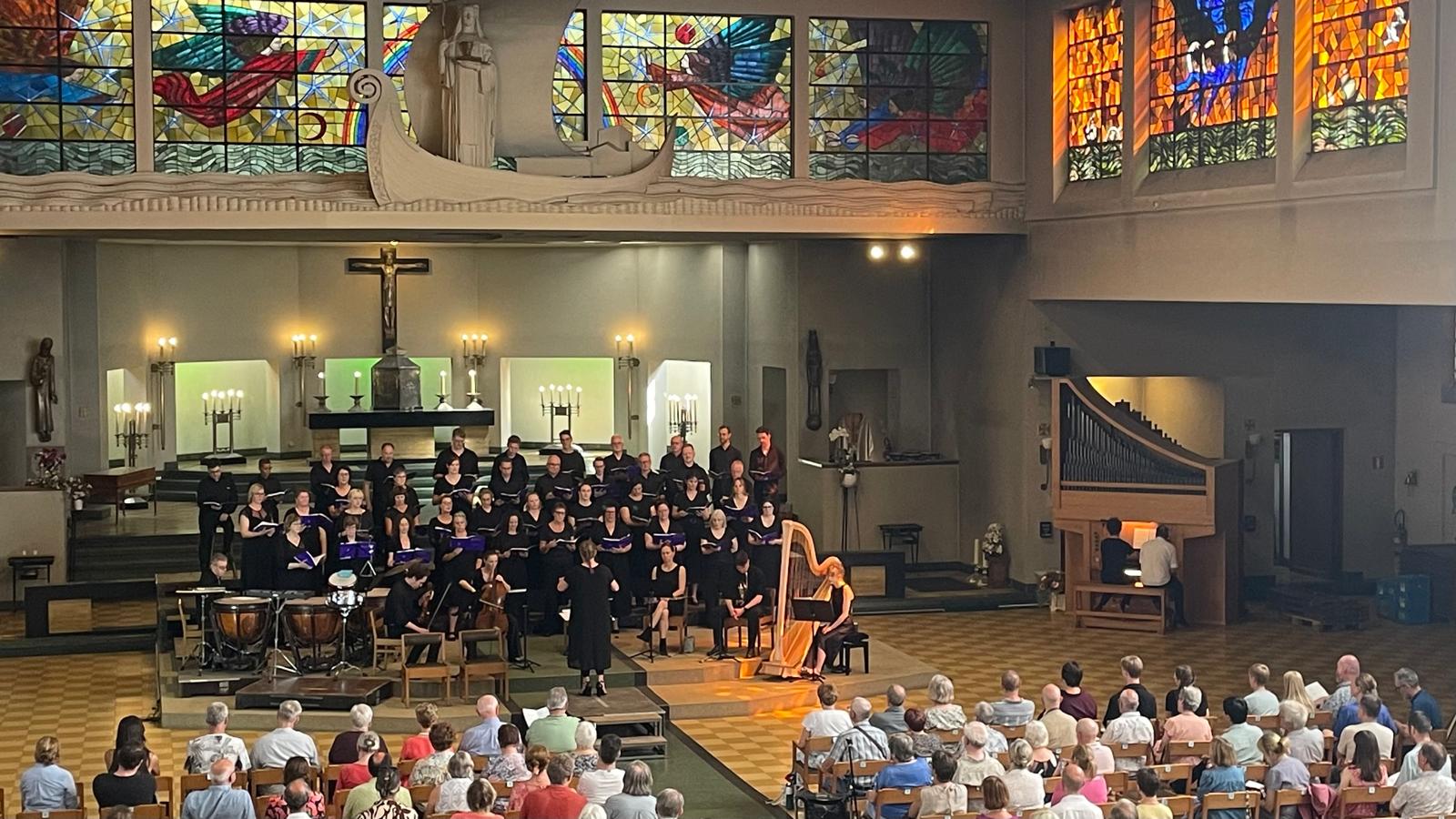
On a sultry June afternoon, Sint-Walburgiskerk in Antwerpen offered a welcome refuge from the oppressive heat. Inside, however, no light summer program was awaiting, but a concert featuring two deeply spiritual works: the Miserere by James MacMillan and the Requiem for the Living by Dan Forrest.
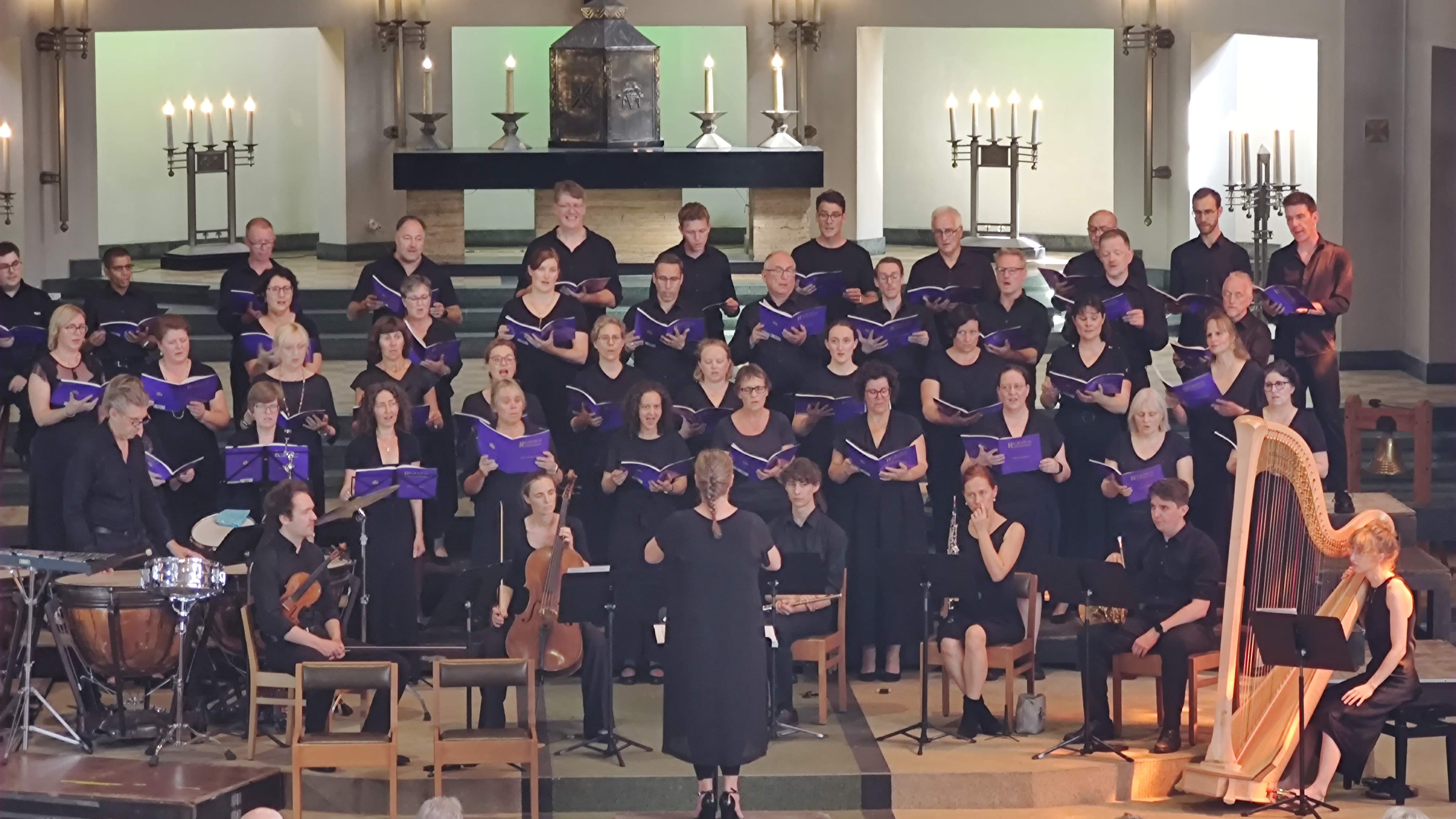
The performance was in the hands of Vox Grata and chamber choir Sistina, both conducted by Ann Janssens. Vox Grata was founded in 2022 as a project choir with the ambition to bring singers and conductor together in a professional framework. Chamber choir Sistina emerged in 2016 from the Kunstacademie van Beveren and initially built a repertoire around early music and baroque. Under the direction of Ann Janssens, that focus was broadened to include both historical and contemporary music.
MacMillan's Miserere opened the concert. The Scottish composer has long been one of the most important voices in contemporary religious music. His outspoken, even conservative Catholic conviction filters through his work, but setting aside personal convictions, one thing is beyond doubt: MacMillan knows how to bring a text to musical life.
The Miserere was performed with thoughtfulness and conviction. From the first measures, the tone was set by a firmly anchored bass line, after which soprano and alto voices subtly wove themselves into the soundscape. Ann Janssens kept the whole thing in a clear tactus throughout, without disturbing the natural breath of the music. What stood out was the combination of gentleness and strength: the choir sang with great control, but never became detached or clinical.
Those familiar with English recordings of this work will have noticed that a Flemish pronunciation of the Latin was chosen. This gave the performance its own character and color.
Particularly impressive was the closing section of the work. As MacMillan increasingly returns to Gregorian formulas and lets the final words shine through by solo voices, a fascinating tension emerges between old and new. The references to Gregorian chant worked here not as historical quotation, but as a natural deepening of the text. The result was a powerful and substantive opening to the concert.
After a brief intermission came Dan Forrest's Requiem for the Living. For this writer, this was a first encounter with the work, but immediately a particularly pleasant discovery.
Forrest departs from the traditional requiem texts but shifts the perspective radically. This is no requiem for the dead, but for the living: a prayer for comfort, rest and hope for those confronted with loss and suffering. This idea determines the entire structure of the work.
Musically, Forrest opts for a decidedly cinematic language. The opening section unfolded from a simple organ score that was gradually taken over by the strings, after which the whole thing blossomed into a broad soundscape. The comparison to a wide cinematic image imposes itself regularly.
What immediately struck the listener was the high quality of the ensemble. From the first note, the intonation was spot on and the sound remained remarkably pure. The choir effortlessly switched between intimate passages and full outbursts fully supported by an impressive percussion section.
One of the highlights of the concert was undoubtedly the second part, in which Forrest replaces the traditional Dies Irae with Vanitas Vanitatum. It is an intervention that perfectly aligns with his concept of a requiem for the living. The music constantly plays with contrasts: harp and organ build an almost playful soundscape, after which the choir suddenly bursts in with powerful exclamations of Vanitas Vanitatum. Here both the expressive possibilities of the choir and the qualities of the instrumental ensemble came fully into their own.
At such moments it also became clear how strongly Ann Janssens directs her performers. Her conducting style is clear, efficient and completely focused on the music. Without theatrical gestures, with minimal means, she manages to convey nuances and radiate confidence. It is a way of conducting that brings calm and lets attention go entirely to the score.
The soloists also made an impression. In the Agnus Dei, the very young soprano Lotte Heyrman provided a particularly moving moment. Her fresh, vulnerable voice gave the plea for peace an almost tangible innocence. The contrast with the mature and powerful soprano voice of Katrien Van Broeck worked excellently and gave this passage extra meaning.
The Sanctus then built from an almost bell-like sound toward a festive climax, while Forrest ingeniously played with the listener's expectations. The expected Hosanna was long in coming and thus had all the more impact.
The closing section, Lux Aeterna, added words from the gospel to the traditional Latin text: "Come to me, all you who labor and are heavy laden, and I will give you rest." Here tenor Michael Limpens made a great impression. His warm, sustained tone had something decidedly English about it – I found myself involuntarily thinking of Britten's recording of Peter Grimes – and gave the passage exactly the rest and comfort that the text demands.
 A factor that cannot possibly be left unmentioned is the acoustics of Sint-Walburgiskerk itself. It remains remarkable that this relatively hidden church, tucked away in the Antwerp urban fabric, enjoys so little recognition as a concert venue. Yet it possesses an acoustic quality that can easily withstand comparison with that of the great Gothic churches for which such music is often programmed. Moreover: while the listener in a cathedral is often at considerable distance from the performers, Sint-Walburgiskerk offers a much more direct listening experience. The sound has room to resonate, but at the same time retains a remarkable clarity and proximity. Especially in the hushed passages of both MacMillan and Forrest it became clear how much the space itself was part of the performance. The warm reverberation enriched the choir sound without obscuring details, while the listener remained close enough to the musicians to experience the smallest nuances. It made this music not just audible, but almost tangible. For this reason alone, this special pilgrimage church deserves a much more prominent place on the map of Antwerp's concert life.
After a final moment of stillness in organ and harp, the work ended almost imperceptibly. No grand apotheosis, no overwhelming final chord, but a soft exhalation that perfectly aligned with the spirit of the work.
The quality of the performance lingers, but so does the intelligence of Forrest's concept. The Requiem for the Living does not speak of death, but of life; not of farewell, but of the need for rest, comfort and reconciliation. It is music that today cannot be sung enough!
If a small reservation can be made, it concerns the programming rather than the performance. A short instrumental work between MacMillan's Miserere and Forrest's Requiem might have created some extra breathing space between the two large vocal compositions and at the same time given the instrumental ensemble more opportunities to profile itself.
That, however, does not diminish the overall impression: this was a concert of high caliber, performed by musicians who clearly know what they want to convey. After the performance, the audience lingered for quite some time, glass in hand and visibly impressed.
For those unfamiliar with Vox Grata, kamerkoor Sistina and conductor Ann Janssens, this afternoon was an excellent introduction. For those already following them, it was once again a confirmation of their musical qualities. And for Sint-Walburgiskerk itself, this concert was a convincing plea to serve more often as a venue for choral and ensemble music. The combination of performers, repertoire and space proved to be of a rare self-evidence.
- Sunday 21 June 2026
- Sint-Walburgiskerk Antwerpen
- Vox Grata, Kamerkoor Sistina, Ann Janssens
- www.voxgrata.be
- www.walburgis.be