
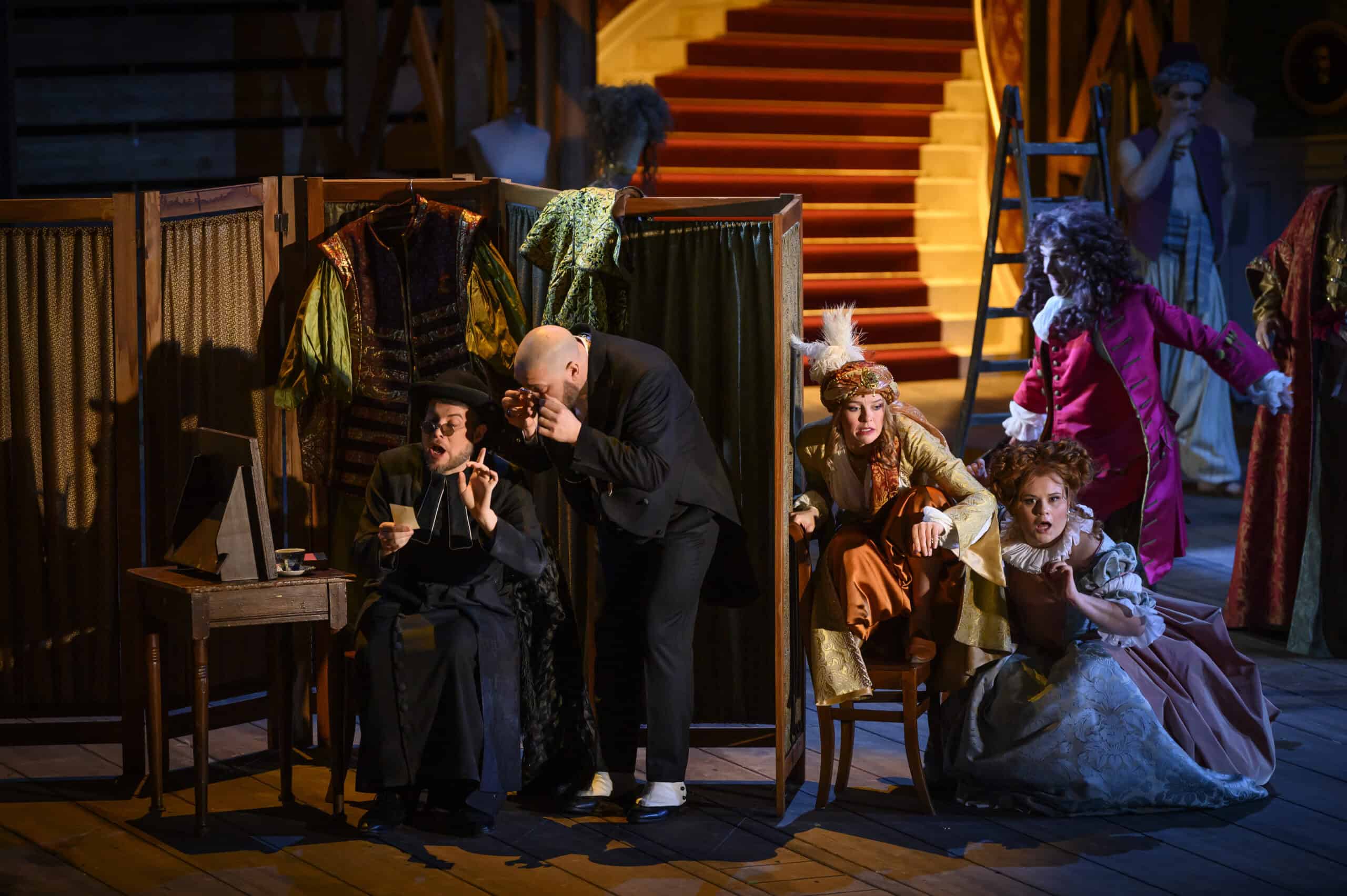
Adriana Lecouvreur is a "theater-opera" in which a singer plays the role of an actress. Adriana Lecouvreur was a great French comedienne who lived from 1692 to 1730. Her rival in the theater was La Duclos, mistress of the Prince of Bouillon. In the opera, Michonnet, the director of the Comédie Française, is in love with Adriana. But she loves Maurizio, the Count of Saxony, to whom she gives a small bouquet of violets as a pledge of love. The Princess of Bouillon, also in love with Maurizio, is her rival in love. In the operatic complications, it is barely prevented that the Prince discovers his wife's infatuation with Maurizio. When the countess must hide during a confrontation with Maurizio and her husband and is helped to escape, she loses a bracelet, which Michonnet gives to Adriana. When the bracelet later fatally betrays her, she plays the conscious actress and recites a monologue from Racine's Phèdre that alludes to the adulterous passion of the Princess. The opera ends tragically when Adriana receives on her birthday as one of the gifts the small bouquet she once gave to Maurizio. However, her rival has poisoned it, so that Adriana – in the presence of her beloved – dies.
The wings of the theater
Director Arnaud Bernard resolutely chooses to depict the entire story as "theater." The set is dominated by the backstage of a theater, with pieces of scenery, props, makeup table, costumes, stage rigging for scene changes. The opening image is a gripping "still": everyone is ready on stage to play their role. Suddenly they come to life and then there is a flurry of activity, with artists and extras nervously running back and forth in preparation for the performance. A large cardboard elephant and hopping, orientally dressed dancers provide a humorous touch. Next to the wings, a narrow space is left that provides a view of the stage, from where we hear Adriana in the first act applauded by the audience. Even for the scenes in the private chambers of the Princess of Bouillon and in the fourth act of Adriana Lecouvreur, the director maintains his theatrical illusion: the walls of the rooms are brought in as set pieces on stage and in the fourth act even placed with the stage rigging. The final scene is a beautiful apotheosis of theatrical tragedy: as the poison intoxicates Adriana to the point of death, she reaches out floating in her pure white dress toward the stage to die as a true tragedienne. A striking image that, as the director explains in the program booklet, can certainly be interpreted as a sincere homage to Adriana Lecouvreur, "a simple girl from the people who became a star thanks to the theater".
Io sono l'umile ancella
"I am the simple girl," is the first aria that Adriana Lecouvreur sings in the opera, at the same time the best-known from the opera and perhaps from Cilea's oeuvre. Elena Moşuc did not entirely convince. She sang with a fairly sharp tone and disturbing vibrato in the upper register. Perhaps partly troubled by nervousness, for as the performance progressed she sang more beautifully, although her interpretation still did not quite live up to expectations. Neither vocally nor as an actress. Especially in the fourth act, she lacked the passion to express her deep disappointment in Maurizio's alleged deception. Her death scene gives her one last chance in the beautiful final scene of this production to shine as a tragedienne.
Luciano Ganci as Maurizio was also not a top-tier casting. I can almost repeat here what I wrote about him in November last year in his performance in Verdi's Alzira at the Opéra Royal de Wallonie "Luciano Ganci's tenor voice emphasized power above all and could have had more nuance in the loving moments". In this opera, it was certainly even more disturbing that the singer sang mainly powerfully and too loudly, without nuance. The other voices were well cast. Anna Maria Chiuri was a stately and haughty Princess of Bouillon and had vocal control over her part. The Prince and the Abbé di Chazeuil were well cast, and especially Mario Cassi sang a highly motivated Michonnet who enjoyed his role as mediator.
© ORW Liège / J.Berger © ORW Liège / J.Berger © ORW Liège / J.Berger © ORW Liège / J.Berger © ORW Liège / J.Berger


As a contemporary of Puccini, Mascagni and Leoncavallo, Francesco Cilea (1866-1950) is conveniently usually classified among the verismo composers. The realistic content of his stories certainly fits in there, but – just like with Puccini and Mascagni – his style is sometimes intimate and refined. We would have liked to hear this aspect also better highlighted in the orchestra. Although Christopher Franklin does have some bel canto operas on his record, we would have expected the melodies in the strings especially to flow more smoothly and refinedly.
A rarely performed opera like Adriana Lecouvreur is in any case a pleasure to experience scenically, and the enthusiastic audience of the Opéra Royal de Wallonie certainly found it so.
WHAT: Francesco Cilea Adriana Lecouvreur
WHO: Direction: Arnaud Bernard
Conductor: Christopher Franklin
With: Elena Moşuc, Luciano Ganci, Anna Maria Chiuri, Mario Cassi, Mattia Denti, Pierre Derhet
Orchestra, Choirs and technicians Opéra Royal de Wallonie
WHEN: Sunday 16-4-2023 (additional performances on 18/20/22 April 2023)
WHERE: Liège, Opéra Royal de Wallonie