
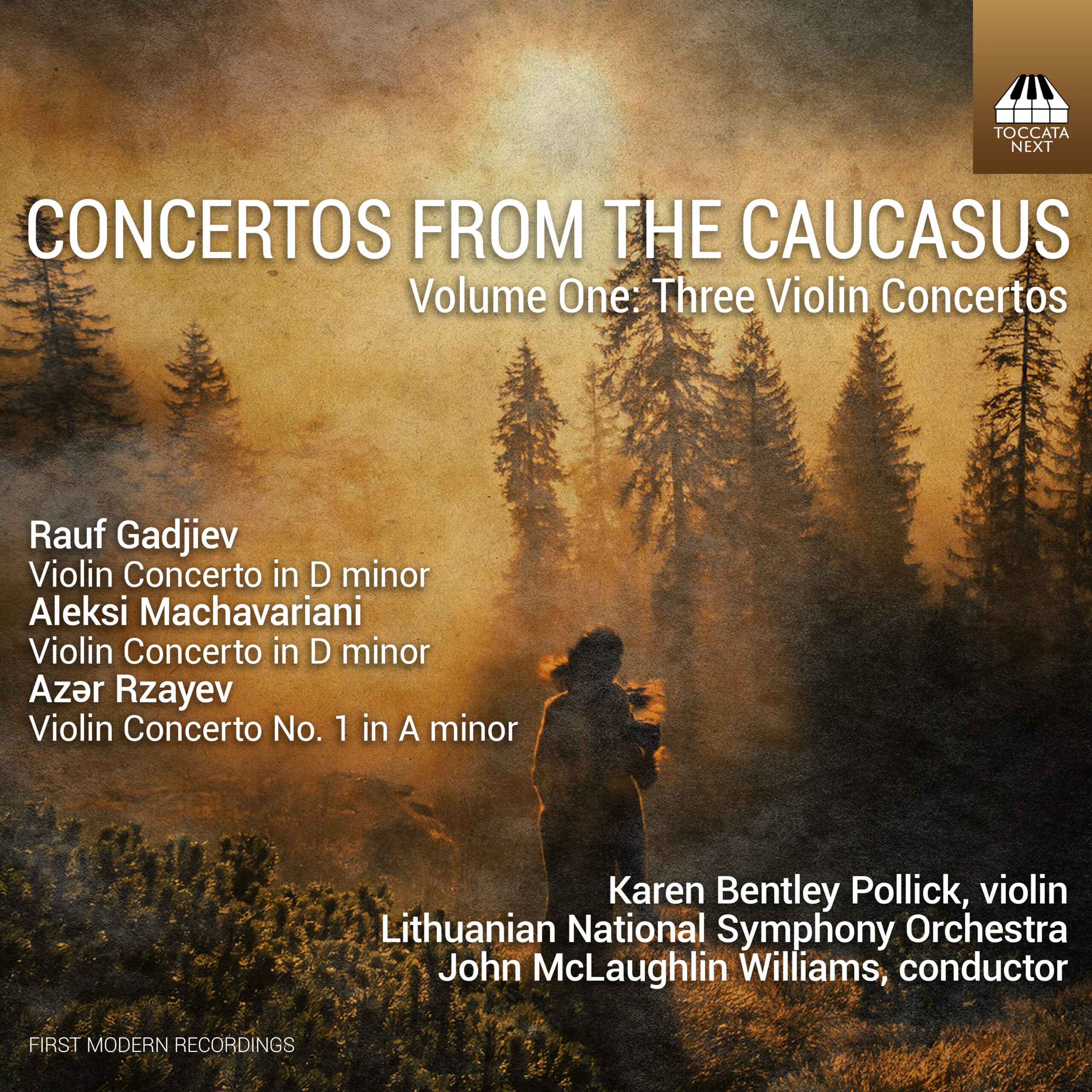
There are recordings that present unknown music as a curiosity from an archive, as a footnote from a history book that happens to be unearthed again. And there are recordings that make you realize that music history encompasses a much larger landscape than the names that have remained in it. Toccata Classics is among the labels that regularly make that forgotten landscape visible again. This first installment of a series devoted to concertos from the Caucasus is more than a collection of rare repertoire: it opens a window onto a musical world in which personal expression, national identity and the complex reality of the Soviet cultural system were constantly in dialogue with each other.
The three composers on this recording – the Georgian Aleksi Machavariani (1913–1995) and the Azerbaijanis Azər Rzayev (1930–2015) and Rauf Gadjiev (1922–1995) – enjoyed considerable recognition during their lifetimes, but largely disappeared from international concert life after the end of the Soviet period. This says less about the quality of their music than about the capricious mechanisms by which a musical canon emerges. Some names endure, others fade into the background, not because their music would be inferior, but because historical circumstances, political systems and programmatic choices determine what continues to be heard.
Anyone listening to these three violin concertos will immediately notice that they are rooted in the great Russian orchestral tradition. There are echoes of Khachaturian – himself from the Caucasian cultural world – but also of the lyrical breadth of Russian Romanticism and the rhythmic sharpness of Prokofiev. Yet these works are no imitations. Behind the familiar language, each time a distinct voice emerges: melodies that preserve the cadence of folk music, rhythms in which regional traditions remain palpable and orchestral colours that betray a very specific geographical background.
The discovery of this recording
All three concertos follow the classical three-movement structure – fast, slow, fast – but Aleksi Machavariani's violin concerto from 1949 undoubtedly stands out. It is not only the longest and most elaborate of the three works, it is also the concerto in which emotional power, lyricism and cultural distinctiveness most convincingly come together.
From the opening bars, it becomes clear why Karen Bentley Pollick is such a convincing advocate for this repertoire. She does not let the violin sound like a virtuoso instrument that places itself above the orchestra, but as a human voice telling a story. In the opening movement, she moves effortlessly between vulnerability and strength: her playing is lyrical and songful when the music opens up, but also acquires sharpness and determination when dramatic tension increases. Together with the orchestra, there is no struggle between soloist and accompaniment, but a true dialogue in which every musical thought gains meaning.
The Andante sostenuto subsequently forms the emotional heart of the concerto and is undoubtedly the revelation of this CD. Here Pollick shows her greatest quality: the ability to let a long melodic line breathe completely naturally. Her warm, rich tone carries the melancholy of the music, but avoids any form of sentimentality. The music thus acquires something of a quiet memory, a moment of reflection that slowly nestles under the skin. It is precisely in these passages that you understand why this concerto should appear much more often on concert programmes: the combination of melodic beauty and human expression is irresistible.
In the final movement, Pollick again demonstrates her versatility. She gives the rhythmic energy and folk music impulses full rein, without reducing the work to folkloric colour. In her hands, this movement too remains part of a larger musical narrative, in which tradition and personal expression reinforce each other.
Thanks to this interpretation, Machavariani does not appear as a historical curiosity from a forgotten Soviet past, but as a composer with a voice of his own. It is particularly the way Pollick makes that voice audible again that makes this concerto the true discovery of the recording.
Refinement and a different folk character
Azər Rzayev's First Violin Concerto from 1957 takes a very different path from Machavariani's work. Where the latter unfolds broadly and builds large emotional arcs, Rzayev is more compact, nervous and subtle. His music seeks less the grand gesture and more refined tensions: melodies seem continually in motion, as if they never quite come to rest.
Pollick knows exactly how to approach that character. She does not opt for exaggerated expression, but for a playing in which small colour variations and dynamic nuances carry the meaning. Her violin sounds here less like a narrator of grand gestures, but as an instrument that subtly creates tension and doubt. The sometimes unexpected orchestral outbursts thus gain extra effect: they do not arise as external contrasts, but as moments when the underlying tension suddenly comes to the surface.
This concerto also sounds culturally different from Machavariani's. Rzayev's Azerbaijani background has its own rhythmic and melodic sensibility, making the programme more than a simple collection of Soviet concertos. You hear different musical worlds side by side: not one uniform Caucasian style, but composers who each develop a personal voice from their own tradition.
It is music that overwhelms less immediately than Machavariani, but precisely through its subtlety it continues to captivate. Thanks to Pollick's refined interpretation, the concerto unfolds slowly and especially rewards the listener willing to listen beyond a first impression.
Rhythm, colour and stillness
Rauf Gadjiev's violin concerto from 1952 is of the three works on this recording most directly connected to the musical traditions of his country. Dance rhythms, pronounced accents and melodic turns reminiscent of the instrumental folk music of the region give the concerto a very distinctive colour and character.
But Gadjiev does more than simply process musical folklore. Behind the rhythmic liveliness and often energetic movement lies a surprising sensitivity. Especially in the slow movement, an atmosphere of stillness and melancholy emerges, in which the violin acquires a warm, almost human glow. It is music that does not so much overwhelm through grand dramatic gestures, but convinces through atmosphere and authenticity.
Pollick senses that balance excellently. She lets the rhythmic impulses speak with fluidity and vitality, but also takes time for the more subdued moments. Her warm tone gives the lyrical passages a special intensity, making the music more than a colourful reference to a regional tradition.
Gadjiev's concerto thus grows into a valuable conclusion of the triptych: a work in which folk music roots, personal expression and a sense of melodic beauty come together in a natural way.
Passionate performers
Karen Bentley Pollick is undoubtedly the great force behind this recording. Her greatest merit is that she treats these concertos not as historical documents, but as living music that deserves its place within the violin repertoire. Her playing unites technical mastery with warm, human expression, making both the lyrical power and the cultural distinctiveness of these works convincingly come to the fore.
What particularly stands out is her sense of character: she knows when the music should sing, when it should pull back, and when rhythmic energy may take the lead. This makes these three totally different concertos sound not like historical curiosities, but like works with their own personality and clear significance.
The Lithuanian National Symphony Orchestra under John McLaughlin Williams also delivers more than an accompanying role. Williams opts for a clear, transparent sound in which the violin is given all the space it needs, but never loses sight of the larger architecture of the works. His approach avoids a heavy monumental Soviet sound and instead lays bare the colors, rhythms, and melodic lines that make this music so interesting.
In a few fast, folk music-inspired passages, the orchestra could perhaps have shown a bit more sharpness and rhythmic glow, but that is merely a minor note on a performance that above all convinces through stylistic sensitivity, commitment, and a clear belief in this repertoire.
A valuable rediscovery
The recording quality excellently supports the musical approach. The sound is clear and spacious, with a natural balance between soloist and orchestra. The violin is sufficiently forward to hear the expressive details, but always remains part of the larger whole. The extensive CD booklet, with attention to the lives, context, and oeuvre of the three composers, also fully meets the reputation of Toccata Classics as a discoverer of forgotten repertoire.
Concertos from the Caucasus does not restore a dry footnote from music history, but brings a lost chapter back to life. This music did not disappear because it had no value, but because history sometimes listens more selectively than the music itself deserves.
Anyone who loves violin concertos in which virtuosity, lyricism, and cultural identity come together should not miss this first installment of the series. This recording above all proves that the musical map of the twentieth century still contains many blank spaces. Thanks to performers like Karen Bentley Pollick, those forgotten landscapes are gaining color again. The continuation of this series can be awaited with interest, for the Caucasus proves to harbor a much richer musical landscape than the canon usually suggests.