
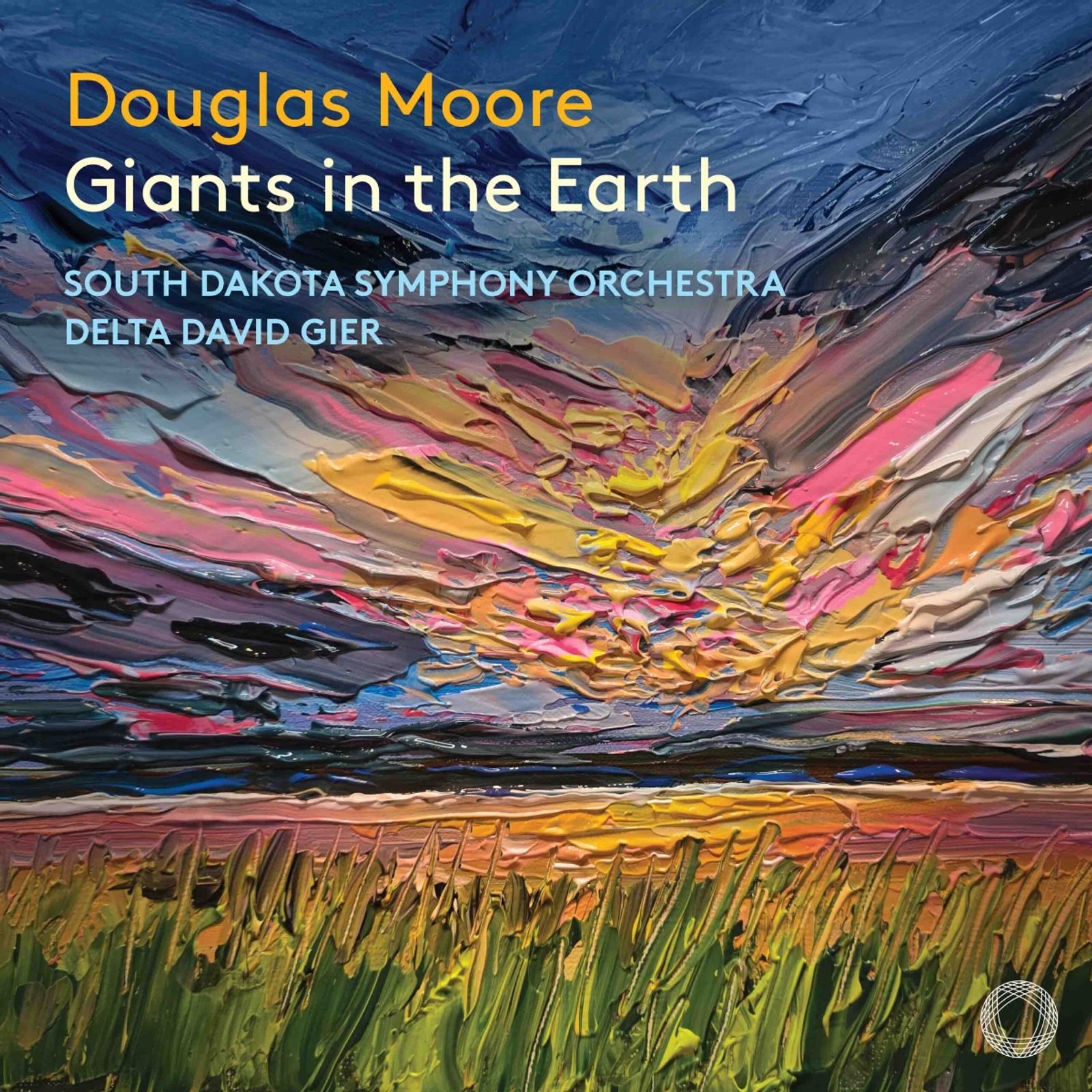
There are operas that you only learn to know when someone takes the trouble to dust them off, and Giants in the Earth by Douglas Moore (1893-1969) is a textbook example of this. Awarded the Pulitzer Prize in 1951, the opera subsequently disappeared from view for decades: no commercial recording available, hardly any performances and at most a vague memory for those who experienced it live. That it now, seventy-five years after that award, finally receives its first commercial recording – and moreover thanks to an orchestra from Sioux Falls, South Dakota, precisely the region where the story takes place – feels almost like poetic justice.
The atmospheric prelude sets the tone immediately. Before a single character has sung a word, Moore captures the vastness of the prairie, the hope of the pioneers and at the same time the underlying threat of an existence that is continually tested by relentless nature. It is music that enters immediately and arouses curiosity about what follows.
The story is known to those familiar with the novel by Ole Rølvaag (1876-1931). Norwegian colonists risk the crossing to the bare plains of Dakota, seeking a new life. But while Per Hansa sees the expanse as a promise, his wife Beret experiences the same landscape as a source of fear and alienation. That fundamental difference in outlook carries the entire opera. Moore does not write a series of great arias that stand apart from the drama, but an almost through-composed whole in which short lyrical passages, declamatory lines and orchestral transitions merge seamlessly. The music follows the natural cadence of the language, so that the characters never seem to posture but truly speak. In this performance this is further reinforced by exemplary diction: the English text remains almost continuously intelligible, making the libretto hardly necessary to follow the drama.
It is remarkable how accessible the musical language sounds. Although Moore later revised the opera, there is nothing here of the intransigence that characterizes many operas from the fifties and sixties. Moore does not seek modernistic provocation, but instead chooses a lyrical, immediately compelling style that stands close to the American tradition of Barber and Menotti. Precisely because of this, the question arises why this work has been absent from the repertoire for so long. The music lies pleasantly on the ear, but at the same time possesses sufficient dramatic tension to hold attention unbroken.
What strikes most is how Moore gives different emotions their own musical color each time. The community is given warmth and connectedness, the humor of everyday pioneer life sounds genuine and disarming, while Beret's doubts increasingly begin to seep through the score. The first act immediately convinces through its natural alternation of lyrical moments and carefully built-up dramatic tensions. Moore manages to make both the domestic warmth of the colonist community and Beret's simmering anxiety tangible, without ever resorting to sentimental effect-seeking. The confrontations between Beret and Per immediately rank among the emotional highlights of the opera. Without grand theatrical gestures, Moore makes the growing estrangement between the two characters palpable, carried by an orchestra that subtly reinforces their inner tensions.
The second act brings more variety in atmosphere. There is room for light moments, for coffee, gifts and stories about new loves, but beneath that apparent lightness the conflict between Per and Beret inevitably continues to grow. It is precisely this interplay between warmth and threat that makes this act so strong: Moore grants his characters moments of joy and connectedness, but continually lets us feel that uncertainty and tension remain beneath that surface. When Per increasingly claims more land and Beret accuses him of crossing moral boundaries, one of the strongest dramatic confrontations of the opera emerges. It is remarkable how Moore allows them to sing almost alongside each other without truly reaching one another. Precisely this makes their relationship breakdown so comprehensible and painfully direct. The subsequent violent quarrel and Beret's bitter realization that they live "like animals" form an impressive build-up to the tragedy of the third act.
There the opera reaches its greatest dramatic power. It begins almost innocuously with the wedding of Henry and Dagmar, followed by the preparations for the baptism of Per and Beret's son Peder Victorious. The choir sings here with a touching homogeneity that underscores the close-knit community. But precisely at that moment the drama pivots. Beret refuses to have her son baptized and poses, in an intensely felt scene, the poignant question: "How can we be saved?". From that moment on, the story takes on the character of a modern biblical narrative. Drought ravages the land, a devastating plague of locusts destroys the harvest and sickness strikes. Beret experiences this succession of disasters as God's punishment for the unbaptized child, a conviction that Moore increasingly gives musical form to. Her inner conflict ranks among the strongest passages of the opera: nowhere does the composer seek cheap effect, but he lets despair grow from a deep religious awareness. The chaotic struggle against the locusts is among the most vivid music of the score and forms the turning point after which the tragedy becomes inevitable.
When Peder Victorious becomes life-threateningly ill, that tragedy reaches its human climax. Against all reason, Beret wants to fetch a priest herself instead of a doctor. Per tries to prevent her and sings in a touching declaration of love everything that ever brought them together. Ultimately it is he who yields to her despair and himself braves the storm to fetch the priest, while Beret completely breaks down spiritually. Without ever imitating Puccini or Strauss, Moore possesses here the same gift for building an inevitable tragedy musically irresistibly. The unresolved final chord leaves no comfort, only the icy silence after everything has transpired.
What makes this world premiere recording so convincing is that nowhere does the feeling arise of listening to a historical reconstruction. Delta David Gier conducts with audible love for the score and gives no moment the impression that this work has been absent from the stage for so long. On the contrary, the South Dakota Symphony Orchestra plays with a naturalness as if this opera has been part of its regular repertoire for generations. From the atmospheric prelude to the dramatic finale, nowhere is there hesitation or academic distance, but only the conviction of musicians who completely believe in this score. Perhaps the orchestra sometimes lacks the very last bit of refinement that the greatest American top orchestras possess, but that small caveat pales completely in the face of the enormous commitment, involvement and musical conviction with which music-making is conducted here.
The cast is uniformly well-assembled. Meredith Lustig gives Beret precisely the fragility and inner turmoil the character requires. Her interpretation remains consistently human and believable, without lapsing into exaggerated pathos. Michael J. Hawk sets against this a warm-sounding, idealistic Per Hansa, whose optimism becomes increasingly tragic as the opera progresses. Andrew Gilstrap makes an impression as Hans Olsa, while Sarah Nordin and the other soloists form an exceptionally balanced ensemble. There is no pronounced star or diva who draws all attention to herself; precisely because everyone puts themselves entirely at the service of the drama, this performance gains in power.
Because this is a live recording, the applause between acts is also preserved. This is hardly disturbing; on the contrary, it reinforces the feeling that you are witnessing a special event and underscores how enthusiastically the audience has received this rediscovery.
Pentatone deserves all praise finally for the recording quality. The warm, spacious sound allows both the orchestral details and the voices to come fully into their own while preserving the natural atmosphere of the performance. For a live recording, the technical execution is exemplary.
Giants in the Earth will perhaps not rewrite opera history. For that, it lacks the revolutionary ambitions of a Wozzeck or Peter Grimes. But Douglas Moore did write an opera that holds the listener's attention for two hours, in which human emotions are drawn with great conviction and in which the immigrants' quest for a new existence proves remarkably timeless. That this opera received the Pulitzer Prize in 1951 seems far from surprising after this performance. The South Dakota Symphony Orchestra and Pentatone prove with this exemplary world premiere recording that some forgotten works are not only historically interesting, but can still touch an audience today. Those who love honest, human-centered opera without embellishment will discover here not only a forgotten work, but a convincing opera that can finally be heard again.