
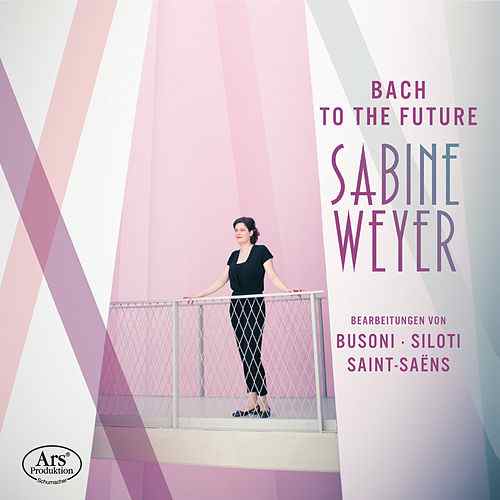
** Bach continues to inspire many! Including Sabine Weyer, who released "Bach to the Future" on ARS Produktion: 11 piano transcriptions of well-known Bach works, arranged by the Italian Ferruccio Busoni, the Russian Alexander Siloti and the Frenchman Camille Saint-Saëns.
If this cd proves one thing conclusively, it is the timelessness of the genius Johann Sebastian Bach. And perhaps herein lies the crux of the performance: Weyer's interpretation lacks originality. Impeccable recording technique, certainly, but we've heard it elsewhere too ... and better.
The cd is built around the French Suite No. 2 (BWV 813), originally written for harpsichord, but performed here on piano (nos. 5 to 10). Weyer begins with the transcription of 4 cantatas: Ich rufe zu dir, Herr Jesu Christ (BWV 639), Wachet auf, ruft uns die Stimme (BWV 645), Nun komm, der Heiden Heiland (BWV 659) and Jesu Christus, unser Heiland (BWV 665). All cantatas are arranged by Busoni (nos. 1 to 4) and performed instrumentally. After the suite, it is Siloti's turn (nos. 11 to 14) with piano reductions of the Siciliano from the Sonata for flute and harpsichord (BWV 1031), Prelude in B minor, from the "Clavier Büchlein" (original spelling) for Wilhelm Friedemann Bach (BWV 855a), the Andante from Sonata No. 5 for solo violin (BWV 1003) and the Air from the Orchestral Suite (Ouverture) No. 3 (BWV 1068). Finally, two arrangements are performed by the Frenchman Saint-Saëns with the Bourrée from Partita No. 1 (BWV 1002) and the Largo from Sonata No. 3 (BWV 1005).
The chosen works are all well-known Bach pieces and sound as if burned into the ears. The many available recordings make it extra difficult for the soloist to come up with something original. In terms of recording technique, there is little to fault on this cd. In terms of playing technique, much more. Weyer masters the instrument but, in my opinion, not the music. Disturbing tempo loss, for example in the sarabande of the French suite, is but one consequence of this. Rhythmic uncertainty is another. As far as interpretation is concerned, the soloist still has considerable room for growth. The entire cd suffers from a tempo that is too slow. Even in the sections where more dynamism and liveliness might be expected. The overly slow tempo causes her to flirt more than once with rhythmic inaccuracies. It seems very much that the soloist has listened very carefully to Glenn Gould, in his overplayed Goldberg Variations (Bach), but falls short in imitating him.
Moreover, the frequent arpeggios are played too heavily—and equally due to the sometimes overly slow tempi—depriving the music of the necessary lightness of touch (or call it "swing" if you will). The listener gets the impression that the left hand sometimes struggles to keep up with the right, which equally prevents a carefree musical sensation. The already frequently used cd title "Bach to the Future" (a reference to Robert Zemeckis' SF classic) promises brand new interpretations of timeless work, but gets bogged down too much in "old school" ingenuity that gifted pianists in the past executed considerably better. Brahms' quip also holds true here: music only begins one meter away from the score ... here you remain sitting on top of it. The soloist is far from finished with this seemingly simple but devilishly difficult music. A decent Saint-Saëns on the whole cannot, unfortunately, change anything about that.
- What: Bach to the Future, arrangements of Bach by Busoni, Siloti and Saint-Saëns
- Who: Sabine Weyer
- Release: Ars Produktion, ARS no. 38 245