
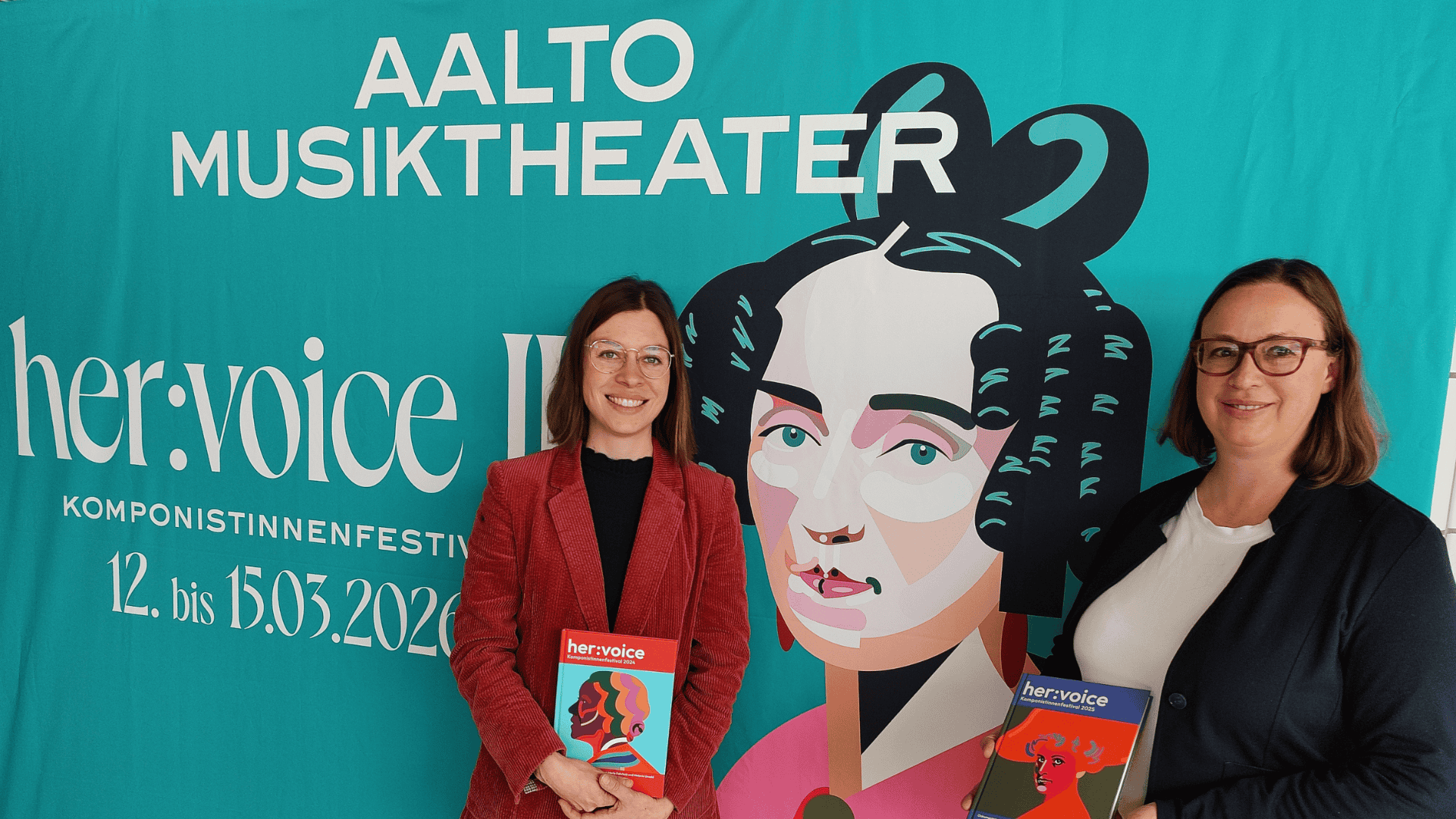
The Aalto Musiktheater and the Philharmonie in the German city of Essen will be the meeting place for music by female composers from March 12 to 15. The third edition of this Komponistinnenfestival features German Maria Herz, Irish Ina Boyle and Swedish Elfrida Andrée as absolutely essential discoveries (or rediscoveries). Lectures are also part of the promising programme.
The Komponistinnenfestival her:voice continues a tradition of placing forgotten repertoire, historical pioneers and contemporary voices side by side. With only music by women on the programme, the festival aims, according to intendant Merle Fahrholz, to 'open new perspectives'. 'Not because the music would necessarily be different from that of men. Nor because it would supposedly be better or because those works should necessarily be included in a new canon,' she writes in the foreword of the festival brochure, 'but because of their origins. These reflect eventful lives, massive resistance and courageous self-affirmation, which touch other levels than those of their male colleagues.'
Fled from the Nazis
Take for example Maria Herz (1878-1950), born in Cologne into a Jewish textile family. Between the two world wars, she experienced her most creative period while also having to care for her four growing children after her husband's death. In 1926, as a composer, she managed to achieve a breakthrough by placing the first name of her deceased husband, Albert, before her own name. However, after fleeing the Nazis in 1935, 'Albert Maria Herz' was completely forgotten.
It was only after her artistic legacy ended up in the Zentralbibliothek in Zurich in 2015 and female students began to study it that Herz could gradually be rediscovered. Thanks to German cellist Raphaela Gromes, who in 2023 also released the acclaimed cd Femmes featuring works by 24 composers, Herz's cello concerto is being performed again today. During the festival, Gromes will be accompanied by the Essen Philharmonie. In the always interesting supplementary programme of lectures and Gesprächskonzerte, the cellist will also explore the life and work of Maria Herz more deeply together with the students.
Courageous
Furthermore, on the programme of this Sinfoniekonzert conducted by Italian-Turkish conductor Nil Venditti is the second symphony by French composer Louise Farrenc (1804-1875) and the rhapsody The Magic Harp by Irish Ina Boyle (1889-1967). A passage about the latter is known from a letter by Ralph Vaughan Williams: 'I think it very courageous of you to persevere with so little recognition. All one can say is that it will eventually come.' I quote this as one of the mottos in my book Woman at the Piano, but as far as I could ascertain, she remains a composer who is rarely or never heard. I'm curious to see if this festival can be a turning point for Ina Boyle.
Socially Committed
Another composer I discuss in Woman at the Piano but whose work I have never heard live is Swedish Elfrida Andrée (1841-1929). This student of Niels Gade was Sweden's first female organist and telegraph operator – she proved to be interested in 'male professions' from an early age. Festival intendant Merle Fahrholz points to the social commitment of both the composer and her librettist, Nobel Prize winner Selma Lagerlöf. In Fritjof-Saga, Andrée's only opera, an Old Norse saga is told from the perspective of the women who remain behind when their men go to war.
The artistic team around Kazakhstan-born director Anika Rutkofsky, winner of the prestigious Ring Award, is turning this archaic Viking story with its unusual, feminine narrative style into a surprisingly modern production, according to the festival organizers.
World Premiere
Andrée and Lagerlöf submitted the work in 1894 for a competition on the occasion of the opening of the new royal opera house in Stockholm, but it was never performed. More than 130 years later, Fritjof-Saga finally receives a full-scale stage Uraufführung in Essen – once again a striking example of how the festival manages to unearth forgotten repertoire with each edition.
At the first edition, the opera Fausto (1825) by French composer Louise Bertin (1805-1877) – the first to make an opera from Goethe's masterpiece – was an absolute discovery. And last year at the second edition, we were introduced to the symphony La grande guerre by Charlotte Sohy (1887-1955) – or Charles Sohy as the male pseudonym read that this Parisian woman adopted in hopes of recognition. Sohy began La grande guerre in 1914, but the work remained unperformed for more than a century, forgotten somewhere in a drawer.
It is noteworthy that the theme of war returns at each edition of the festival. Or how such forgotten works remain topical in any case…
Symposium
As mentioned, the Komponistinnenfestival her:voice is not limited to concerts. The festival combines music with reflection through an extensive symposium on themes such as pioneering, gender in opera and the visibility of female composers in music history.
The power of her:voice is that it does not want to be a niche event. The festival shows how rich and diverse the repertoire of female composers is, and how self-evident it should actually be that this music is part of the standard repertoire. Some concerts, such as the Fritjof-Saga, are also programmed outside the festival.
• Komponistinnenfestival her:voice III from 12 to 15 March in Essen (Dl.). Consult here the complete programme of concerts and lectures.
• This article also appeared on the blog Notities van een vrouw aan de piano.