
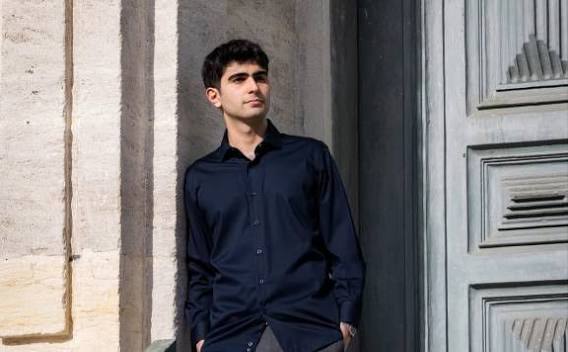
Following the performance of the National Youth Orchestra of Turkey at Young Euro Classic, I had an unexpectedly candid conversation with composer Emre Şener. About injuries, new challenges, a composer who must remain secret and a title he himself can't really explain.
"Oh my God, this is immediately the hardest question to start with." That's the first thing Emre Şener (25) says when I ask him how he would describe himself as a musician. No rehearsed answer, no slick PR phrase – just a young man thinking out loud, and he continues doing that throughout the rest of the conversation. His answer gradually transforms into a small biography of a musician constantly seeking new paths.
From guitar to conducting baton to dancefloor
Şener began as a guitarist in Istanbul, devoted to jazz, blues and a touch of rock-'n-roll. Then came an injury that turned everything upside down. He had to stop playing for a year and spent another seven years away from the guitar. In the meantime, he founded a choir and began composing for them – and for a while he was convinced: this is what I want to be, a composer.
He received a solid education and worked with great names, including maestro Cem Mansur and the orchestra with which he will take the stage again tonight. But the closer he got to that world, the clearer it became to him that composing alone was not enough. "I wanted to contribute," he says, "more than just writing music on paper." So he started playing again, ventured into the studio for electronic music and is now experimenting beyond the boundaries of classical music, with influences from electronic, dance and club music. "I want to be an all-round musician," he says, "someone who has more to say than just writing for a very specific audience."
It's telling that he doesn't describe himself from one specialty. For Şener, being a musician seems to mean constantly exploring new possibilities: playing, conducting, composing, making electronic music and listening to what's happening outside familiar boundaries.
Dreamers, drive and imperfection
Ask him about his musical heroes and Şener becomes almost mystical. He feels particularly drawn to music that lets him dream. In some pieces, he tells, he experiences something like both a consciousness and an unconsciousness. They're not perfect works, and therein lies their appeal: they're human, idiosyncratic, they wander and take you to places you didn't expect.
Schubert, Chopin, Mahler and Scriabin are for him all dreamers: composers in whom he hears precisely idiosyncrasy and beautiful imperfection. "I love finding that humanity in them," he says, "that individuality and in a way also that imperfection, but then an incredibly expressive imperfection." And he seeks that quality not only in classical music. It's something he also tries to find in other genres – though it's hard to put into words. "It's more a feeling than something you can really explain," he says, "but maybe I can in a few years."
Perhaps that inability to define it precisely is more important than the answer itself. Şener seems to be searching for music that has something to say that he rationally can't fully explain. That also becomes the key to the piece on the music stands tonight.
The title that came before the music
Then tonight's piece: Je ne sais quoi. And here the story becomes really special. When Cem Mansur asked him a few months ago to write a piece, panic struck immediately. Şener himself grew up with Mansur's concerts with this orchestra: this orchestra means a lot to him and to Turkey. That responsibility weighed heavily. A week later Mansur called again. Not for the music, but for the title. A name was needed for the program notes and the website, while not a single note had been put on paper yet.
Şener remembered an expression a friend had once told him: je ne sais quoi. The unexplainable feeling that draws you somewhere without being able to say exactly why. Something attracts you and you can't turn away from it, even though you don't know exactly what attracts you to it: "I immediately knew: I need to write a piece about this." And in his opinion it fit perfectly with a youth orchestra. Following such an instinct, rather than a feeling you can rationally understand, is precisely what can make a young person so passionate and determined.
The result is seven minutes of music, one of the shortest pieces Şener has written lately. What preceded it was anything but calm. "I was writing like crazy, day after day," he tells. In total he composed about forty minutes of material – almost six times as much as what ultimately remained. Whenever he recognized that elusive je ne sais quoi feeling in what he wrote, he set the fragment aside and started over. Then he found such a moment somewhere else, put that next to the previous one and continued.
So ultimately a kind of collage of musical ideas emerged, which he himself can't fully explain why they appeal to him. The composition process thus seems to have become an almost practical translation of the title: not first understanding and then writing, but first feeling and only then trying to understand. "It's like running down a slope," he says, "you have to react before you can understand what's happening." The result, he thinks, is full of surprises and constantly moves forward.
A bit of a mad wizard
Tonight's concert theme is magic, and Şener has an immediate opinion on that: "Without magic there is no music. That simple." Music is for him one of the glues that hold society together, regardless of genre – and it owes that to something universal that we can simply feel.
According to him, the other pieces in the program deal with magic in a more programmatic way. His own composition does not. Yet magic and je ne sais quoi are close to each other for him: in every music each of us searches for a different form of magic, and what is magical for one person doesn't have to be for another.
He describes his own role during composition with a delightful image: "With this piece I'm trying to be a bit of a mad wizard." One instrument here, another there, a spell over it, another instrument added. He felt as if he had opened one of the books from Harry Potter and started making a magic potion by simply throwing all sorts of things into it. John Williams isn't in there, he reveals with a laugh. But another composer is. Who, he won't say. That's for the audience to discover tonight.
What was that then?
On the last question – what he hopes people will take with them after hearing his music – he falls silent for a moment. "This is immediately the hardest question you can ask a composer," he says, "but they are the best questions."
Before Şener writes a single note, he first hears a feeling. He imagines what a chord should evoke even before he's actually heard it. Then he looks for the notes that fit that feeling. And if a note does evoke a different feeling than he had in mind, he changes it again. So he works not only on individual chords, but ultimately on the feeling of an entire piece.
For Je ne sais quoi he doesn't want to prescribe what the audience should feel – he can only tell what he himself hopes to experience when he leaves the hall after: "What on earth was that? What actually happened in those seven minutes?" And then he wants to go home, think about it for a bit and think: "I think I want to hear that again."
A lovely answer, we both thought – and perhaps exactly the kind of je ne sais quoi that the whole conversation was about.