
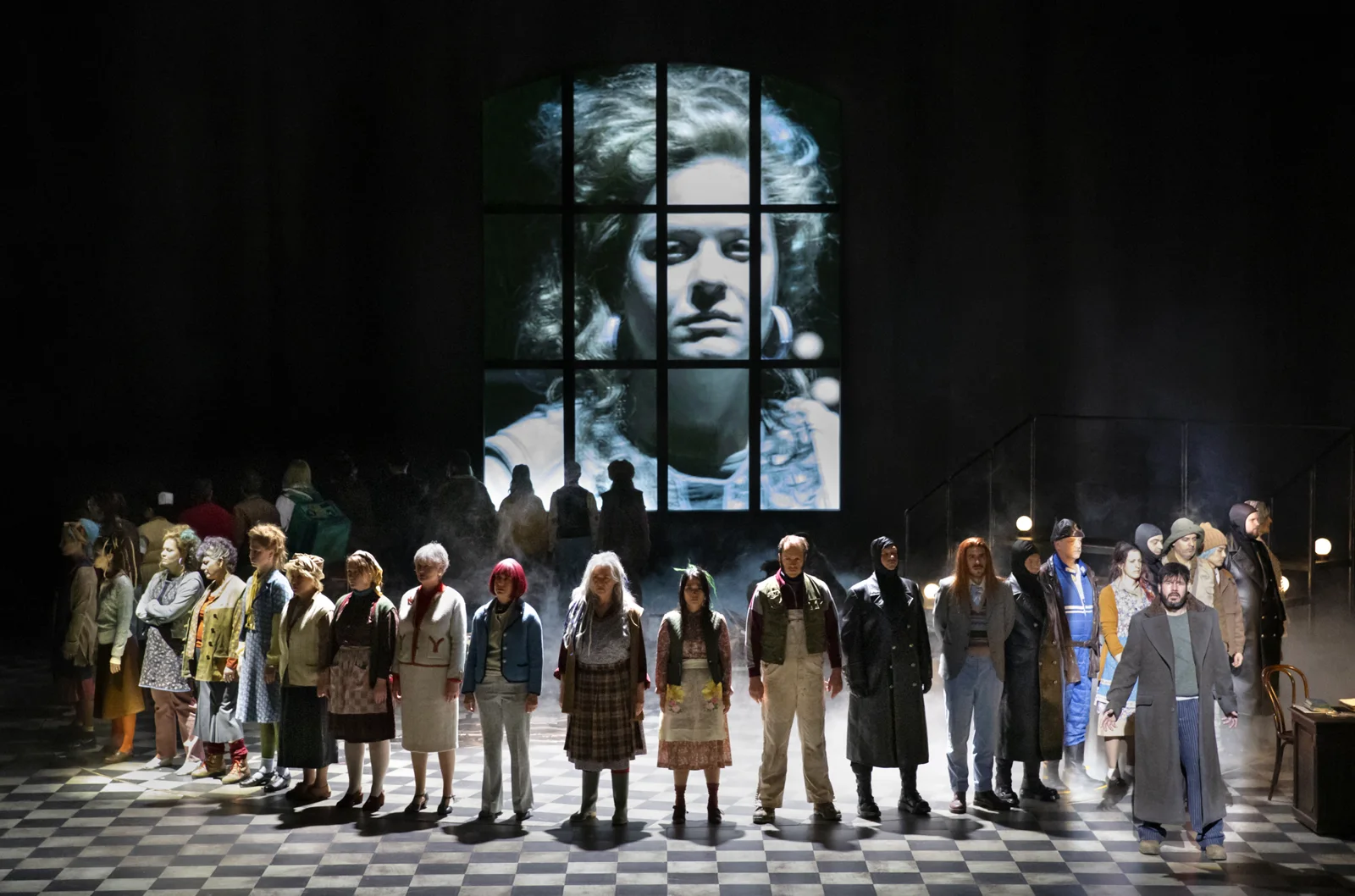
After the psychological dissection of Brodeck, it is time to move on to the essence: the music. A world premiere insinuates that a story gets its own unique sound world. It is here where the question lies whether Opera Ballet Vlaanderen (OBV) and Daan Janssens have been successful in bringing Philippe Claudel's world to life.
Cinematographic Leitmotif
Daan Janssens already indicated that, during the composition, he sensed that this was going to be one influenced by Wagner.* The use of leitmotifs is therefore prominently present. Listening to it, you also hear, as the story progresses, these musical signals becoming increasingly prominent. Emélia's ethereal broken sounds, Brodeck's springing melody, the descending glissando in the celesta as a motif for the Anderer/the stranger – these are introduced and intermingled with each other. Being able to hear the unspoken is pure Wagner.
To stay with Janssens' Brodeck: leitmotifs play the leading role here. Underneath lies an uninterrupted field of tension in the orchestra. It was striking how the composition hardly knew any rest points. There are only two caesuras that have remained prominent in my memory, both towards the end. One falls after the execution of a Frëmder, with spoken words by officer Buller: "Je vous souhaite le bonsoir." These banal words, combined with death and silence, sounded downright macabre. The other? The Anderer who screams "murderers" at the villagers.
It is not only silence and leitmotifs that Janssens makes use of. The power of the composition also seemed to lie in the sparing, yet correct, application of persiflage and musical expectation patterns. It sounds like a thriller (film), where you constantly hear the same repeated waves of tension – the cutting beep tone, the sustained strings, the unearthly celesta and harp (two instruments beloved in the supernatural and horror genres). The fear of the strange and death – the unbroken tension – that dominates the story returns in the musical composition.
The framework certainly meets all expectations, but what about the details?
Less is more
When you listen to an opera in which the expected stylistic figures are used sparingly, you realize as a listener how this actually hits harder. An example of this is Emélia's hysteria leap, after the betrayal of Brodeck. A high leap of a soprano, as an expression of passion or fear, is an operatic stylistic figure. If this then appears only once – in a vocal composition that is otherwise mostly low and flowing – then it speaks all the louder.The use of a known waltz motif, broken and parodied, gave the same effect. The dislocation of the sound linked itself to Emélia's motif – why she floated through the story like a broken bird – and how the estranged tonality also said something about the village. A waltz is already a kind of moment in time, and with the requisite chromaticism and exaggeration it can sound downright menacing.
The combination of spareness, unbroken musical tension and leitmotifs creates a (successful) lack of rest.
Sung cinema
The objective of creating cinematographic tension has been successfully composed and performed. The choice to make the only "threat" – the Anderer – a spoken role provided the intended contrast. The performance is an ensemble, so those were the moments that spoke most powerfully. The ghost choirs – floating choral passages, with or without a church motif – provided the necessary sound tableaux. It was pleasant that for once – instead of looking at the singers individually – everything felt as a whole. If that was the intention, then certainly bravo, Janssens.
Still worth discussing Brodeck separately. Damien Pass did not have the easiest task – trying to stand out in a strong ensemble composition. He certainly succeeded in this, along with his clear voice. Elisa Soster, employed sparingly enough to maintain the dislocated tension, was also the right choice for a fragmented, unearthly (war) soul like Emélia. The cast was certainly strong, especially as a whole.
With this exposition I could only touch on half of what Brodeck ultimately is (as a composition). This is a compliment to the power of Daan Janssens and the OBV production. If I fall without words, that is certainly a sign of success. With that: bravo!
* Paraphrased from Daan Janssens, Brodeck Press Conference - OBV, 09/02/2024.
---
WHAT: Brodeck by Daan Janssens (2023).
WHO: Daan Janssens (composer and librettist), Marit Strindlund (conductor), Fabrice Murgia (director and librettist), Philippe Claudel (author), Susan De Ceuster/Gay Huygen (child actor), Jose De Pauw (actor), Jean-Pierre Baudson (voice actor), Damien Pass, Elisa Soster, Helena Rasker, Thomas Blondelle, Kris Belligh, Werner van Mechelen, Tijl Faveyts, Symfonisch Orkest Opera Ballet Vlaanderen, Koor Opera Ballet Vlaanderen, Kinderkoor Opera Ballet Vlaanderen.
WHERE: Opera Ballet Vlaanderen, Antwerpen.
WHEN: 9 February 2024 through 20 February 2024 (OBV Antwerpen) and 29 February 2024 through 3 March 2024 (OBV Gent); seen on 9 February 2024.