
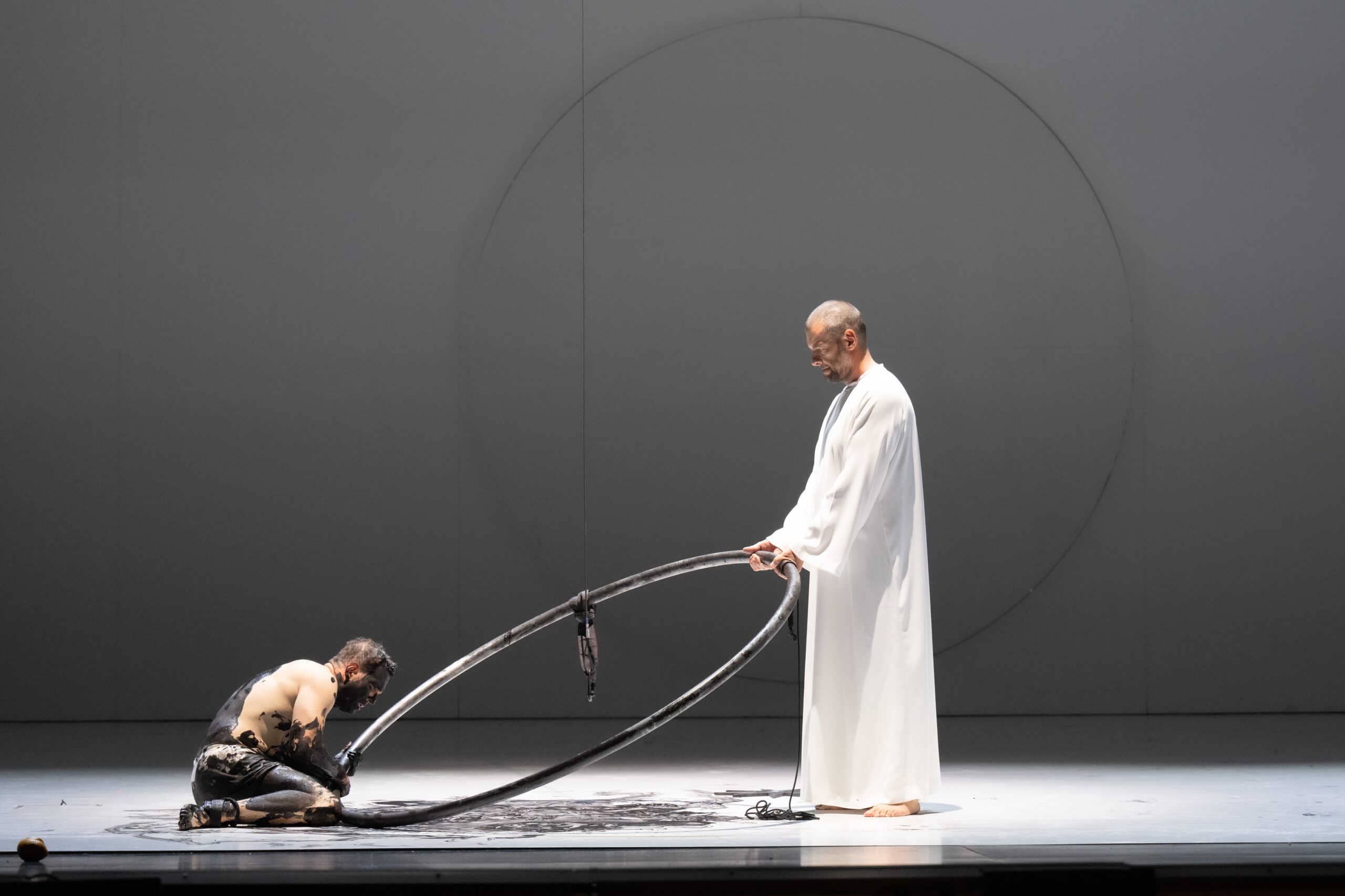
Romeo Castellucci played with abstraction and a subtle hint of surrealism during the production at De Munt. The latter was not intentional, but the physical bodies struggling to bear the weight of the divine reminded me of Jean Cocteau's La Belle et La Bête (1946). Instead of mysterious arms and faces that seem to move in service of magic, here the human served to carry supernatural burdens. Because Castellucci releases his work the moment it is performed, this is something I, as an audience member with my background, read into it. That is the beauty of suggestive communication between the product and the audience.
What was clear was that there was a lot of playing with perspective and the idea of time. First, time in function of the physical: the elderly who had to portray the weakening of the gods, with the singers singing behind the scenes (Fernorchester, which means "orchestra at a distance"). Additionally, there is also time in function of the past. As mentioned in the first part, it is difficult to create a production of the Ring cycle without being mindful of the loaded background of the work and the composer. Castellucci played with this idea. The portraits of opera productions from the past seem to suggest this. It was certainly nice to see the Swedish soprano Birgit Nilsson pass by, even though she was subsequently smeared.
Castellucci worked in an abstract visual manner. Round figures, golden bodies, a laser simulating the glimmer of the Rhine gold on the body – it was visually very suggestive. Someone waiting for an exact realization – with stomping gods in impressive armor à la Nilsson – might go away hungry. But if you aspire to timelessness and want to see the Ring cycle in the here and now, then this is certainly something for you as an audience member. Without becoming political – that Castellucci also seems to leave to the audience – there is an internal dialogue taking place between the production and viewer. But what does all this mean for the ensemble itself, the heart of the story?
An ensemble on discovery
Peter de Caluwe (director of De Munt) mentioned that there was an explicit choice for an ensemble that would make their collective debut in the Ring production. This meant that, just as at the end when the divine family descended together (rather than ascended, interestingly) to Walhalla, the ensemble collectively concluded their first tour de force in this discovery. This involved a whole that was unique and distinctive in sound, but not without risk. There was no seasoned Wagner singer to carry along. Did it work then? In my opinion, yes.
In terms of harmony, the aforementioned Rhine Maidens (Eleonore Marguerre, Kordić and Loetzsch) were a pleasure to hear. As Fernorchester they truly blended into each other, creating an ethereal effect. The stars of the evening were baritone Scott Hendricks and tenor Nicky Spence. What Hendricks did with the figure of Alberich, vocally and in terms of acting, was incredible. His corruption was palpable. It was as if he alone started outside vocal purity, but with his Ring he gradually spread that aggression to the rest. A strong and powerful voice, but with the necessary grain when needed – it certainly worked. About Spence: what vocal playfulness – airy, mischievous, and therefore perfect. Gurbisch as Erda was brief, but powerfully present, with ominous depths. Contralto Marie-Nicole Lemieux was amazingly soft (in a positive way) as Fricka. Having heard her in other productions, it was lovely to hear how she could make such fragility her own without losing strength. Gábor Bretz was a pleasant Wotan – actually the entire ensemble deserves compliments. De Munt's objectives have certainly been achieved.
To conclude this entire account, I say that the production gave me more than just a pleasant introduction to the Ring cycle. It resulted in a complete analysis of history and epic. Playing Wagner with philosophical ideas is certainly felt here. De Munt has taken on the Wagnerian challenge and executed it successfully. This bodes well for the upcoming production of Die Walküre. With the substantive and performative quality of Das Rheingold, I can only look forward to it. Will the Rhine gold return to the Rhine Maidens and break the evil – complete the circle? That will become a bit clearer with Die Walküre (January 2024). Bravo to everyone involved, and see you soon!
WHAT: Das Rheingold (1869) by Richard Wagner (1813-1883) WHO: Alain Antinoglu (conductor), Romeo Castellucci (director) Gábor Bretz, Andrew Foster-Williams, Julian Hubbard, Nicky Spence, Marie-Nicole Lemieux, Anett Frisch, Nora Gubisch, Scott Hendricks, Peter Hoare, Ante Jerkunica, Wilhelm Schwinghammer, Eleonore Marguerre, Jelena Kordić, Christel Loetzsch, Symfonieorkest van de Munt WHERE: De Munt/La Monnaie, Brussels WHEN: Saturday 24 October 2023. Production from 24 October 2023 to 9 November 2023 Next opera (cycle): Die Walküre from 21 January 2024 to 11 February 2024