
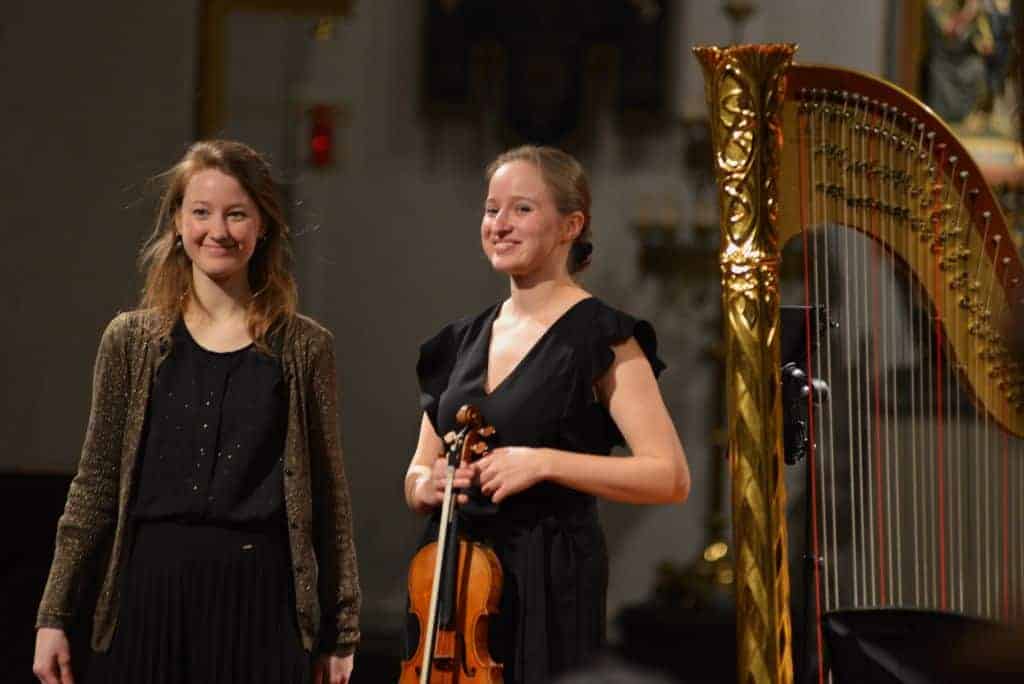
Veronique De Raedemaeker is a young violinist, this year one of the twenty-somethings at Radio Klara. A name that has appeared more frequently in recent years as a promising young talent. She has already won quite a few prizes and last year passed the Konzertexamen at the Musikhochschule Koln under Mikhail Ovrutsky with summa con laude. By the way, not only for violin, but also for the interpretation of Neue Musik.
Together with harpist Mathilde Wauters, who has also made a name for herself in recent years, she performed a recital in the Onze-Lieve-Vrouwekerk in Mariakerke, under the auspices of Davidsfonds Mariakerke and SWUK. On the programme: French composers from the belle époque: Debussy, Ravel, Jean Cras, Fauré, together with Chopin, Saint-Saëns and some lesser-known names.
SWUK stands for social works of performing artists in Flanders. Since 2010 they have launched quite a lot of young talent. You can almost take that literally. Some of them, such as clarinetist Annelien Van Wauwe and harpist Anneleen Lenaerts are making an international career.
Outsider
17 March, Saint Patrick's Day, national holiday of Ireland. It could also be the Day of the Harp. Violin and harp certainly occurs less frequently than violin and piano, but has its own intimate charm. The harp is somewhat of an outsider in classical music. You sometimes see them in the orchestra. Harp concertos are not often performed. The plucking and tinkling on the harp has something fairy-tale-like about it. That a harp as an instrument is taken less seriously than a violin or piano is an overstatement, but there is something to it. The Elisabeth Competition for harp, few would be able to imagine it. Mathilde Wauters has broken this image today.
Before she even places the violin under her chin, the lovely smile of Veronique De Raedemaeker strikes you. A radiant figure who captivates the audience before she begins to play. A confident smile that disappears and makes way for deep seriousness at the first notes. The timbre of her violin, built by German violin maker Stefan-Peter Greiner in 2005, immediately stands out. A grainy tone, a special sound with relief in it. A powerful violin sound with which she creates beautiful phrases, sometimes lyrical, sometimes cheerful, sometimes agitated.
Arrow
They play a suite and duo by Jean Cras, according to the programme. After the piece, Mathilde Wauters speaks: we have misled you, because this was the Fantaisie for violin and harp by Camille Saint-Saëns, which was the last piece in the booklet. Yet it sounded rather un-Saint-Saënsian, impressionistically dreamy in a way we are not used to from him. They continue with transcriptions of songs by Debussy and variations by Chopin. Then Veronique speaks for a moment to announce the well-known Pavane pour une enfante défunte by Ravel. They dedicate it to all children who today in the world are dying from hunger and war. After Gabriel Fauré's Après un rève I am completely drawn into the dreams of the belle époque, moved and wrapped in the beautiful playing and bewitching charm of this special violinist. I won't be the only man in the audience who felt her bow like an arrow in the heart.
Whale
It is especially in these serene, lyrical pieces that she plays so brilliantly, I suspect. This is evident once more in the even more well-known piece after the intermission: Spiegel im Spiegel by Arvo Pärt. She plays this with an almost supernatural mastery and enchantment. Spine-tingling, without relying too much on a senza vibrato effect. The piece lasts ten long hyperserene drawn-out minutes. We sit on an ice floe, in the distance we see a few polar bears, nearby a whale surfaces. When the last notes have died away, there is a deafening silence. We are transfixed by such serenity, control, spine-tingling beauty.
Mathilde then plays a work by Marcel Tournier for solo harp. Fascinating how she plucks and caresses the strings virtuously and gracefully, operates the pedals with her feet as an organist is always busy with the feet. She convinces me of the richness and refinement of harp playing. If I felt an arrow in my heart with Veronique, the harpist Mathilde Wauters moves me equally, but in a completely different way. The harp is also a much heavier instrument. For a moment I feel like the whale struck by her harpoon.
Angel
With the last work we are again on the open sea, for Jean Cras was not only a composer but also an admiral in the French navy. You always hear the waves and the sea wind in his work. The waves with which Veronique and Mathilde have carried us along for well over an hour on this adventurous journey through the belle époque.
I would like to hear them in work from another period, I think to myself, and after the concert I buy a cd on which Veronique De Raedemaeker plays Ysaÿe and Prokofiev. The cd MALINCONIA was praised as Keuze van Klara in 2020. Played very well, but in the Prokofiev I miss some fire. The Allegro brusco from Prokofiev's first sonata, for example, you really have to go at it like the devil. There I would hear and see a violinist like Patricia Kopatchinskaya. That is something less the repertoire for an angel like Veronique De Raedemaeker.
- WHAT: Duets for violin and harp
- WHO: Violinist Veronique De Raedemaeker and harpist Mathilde Wauters
- ORGANIZATION: Davidsfonds and SWUK
- WHERE & WHEN: 17 March 2024, Onze-Lieve-Vrouwekerk in Mariakerke
- PHOTOS: © Pieter Van Haute