
Being born and dying on 'the 4th of July', the national holiday of your 'second homeland' – not everyone is given that. Flor Peeters (1903-1986) was. Last Saturday, 4 July, this received a resounding celebration in Mechelen's Sint-Romboutskathedraal, where the Master built an important part of his musical legacy over half a century.
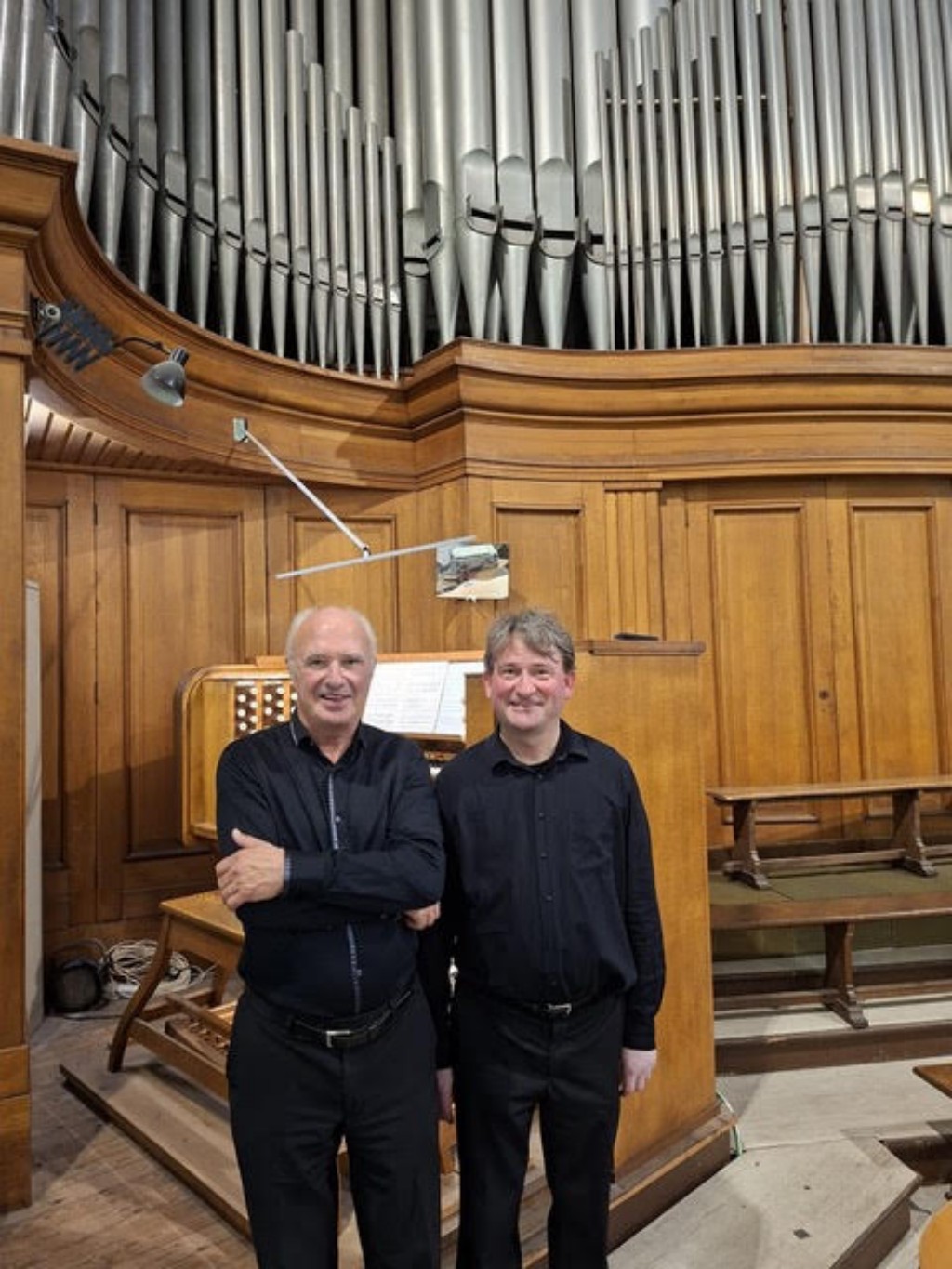
The monumental Stevens organ was played by his successor Peter Pieters and by Stijn Hanssens, himself a student of Peter Pieters and director of the Kunstacademie van Halle. Football, cycling, fairs, barbecue-time had no hold on those truly interested.
Introduced by pastor Filip Hacour, both organists explained their programme. This yielded interesting details and was not superfluous. For the music of Flor Peeters, however impressive, is not always equally accessible. This is the case, for example, with the much-praised opus 66, 'Lied Symphony' from 1948. More so than 'Lied to the Ocean', 'Lied to the Desert', 'Lied to the Mountains' and 'Lied to the Sun', the promising 'Lied to the Flowers' does not give the spontaneously overwhelming feeling of "yes, that's it!". Analogous to its title, it is a colourful swarm of motifs but I miss a connecting, flowing line. It is precisely this abundance, this versatility in the work of Peeters, this combination of French charm and Germanic severity, of liturgical and folk elements, of tradition and modernism, of harmony and dissonance, these experiments with polyrhythm and polytonality, that demand an effort from the listener. Yet most pieces received high marks.
It began impressively with an early work from 1925. The 'Symphonische Fantasie' was the end product of Peeters' education, which proceeded at lightning speed. Opposite the graceful post-Romantic influence of Franck and Tournemire stands the solid construction of the Germanic tradition of Reger and Karg. The result is a solid ABA structure with sturdy outer sections, an animated middle section and an almost symphonic finale.
Ten years and many concert tours later, he returned to our original Flemish 'Heer Jezus heeft een hofken'. He varied it in a modernistic manner and did not shy away from dissonances. Another ten years on, in 1945, Flor Peeters reworked the middle section of his Sonata for trumpet and piano at the request of Berten De Keyzer, sexton, organist, journalist, organ enthusiast and author, who with his organ journal 'De Schalmei' made an active contribution to Flemish organ literature. It resulted in a delightful 'Aria', sustained by a broad meditative melody.
After an imposing finale of 'Toccata, Fuga and Hymne op Ave Maria Stella', Stijn Hanssens took up the theme of the hymn with a firm approach in 'Four Pieces opus 71'. What followed, 'Largo', he called "one of the most beautiful compositions of Flor Peeters". Rightly so, with that ongoing movement, the warm melody and the richly nuanced accompaniment. A similar intensity spoke from 'Élégie'. Peeters composed it after the death of his mother, with whom he had a strong bond, all the more so because he lost his father very young.
Another personal connection concerned 'Abdijvrede'. In 1927, when organ concerts in churches were not obvious, Flor Peeters attended a liturgical congress at Tongerlo abbey and was given permission for this. In gratitude, he wrote 'Abdijvrede' "In sincere affection to my good friend E. Pater Tharcicius Valvekens, dedicated from the heart". The native of Kempen from Tielen knew how to express the quiet of Kempen. A more typical ending than the 'Vlaamse Rhapsodie' was unthinkable. In a letter from the States to his Marieke, Flor told how he wrote it on a train between Hamburg and Cologne. Homesickness for his Flemish roots perhaps inspired him to a melodious reverie on our familiar 'Ik zag Cecilia komen'.