
"POWER" was the theme of the Festival van Vlaanderen Gent this year and they wanted us to discover and analyze this Power through music. That religion and politics can be an important source of inspiration, both positive and negative, is fairly obvious and so the program offered a number of compositions that clearly illustrated this.
Besides, every listener could immerse themselves in the musical offering in their own way and be seduced or dominated.
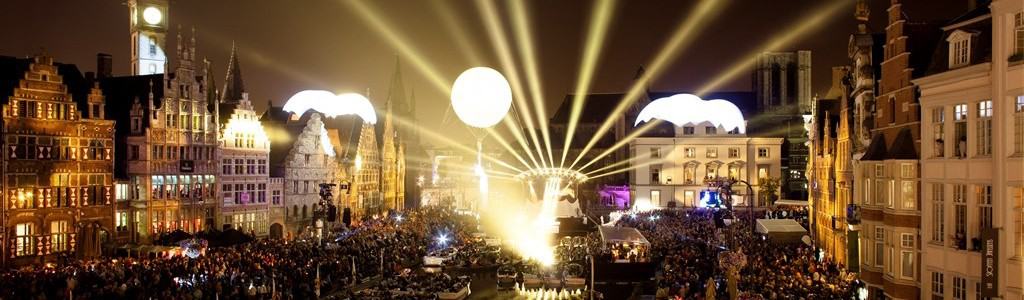
Traditionally opened by a sunny, colorful Odegand, the festival opened with a performance in Sint-Baafskathedraal of Bach's Hohe Messe by the Amsterdam Baroque Orchestra & Choir under the direction of Ton Koopman. A full cathedral listened with dedication to Koopman's engaged performance, mainly carried by orchestra and choir, but with somewhat less convincing soloists and whose sound sometimes got somewhat lost under the high vaults of the cathedral. That was not the case for the Philharmonia Orchestra London which, under the direction of Esa-Pekka Salonen, a week later offered an impressive and moving performance of Bruckner's Seventh Symphony, well structured, tense and warm in sound. Bruckner was preceded by a subtle performance of Schönberg's Verklärte Nacht.
The sixty young musicians of the Landesjugendorchester Nordrhein-Westfalen formed the strongest trump card the next day in the performance of Verdi's opera Don Carlos which had received the subtitle The corridors of power. In the program booklet one could read Verdi's opera revisited, but what director Bernd Schmitt presented seemed more like a parody. There was not only considerable cutting in the score, among other things because there was no choir, but also the order of scenes was changed and instead of the auto-da-fé there was an art happening. The idea of replacing the figure of the Grand Inquisitor, the most powerful character in the opera, with six singing and six acting figures also yielded little.
Don Carlos was presented as a clown who left at the end of the opera on a children's bike, Philip II was allowed to show his bare chest and Elisabeth appeared as a slut. The French pronunciation was deplorable with one exception: Simon Stricker (Philip II) who was also approximately the best singer. But the orchestra played gallantly and let Verdi's score sound good under the musical direction of Sebastian Tewinkel. All in all, however, a production unworthy of the festival.
A musical experience of a very different kind was offered a few days later by the concert of the Huelgas Ensemble led by Paul Van Nevel, titled Het landschap van de polyfonisten. Since Paul Van Nevel is convinced that the music of the Franco-Flemish composers is strongly influenced by the melancholy, beauty and variety of nature and cathedrals, the concert was accompanied by projected atmosphere images photographed by Luk Van Eeckhout. Thus we could possibly listen with different ears to the various compositions performed by the twelve members of the Huelgas Ensemble, shrouded in darkness, against a background of melancholic, hazy, rolling landscapes.
The Collegium Vocale Gent was the main interpreter of De Blinden, a musical theater version worked out by Josse De Pauw and LOD muziektheater of Maurice Maeterlinck's Les Aveugles with music by Jan Kuijken. Maeterlinck's blind men are a group of blind people waiting in vain for a guide in a dark forest. With LOD they form a group of washed-ashore souls, admittedly with a leader who is present, but who wraps himself in silence. So they feel helpless and abandoned and grope in the darkness like blind men or like many refugees today, who cannot go anywhere, washed ashore in a strange world. Perhaps for this reason Josse De Pauw preferred to use an English translation of Maeterlinck's French text. His closing monologue as the present/absent leader, in which he depicts the abuse of power, he spoke in Dutch.
Jan Kuijken's music requires no instruments and is completely a capella and was performed by the singers of Collegium in group or solo. They evolved groping in a sparse setting (a wooden slope), together with two actors, spied on from above by Josse De Pauw. Together they managed to create a certain atmosphere but could not maintain attention for the hour and a half that the performance lasted.
A very different form of musical theater was offered by Mi Carmen Flamenca, a version of Bizet's opera Carmen danced by the Antonio Andrade Flamenco Ballet. Thus the performance was at least announced. In reality, little remained of Bizet's Carmen except a skeleton of the story with occasional (recorded) orchestral fragments. Live music was mainly provided by musicians on stage (vocals, guitar, cajon, saxophone and flute) in a rather meager mini-setting. The dancers of the ensemble led by Ursula Moreno (Carmen), José Galvan (Don José) and José Luis Vidal (Escamillo) provided color and temperament. And the audience seemed to appreciate the spectacle.
My last festival evening led me again to Sint-Baafskathedraal for a concert entitled Over lijden en verlossing, brought by the Mahler Chamber Orchestra with as soloists bass Peter Harvey and countertenor Alex Potter. He replaced the originally announced Iesteyn Davies in Vivaldi's Stabat Mater while Peter Harvey was heard in Bach's cantata Ich habe genug. Peter Harvey impressed with a restrained, sensitive interpretation with his homogeneous bass. Alex Potter did his best to let us feel Mary's suffering in a sometimes rather cramped vocal interpretation. Both singers were well accompanied by the Mahler Chamber Orchestra, led by concertmaster Matthew Truscott.
It came into full bloom in the Chamber Symphony Op. 110 a by Sjostakovitsj, an extremely fascinating composition grown from his eighth string quartet. The Mahler Chamber Orchestra managed to convey the different moods excellently with a full orchestral sound and fine color shadings and spanned a captivating dramatic arc throughout the performance. Here too, an almost completely filled cathedral and an attentive and grateful audience.
- WHAT: Odegand – Gent Festival van Vlaanderen
- WHERE: multiple venues in Gent from 15.9 to 6.10.2018
- PHOTOS: © Gent Festival van Vlaanderen and © Wouter Rawoens
- WEBSITE: www.gentfestival.be