
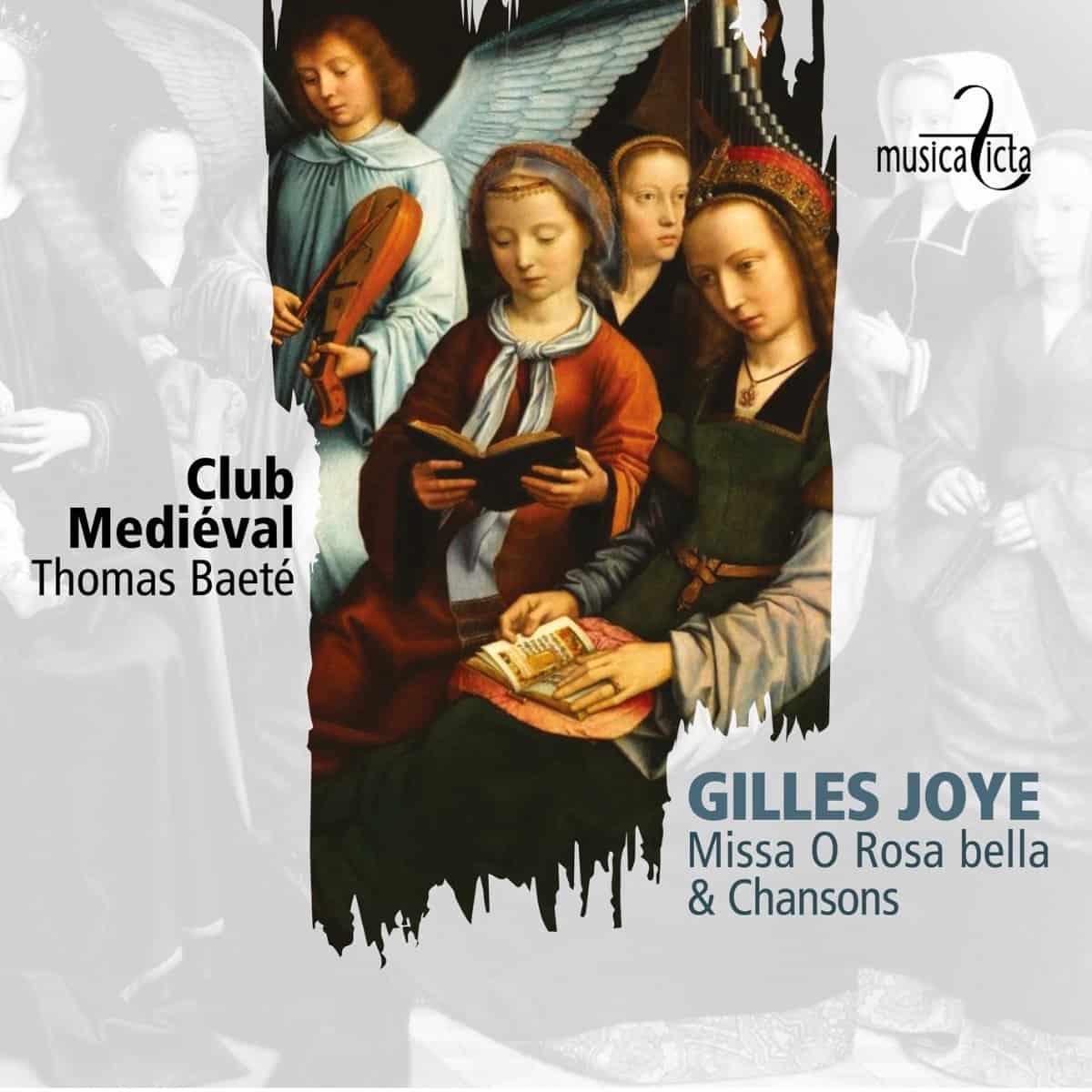
Those who hear the name Gilles Joye today may well shrug their shoulders. Yet this Flemish composer — born around 1424/1425 in the diocese of Tournai, presumably in Kortrijk — was a renowned name in his time within the Burgundian polyphony of the 15th century. His life path, rich in controversy and musical talent, brought him to the court of Philip the Good and Charles the Bold, where he rose to singer and eventually chaplain of the celebrated court chapel. At the same time, he led a dissolute life, which only strengthened his fame.
ClubMediéval, the ensemble for late medieval music under the direction of Thomas Baeté, introduces us to this colourful figure through a selection of his work: five secular three-part chansons and one of his two masses. Among the selected pieces is the downright bawdy Ce qu'on fait, which shows how outspoken and bold Joye dared to compose. Another striking choice is O rosa bella, a chanson with an eventful history.
That title, O rosa bella, refers to two different chansons from the 15th century. The first was written by Johannes Ciconia; the second, long attributed to John Dunstable, is now recognized as a work of the English composer John Bedyngham, connected to St. Stephen's Chapel in the Palace of Westminster. The text — a yearning love poem by Leonardo Giustiniani (1388–1446) — became a true evergreen in the Middle Ages and inspired numerous other composers, including Johannes Ockeghem and, remarkably, also Gilles Joye.
Joye's version of O rosa bella is not merely a musical composition; it presumably also reflects part of his personal life. From 1449, Joye was connected to Sint-Donaaskerk in Brugge, where he was also chaplain of the Sint-Basiliuskapel. During that same period, he lived together with "Rosabelle", a prostitute who according to city chronicles was known as the most notorious woman of loose morals in Brugge. It is therefore tempting to draw a connection between this Rosabelle and the beloved in O rosa bella: the beautiful, but unattainable rose to whom the lover loses his heart.
The compositions of Gilles Joye have been preserved in only a few sources and are limited to secular three-part works. Yet they testify to a pronounced melodic talent and a keen sense for textual expression, making them valuable examples of the Burgundian musical tradition. The fact that he effortlessly managed to unite the earthly, the obscene and the sacred makes him an exceptional figure within late medieval musical culture.
The performances by ClubMediéval bring Joye's work back to life in all its richness and ambiguity. Artistic director Thomas Baeté, born in Oostende in 1978, is the driving force behind the ensemble. His musical journey began at the Royal Conservatoire of Antwerpen, where he studied violin with Vegard Nilsen. Later he specialized in the viola da gamba, studying with among others Wieland Kuijken in Brussel and Jordi Savall in Barcelona. He perfected his craft through masterclasses with, among others, Paolo Pandolfo and Sigiswald Kuijken and is today a teacher of gamba and medieval music at the Stedelijk Conservatorium of Leuven and the Academy of Sint-Lambrechts-Woluwe.
With ClubMediéval, Baeté is building an increasingly rich repertoire from the late medieval period, with special attention to obscure masters such as Gilles Joye. Their interpretations are not mere reconstructions, but vivid performances in which the spirit of the 15th century becomes palpable again. Thanks to their work, Joye finally receives the reappraisal he deserves — as a composer, as a singer and as a chronicler of a Burgundian age full of splendour and passion.