
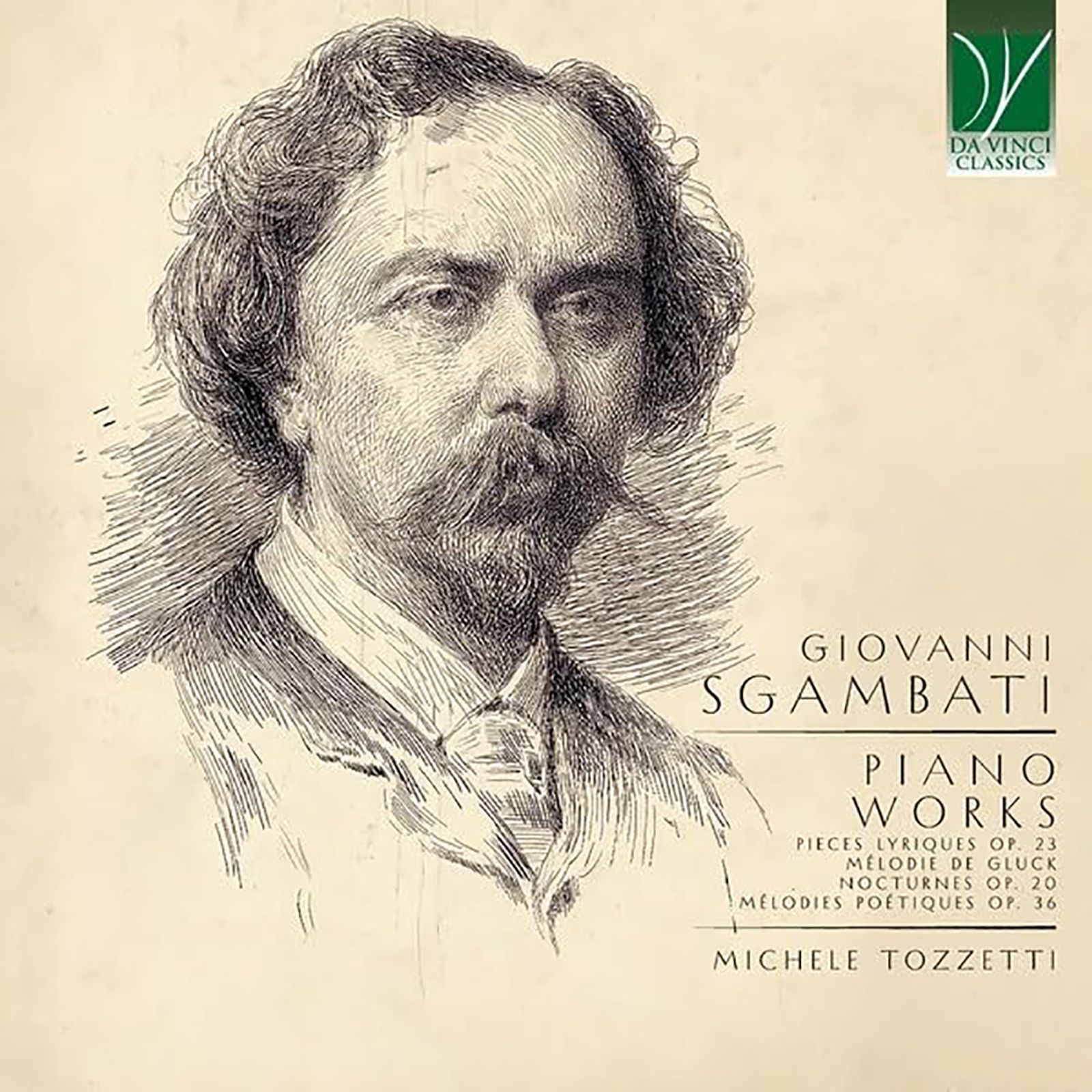
There are composers whom history remembers primarily for what they wrote, and there are those who live on mainly through what they made possible. Giovanni Sgambati (1841-1914) undoubtedly belongs to that second category, but that description ultimately does him a disservice. This new recording by Michele Tozzetti convincingly demonstrates that behind the pedagogue and organizer lay a composer who had more to say than the modest place music history long accorded him.
In the second half of the nineteenth century, Rome was a city where opera held sway and instrumental music barely had a place of its own. Together with violist Ettore Pinelli, Sgambati founded the Società Musicale Romana and helped lay the foundation for what would later become the Conservatorio di Santa Cecilia. Under the patronage of Liszt and thanks to Wagner's intervention with publisher Schott, he developed into one of the first Italian composers of his generation to restore international prominence to instrumental music in Italy.
You hear that history in his piano music too. Italian melodic inevitability goes hand in hand with an almost German sense of form and structure. Sgambati rarely seeks grand effect; even when the piano part sounds rich and full, melody remains the starting point. His music lives from elegance, balance, and an unselfconscious lyricism. It does not reveal its secrets immediately, but rather gains in persuasive power the longer you listen.
Michele Tozzetti, trained at Santa Cecilia in Rome and now an experienced chamber musician with a particular affinity for lesser-known Italian repertoire, fully understands that approach. He resists trying to make this music grander or more dramatic than it is. That very modesty proves a virtue: he trusts in the strength of the score and gives Sgambati every opportunity to speak for himself. His playing possesses meanwhile a rare combination of clarity and warmth: never coolly analytical, yet equally free from the indulgence of romantic exaggeration.
The six Pièces lyriques op. 23 open with a restrained Romance, and what immediately strikes you is how Tozzetti never forces anything: the lyricism receives all the breathing space without descending into salon-like sentimentality. That is no small achievement, for this repertoire constantly teeters on the edge between refinement and superficiality. Tozzetti maintains that balance with an unselfconscious sense of proportion and unfolds the six miniatures as a carefully constructed cycle, in which each character piece retains its own color while contributing to the whole. You hear it in the natural tension building of the almost hymn-like Vox populi, in which Sgambati's interest in church music subtly resonates. Equally convincing is the unselfconscious elegance with which the restrained lullaby Do-do transitions into the playful lightness of the closing Ländler and Gigue. Tozzetti maintains remarkable transparency in the texture, allowing the different voices to breathe freely and the music to retain its natural lightness.
The Mélodie de Gluck, Sgambati's arrangement of the Dance of the Blessed Spirits from Orfeo ed Euridice, is one of those nineteenth-century transcriptions that can easily become merely decorative piano music. Tozzetti, however, chooses a notably heartfelt reading. He allows the melody to breathe freely, while the accompanying figures enfold it like a transparent veil of sound. Thereby not only does Gluck's music's simplicity remain intact, but it also acquires a hushed intensity that deeply moves.
The heart of the disc, however, is formed by the three Nocturnes op. 20. Chopin is never far away as a point of reference, but Sgambati chooses a different path. His nocturnes are less conceived as a personal confession; they possess a solidity that sometimes recalls Brahms rather than Chopin. The melodies are given every opportunity to sing, while the music never loses its steady course. It is precisely in this that Sgambati's own voice lies: he seeks no ostentatious effect, but allows beauty to emerge from balance, patience, and an infallible sense of construction.
Tozzetti senses that approach infallibly. Right from the opening section, Animato, he draws the listener into a wondrous sonic world. With his rich color palette and natural phrasing, he lets the music flow as if of its own accord, never disturbing the poetic atmosphere. That same unselfconsciousness continues into the Allegretto con moto, where elegance and liveliness constantly balance each other. The emotional heart of the cycle lies, however, in the Andante espressivo. There Tozzetti achieves the greatest eloquence. Without grand gestures or exaggerated pathos, he lets the music slowly unfold, so that each climax feels like a natural consequence of what preceded it. His interpretation breathes an unselfconscious calm and maturity, allowing the music to convince through its own power.
The Mélodies poétiques op. 36 close the disc as a musical diary in twelve short chapters. Precisely in these miniatures does Sgambati perhaps demonstrate even more convincingly than in his larger works his compositional craftsmanship. He knows not only how to develop a musical idea, but especially also when to let it go. That instinct for proportion lends the cycle an unselfconscious elegance, which is brought optimally to full expression by Tozzetti's heartfelt and finely calibrated playing. With subtle tempo shifts and refined color accents, he welds the twelve miniatures into an organic whole, without their individual character being lost.
Not every section possesses the same inventiveness, but thanks to Tozzetti's sensitive and colorful playing, quite a few pages linger effortlessly in memory. Especially the playful Canzonetta d'aprile, the idyllic Rivelazione, the hushed Dolci Confidenze, the gripping Anima appassionata, and the closing piece Cantico di speranza show a composer who, with relatively simple means, knows how to evoke a surprisingly rich emotional world. It is precisely in the intimate, more poetic moments that Sgambati comes, in my view, most into his own, though the more animated pieces are indispensable for giving the cycle its natural balance. Tozzetti gives that music precisely the space it needs: warm, heartfelt, and sure-footed, he lets the miniatures slowly but irresistibly nestle into memory.
Is this music that rewrites the history of piano literature? No, and it need not be. Sgambati was no revolutionary, but a composer who achieved a remarkably high level within his own musical world. His best pages undoubtedly belong among the most convincing Italian piano miniatures from the late nineteenth century.
Michele Tozzetti proves himself thereby as an ideal guide. He trusts in the eloquence of the music itself and gives it precisely the space it needs to convince. Just as Giuseppe Martucci gave the Italian symphony a place again within European musical life, so Sgambati restored artistic weight to Italian piano music. This recording is therefore far more than a historical curiosity: it is a convincing plea for a composer who may never rank among the greatest masters, but whose music deserves far more attention than it long received.