
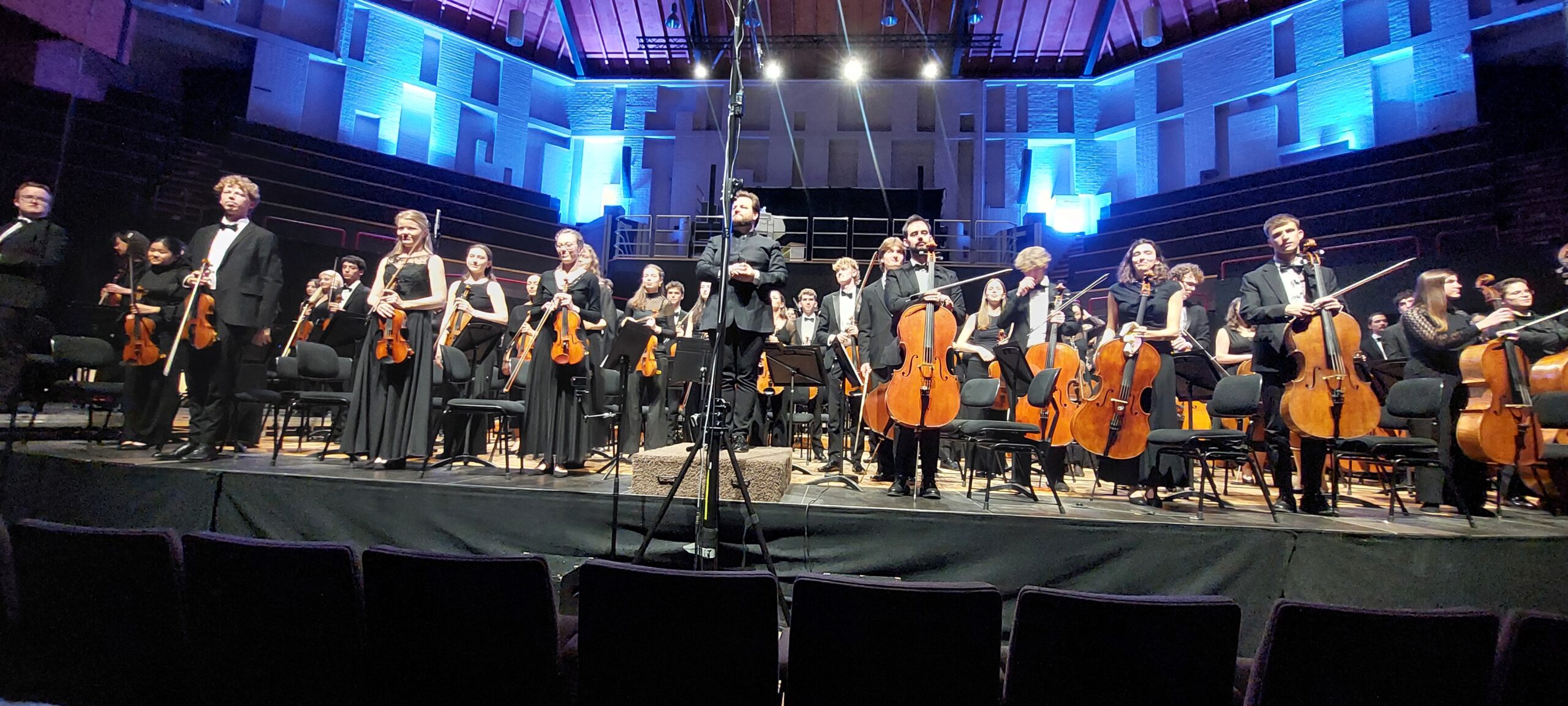
Eine Alpensinfonie by Richard Strauss sounded like a welcome gift, offered by the Lemmensinstituut in Leuven. The Mahler Student Festival Orchestra specializes in monumental symphonic repertoire, including this work, Mahler's Ninth, Bruckner's Ninth and Beethoven's Ninth in 2025, and César Franck's Ce qu'on entend sur la montagne in 2026.
The musicians – a selection from the elite of European conservatories – were in excellent form and confirmed their high level thanks to intensive coaching, dedication and ensemble playing. Yet, when listening to such engagement, a persistent question imposes itself: how do they reconcile this exceptional artistic commitment with the needs of their youth and their further development?
Grim Ongena, who performed in a dual role as leader of the percussion section and composer, opened the evening with his creation The Ecstasis of Flight. Will his trajectory unfold like that of an avant-gardist within this context? The audience listened attentively to this ambitious work, which premiered earlier, in 2025, at the Antwerp Symphony Orchestra.
A 'hermeneutic' work
The coherence, consistency and precision of the MSFO made a profound impression: in more than one respect, this became a true Eine Alpensinfonie. Conductor Lars Corijn seeks an almost perfect unity within the orchestra and knows as few others how to stimulate synergy and inspire confidence. The artistic approach emphasizes an in-depth study of the work, with the aim of uncovering the meanings embedded by the composer. This reconstructive interpretation constitutes an essential contribution of the MSFO to the cultural field, in which its hermeneutic approach is gaining increasing recognition.
Knowledge allegory
Two symphonic poems were placed in opposition here. Both Franck and Strauss undertake their musical journey as a voyage which, besides the literal ascent of the mountains, also involves a spiritual initiation – a striving for knowledge. The way is prepared by Franck's orchestral meditation, inspired by Victor Hugo, in which the loneliness of mankind resonates in the confrontation between human and natural voices. Strauss translates this into a striving for genius, in line with – but also going beyond – the philosophy of Friedrich Nietzsche, whom he admired: a purification and redemption through art.
We are drawn into an almost revelatory experience, built up via a steady crescendo towards a moment of sublime intensity. The evocation of the Alps – their immovability and timelessness – exerts a captivating fascination: the familiar world fades, time gives way to eternity. The landscape unfolds, until an inner panorama becomes visible, an 'inscape' in which the self takes shape. Especially the wind instruments are pushed to the limit here to make space and distance tangible.
In broad, romantic phrases, the transition from night to day, from the unknown to the familiar, takes place. The music appeals to all the senses: fragrant forest glades, steep rocks, birdsong, flowing water, circling birds of prey – a world that seems reborn. Nature remains the same, and yet we experience it as renewed, as if we were beholding it for the first time. This rediscovery, so characteristic of Romanticism, becomes a form of knowledge, an expansion of human consciousness.
Dramatic moments emerge in sharply articulated signals, carried by a serious register that underscores the majestic panorama. The wild life and its hidden threats become palpable – listen to the pleading strings. Yet a sense of sublimity remains dominant: at the summit reigns a royal majesty, both literally and symbolically. This climb opens a perspective on the transcendent, in which the unspeakable presents itself as an overwhelming 'more'.
The descent mirrors the ascent. The storm – as intense as the summit – marks a reversal, a movement from zenith to nadir. The unrest and threat give way to reconciliation: a return to the earth, to the origin, after the quest for knowledge has been completed.
The MSFO proved itself particularly powerful in this impressive interpretation. If the death of Gustav Mahler in 1911 prompted Richard Strauss to, during his stay in Heimgarten, return to the symphonic poem, then both the orchestra and the composer honored his legacy with a performance that lingers.