
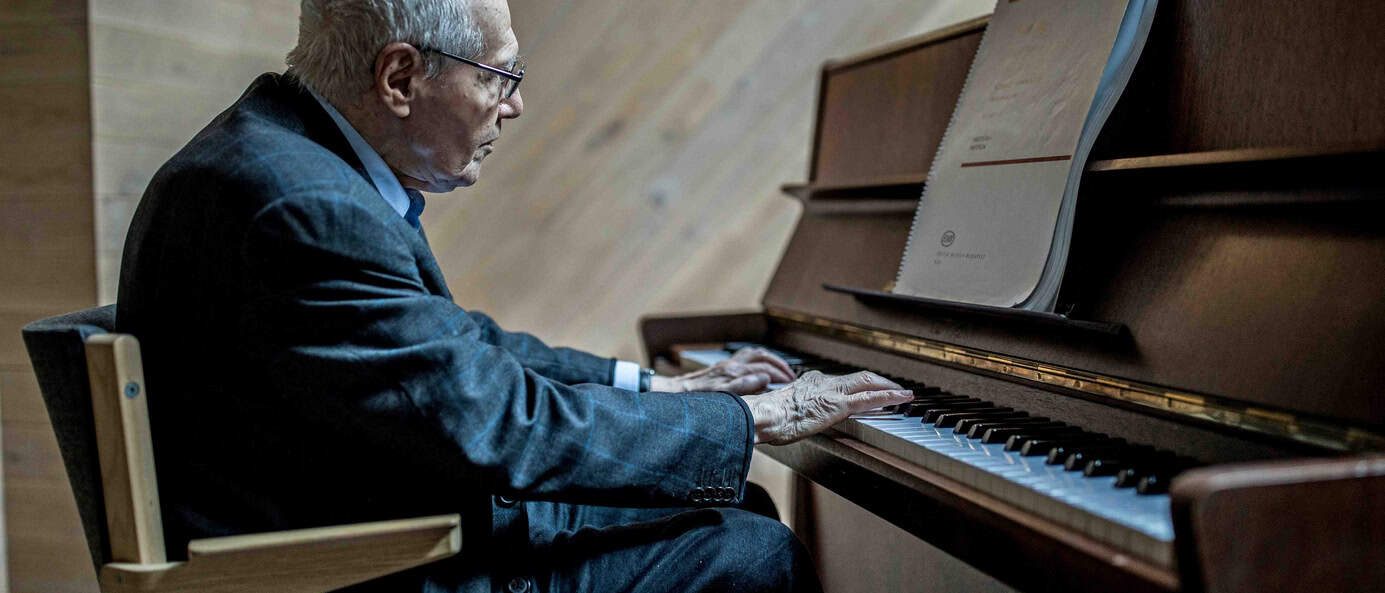
On 19 February 2026, the world of classical music celebrates the hundredth birthday of György Kurtág, a composer for whom every note counts and no detail is insignificant. In an age of grand gestures, Kurtág is the antidote: a master of the minimal, of concentrated expression, in which silence and sound meet as partners in a delicate dance.
The universe in a note
Kurtág's oeuvre is small in scope, but immense in emotional charge. His language consists of miniatures and fragments: a single piano key, a brief vocal line or a few bow strokes can open up an entire universe.
Works such as Játékok ("Games") may seem playful, but are carefully ordered: each gesture is considered, each rhythm a proof of inner discipline. The listener is confronted with a paradox: a world full of intensity in just a few seconds.
Kurtág shows that the power of music does not lie in loud sound or long pieces, but in small gestures, the subtle touch of a note and the silence in between. Even a short fragment can evoke a world of feeling and meaning. His music consists of small puzzle pieces that together form a rich and wondrous whole, and invites the listener to think along, to feel and to discover for themselves what each sound means.
Musical philosophy and radicalization
Kurtág was shaped by the tragedy and complexity of the twentieth century: the Second World War, totalitarianism in Hungary, and the political and cultural restrictions he defied. These experiences partly explain his concentrated style, in which every note carries an ethical and existential charge.
His music is not loud protest, but an intense inner concentration, a form of moral and spiritual precision. Influences from Béla Bartók (1881-1945) are audible in rhythmic sharpness and folk music references, while the modernism of Anton Webern (1883-1945) provided him with a language of condensation and precision. Kurtág merged these influences into his own style: the essential over the superfluous, the intimate dialogue over theatrical grandeur.
He consciously chooses a radical path within the European avant-garde: less is more, but in a way that touches both intellectually and emotionally deep. His works, such as Stele and Signs, Games and Messages, consist of short fragments that together form a rich and coherent universe. The listener is invited to actively think and feel along, and thus discovers the emotional logic of the music. In this concentrated world sounds a commentary on the human condition: fragile, intense and always seeking meaning.
The partnership with Márta Kurtág
A crucial aspect of Kurtág's work is his collaboration with his wife Márta, pianist and muse. Their performances of Játékok and other works are legendary. Márta transformed small gestures into a rich psychological spectrum, bringing the intensity of Kurtág's concentrated compositions fully to life.
Their partnership shows that Kurtág's music is never a personal ego proclamation, but a quest for dialogue: between sound, time and humanity. Interpretation and performance are inseparable from the meaning of his music.
The centennial: reflection and continuity
The festivities surrounding Kurtág's hundredth birthday include performances, lectures and new interpretations of his works. But celebrating Kurtág is not a retrospective: it is an invitation to new generations of composers and listeners to rediscover the microcosmic and existential in music.
Kurtág's music slows down time, sharpens attention and confronts the listener with a fundamental question: what makes music truly valuable? His influence on contemporary composers and performers shows that his concentrated approach has left a lasting legacy.
Music as ethics
What Kurtág teaches us is that music has an ethical dimension: it is not about impressive gestures, but about integrity, precision and respect for sound. His hundredth birthday is a moment of contemplation: a reflection on the small, the essential and the concentrated.
In a world that becomes ever louder and more fleeting, Kurtág sounds like a subtle echo, intimate and unforgettable. A hundred years ago this delicate gesture of sound began, small but full of meaning. Today we celebrate that this concentrated voice embraces a century of resonance and inspiration.