
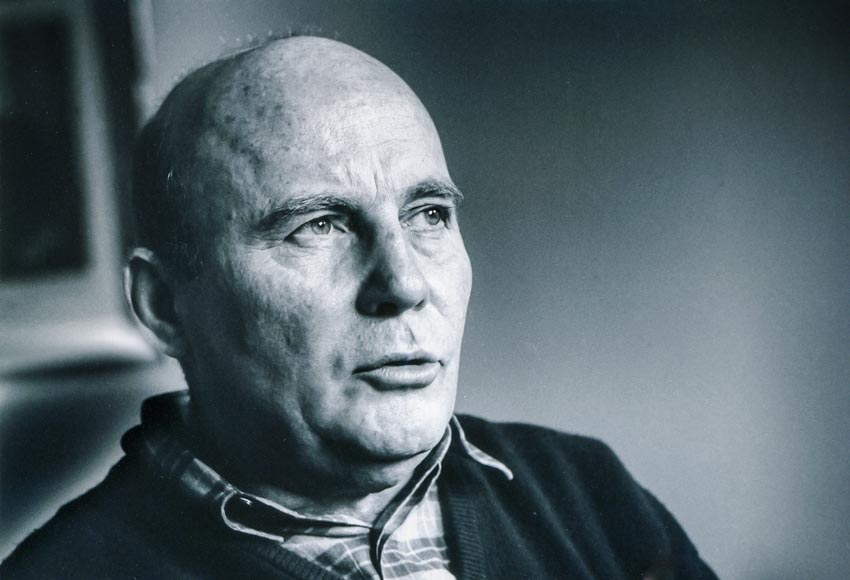
On 1 July 2026, it will be a hundred years since Hans Werner Henze was born. Such commemorations tend to make composers seem manageable, as if an oeuvre could be neatly rearranged around a birth date. New recordings appear, concerts are programmed, and for a while a life seems to reduce itself to a series of works with a beginning and an end, as if music were ultimately something complete.
With Henze, that mechanism barely works. His music does not openly resist overview, but undermines it from within. Not because it splits into styles or periods, but because it continues to move in a tension that never fully resolves. That tension is not primarily musical, but moral. It lies somewhere between form and experience, between memory and actuality, between what can be said and what can only still be heard as unease.
Whoever commemorates Henze, therefore, commemorates not an oeuvre in the usual sense, but an enduring restlessness.
A youth in which purity became a language
To understand why that restlessness remains so deeply anchored in his music, one must return to the environment in which it originated. Hans Werner Henze was born in Gütersloh on 1 July 1926, the eldest of six children, in a family where the father, initially a convinced pacifist, gradually adapted to National Socialism. That shift is more than a biographical detail. It means that young Henze witnessed firsthand how concepts such as order, discipline and purity could nestle into family life without ever experiencing themselves as problematic.
In that context, music became for him not an aesthetic choice, but a parallel mental space in which other forms of thinking and speaking could continue to exist. He discovered composers who did not fit within the official cultural framework of the Third Reich, and precisely because of that exerted a greater attraction on him. Debussy, Hindemith, Berg, Stravinsky: names that suggested another kind of modernity, less dogmatic, less purified, but precisely therefore more complex.
The war interrupted that first musical training abruptly. Henze was deployed as an adolescent in the Reichsarbeitsdienst and later in the army, and eventually ended up in British captivity. That experience is rarely explicitly present in his music, but it works as an undertone through almost everything he later writes. Not as memory in the autobiographical sense, but as deep distrust of systems that present themselves as necessary and self-evident. Anyone who has seen how quickly a society can surrender to an ideology will never again be able to take for granted the idea that art stands outside history.
Between Darmstadt and Italy
After the war, Henze studied composition with Wolfgang Fortner and subsequently with René Leibowitz, who brought him into contact with Schönberg and Webern's twelve-tone technique. Through Leibowitz, he came into the circle around Darmstadt, where postwar European avant-garde took its most consequent form. Boulez, Stockhausen, Nono and Maderna sought a new musical language that wanted to radically break with the past.
Henze moved in that environment without ever allowing himself to be fully absorbed into its strict logic. He witnessed the serial way of thinking firsthand, but remained at the same time sensitive to what that approach left out of view. Where many of his contemporaries saw the twelve-tone technique as a necessary purification of musical material, in him rather an enduring doubt arose: not about the usefulness of the system, but about the question what musical and human reality would become invisible with it.
That tension is often misunderstood as stylistic inconsistency. In reality, it is a fundamentally different attitude toward modernity. Henze accepts the modernist break with the past, but refuses to believe that this break can lead to a new kind of innocence. For him, music always remains connected to experience, to body, to theater, to history.
This also explains his move to Italy in 1953. That step is often described as a biographical turning point, but it is at least equally an aesthetic decision.
For Henze, Italy meant not an escape from modernity, but a shift in the way he related to musical tradition. In that Mediterranean context, the history of music remained perceptibly present without being experienced exclusively as a burden or problem. Lyricism, theater and beauty could exist again without immediately being suspected of nostalgia. At the same time, he also found there a more livable environment for himself, in which he as a homosexual composer – in a period when that was still socially and legally problematic in much of Europe – could build a more stable existence, first on Ischia and later near Rome, together with Fausto Moroni, his life partner and regular librettist.
Music that does not let itself be reduced to genre
From that point on, an oeuvre develops that is difficult to classify into a single category. Opera, symphony, concerto, chamber music: time and again Henze uses the existing forms, but without letting them function as closed worlds.
His operatic work, symphonic pieces and chamber music do not function as strictly separate domains, but as interconnected forms of musical thinking. Operas often take on the intensity of political or moral reflections, symphonies behave like dramatic developments without scene, and chamber music sometimes opens an intimate theatrical space. Thus Boulevard Solitude (1952) reinterprets the Manon Lescaut subject in a postwar urban context, while Die Bassariden (1966) reduces a Greek tragedy to a concentrated study of human conflicts and psychological tension. In doing so, the boundaries between genres are not abolished, but continually stretched.
This equally applies to his engagement. Henze becomes more openly political in the sixties and seventies, with sympathies for left-wing movements and explicit references to contemporary conflicts. But that engagement should not be read as an external addition to his music. It is rather an expression of the same question that permeates his entire work: how can music speak without losing its complexity?
The work Das Floß der Medusa (1968) refers to the historical shipwreck of the French frigate Méduse, but does not use that fact as an illustration of an event from the past. Instead, the material is used as a layered space in which different voices remain beside each other without allowing themselves to be reduced to a single moral or narrative position. The controversy surrounding the planned premiere in Hamburg, which resulted in political tensions and police intervention, is often mentioned as an anecdotal detail, but at the same time points to the difficulty of still viewing such works as "neutral" cultural objects.
Tristan (1973) – mistrust of continuity
In Tristan, Henze seems to move within a very different tradition. The title inevitably refers to Wagner and thus to the nineteenth-century idea of desire as endless movement. But what in Wagner still has a metaphysical horizon is immediately interrupted in Henze.
The work – written for piano, tape and orchestra – does not allow for continuous development. Musical ideas appear, but are not continued in the classical sense of the word. They are interrupted, displaced, resumed in a different context. The electronic layer – built from fragments of Brahms and Chopin alongside Henze's own material – does not function as a modernist contrast, but rather as a kind of memory in which the past continues to resonate without stabilizing itself.
In the recently released cd interpretation by Igor Levit, that fragility becomes particularly audible. His approach avoids any attempt to bring the fragments together into an overarching gesture. The piano does not sound like a solo voice, but as a consciousness that continually probes its own possibilities. Silences gain a weight that extends beyond breathing space; they function as an interruption of any possible taken-for-grantedness.
Where Wagner stretches the desire for a continuum that ultimately finds its completion in death, Henze refuses precisely that logic. Desire persists, but it takes no form in which it can dissolve. It becomes rather a series of attempts that already carry their own failure within them.
Sinfonia No. 9 (1997) – Seghers and memory without reconciliation
The Ninth Symphony forms a different kind of culmination point. Here the relationship between music and history becomes more explicit, without the music ever allowing itself to be reduced to illustration. The work is based on Anna Seghers' novel Das siebte Kreuz, a story about seven prisoners trying to escape from a Nazi camp. The novel is not a heroic tale, but a study in fear, solidarity and moral ambiguity.
Henze does not adopt this structure as a narrative schema, but as a moral framework. The seven movements of the symphony – Die Flucht, Bei den Toten, Bericht der Verfolger, Die Platane spricht, Der Sturz, Die Nacht im Dom, Die Rettung – do not follow the logic of the novel, but repeatedly assume a different position within the same experience. It is not the story that is central, but the question of how memory sounds when it is not allowed to be concluded.
The presence of Hans-Ulrich Treichel's text strengthens that tension. It does not function as commentary, but as an independent voice within a much larger whole of testimonies. The choir is thereby given no unambiguous role. It does not represent a community, but a series of voices that continually move between individuality and anonymity.
In musical terms too, Henze confronts himself here with a charged tradition. The Ninth Symphony has never been a neutral form in German musical history. It bears the shadow of Beethoven, Bruckner and Mahler, and thus also the question of completion and reconciliation. Henze does not adopt that legacy, but places it under tension. Where Beethoven allows the symphony to culminate in universal brotherhood, and Mahler in a final form of existential vastness, Henze refuses any form of closure.
The ending, Die Rettung, is therefore not a conclusion. It is rather an open maintaining of the question. The music seems to fall silent for a moment, but without the underlying tension disappearing. What remains is not reconciliation, but memory that refuses to lose its sharpness.
An oeuvre without a resting point
What Tristan and the Ninth Symphony have in common is not stylistic similarity, but a shared attitude towards musical meaning. In both cases, music becomes a space in which closure is systematically deferred. Not as a formal strategy, but as an ethical choice.
Perhaps that is the core of Henze's oeuvre: an enduring resistance to the temptation of resolution. His music does not seek comfort, but rather a form of speech that does not simplify the complexity of experience. That makes it sometimes uncomfortable, but precisely that discomfort is not accidental: it is where music refuses to be reduced to a closed aesthetic object – and where it, a century after his birth, still demands a listener willing to remain unfinished themselves.
Henze did not write music that could be closed off. He wrote music that continues to resonate, even long after it has ended. He died on 27 October 2012 in Dresden, 86 years old, but those who listen to his work today (again) will notice little of a closed life. Rather the opposite: a hundred years after his birth, precisely what he refused to close off remains most current – precisely because it continues to elude any definitive reading.