
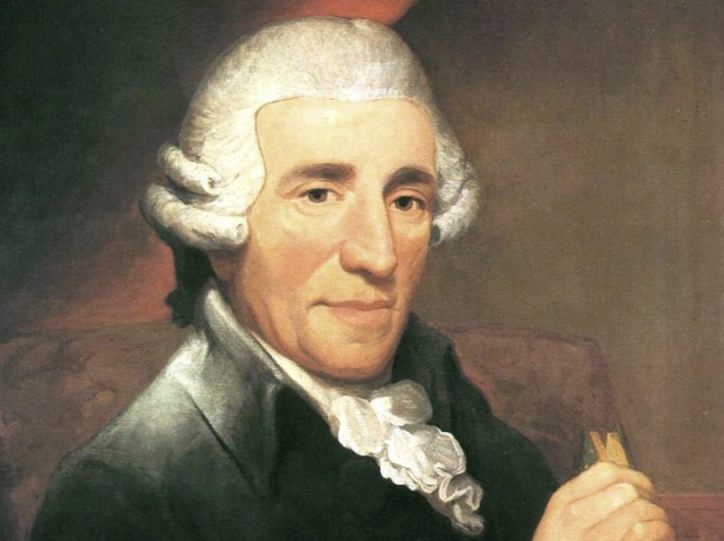
Some performances confirm the status of a masterpiece. Others do more: they let you hear why that music must once have sounded like a revelation. The performance of Die Schöpfung by Franz Joseph Haydn (1732-1809) on Friday, May 22 in the Koningin Elisabethzaal, within the Cofena series in collaboration with the Antwerp Symphony Orchestra, undoubtedly belonged to that latter category. What Václav Luks achieved with the Orchestra of the Age of Enlightenment, the Choir of the Age of Enlightenment and an excellent soloists' team was a performance that sounded at once spirited, deeply felt and genuinely inspiring – a reading in which musical refinement and pure performance joy continuously reinforced each other.
From the first measures of the representation of chaos, it was clear that Luks was not aiming for monumental ponderous weight, but for movement, tension and dramatic sharpness. The darkness with which Haydn opens his creation narrative took on something tangible here: restless harmonies, abrupt silences, lines seeking each other without quite finding each other. The Orchestra of the Age of Enlightenment played that opening with an intensity that got under your skin. When the famous "Und es ward Licht" then burst forth, a visible shiver ran through the hall. Not because the effect was played broadly, but precisely because Luks had prepared the moment organically. The light did not break in spectacularly here – it became inevitable.
That momentum remained palpable throughout the evening. Luks conducted with an almost contagious enthusiasm: continuously alert, energetically propelling forward, visibly enjoying Haydn's inventiveness. He drove the orchestra, choir and soloists to a performance that never flagged for a moment. At the same time, he never lost control of the architecture of the work. The great arcs of tension remained intact, while details continuously lit up.
This was evident, among other things, in the masterly orchestration of the nature scenes. The rising of the sun was one of the absolute highlights of the evening: from an almost imperceptible build-up, Luks let the orchestra grow into a dazzling orchestral brilliance. The subsequent creation of moon and stars, on the other hand, gained a hushed elegance, with finely drawn woodwinds and an almost weightless transparency in the strings. The famous musical evocations of the animals were also played with audible pleasure. Haydn's humour and imaginative power were given full rein: roaring lions, graceful deer, wriggling worms – the orchestra painted them with a virtuosity that never became caricatural.
The bass part found an ideal interpreter in Krešimir Stražanac for Raphael and later Adam. His voice combined warmth with authority, but above all his text treatment made an impression. In the descriptive passages, he gave Haydn's pictorial music precisely the right rhetorical impulse, without ever overdoing it. His evocation of the animal world was exemplary: lively, colourful and musically intelligently structured. Moreover, as Adam he formed a wonderfully natural duet with soprano Robin Johannsen, who stepped in at the last moment for Samantha Clarke.
Johannsen proved to be a revelation as Gabriel and Eve. Her fresh, youthful timbre gave both roles a disarming lightness, while her phrasing remained consistently elegant and unerring. Particularly in the lyrical passages, it was striking how naturally her voice blended with that of Stražanac. Their singing together sounded remarkably natural; Haydn's ideal of harmonic connectedness took on an almost tangible form here.
Tenor Nick Pritchard completed the soloists' team as Uriel with a clear, smooth and remarkably musical interpretation. His voice combined narrative power with warmth and surprising dramatic ability: every recitative line seemed carefully chiselled, with phrasings that gave breath to the story. In the opening passages, in which Uriel announces the creation, he brought a sparkling energy that swept along the orchestra and choir, while in the arias he effortlessly shifted between lyrical tenderness and jubilant clarity. His interactions with Robin Johannsen and Krešimir Stražanac resulted in subtle dialogues that gave extra relief to the human dimension of Haydn's masterpiece.
The choir also delivered a performance of exceptional standard. From the first major choral interventions, the astonishing purity of intonation stood out in particular. The different voices remained transparently audible within the whole, while the dynamic build-up was always organic. Moreover, the German diction of both choir and soloists was so clear and refined that the surtitles were almost superfluous – though they remained welcome, of course, for those less familiar with the language.
In the great hymns of the final section, the choir grew into an almost symphonic power: jubilant without heaviness, forceful without harshness. A particularly beautiful detail was how the soloists positioned themselves among the choir members and increasingly integrated themselves into the choral fabric. By the end, the distinction between individual and collective seemed almost to dissolve – as if Haydn's idea of a perfect creation was also musically realised.
What ultimately made this evening so special was the naturalness with which everything came together. Historical performance practice was here not an aesthetic goal in itself, but a means of restoring the score to its original freshness. Luks and his musicians played Die Schöpfung not as an inviolable monument, but as living music full of wonder, humour, drama and humanity.
It is rarely wise to immediately label a performance as a reference, but anyone who heard this Schöpfung caught themselves having that thought nonetheless. Moreover, this was one of those evenings that will inevitably shape future performances of the work. A dream team, indeed – and a performance that stood like a cathedral.