
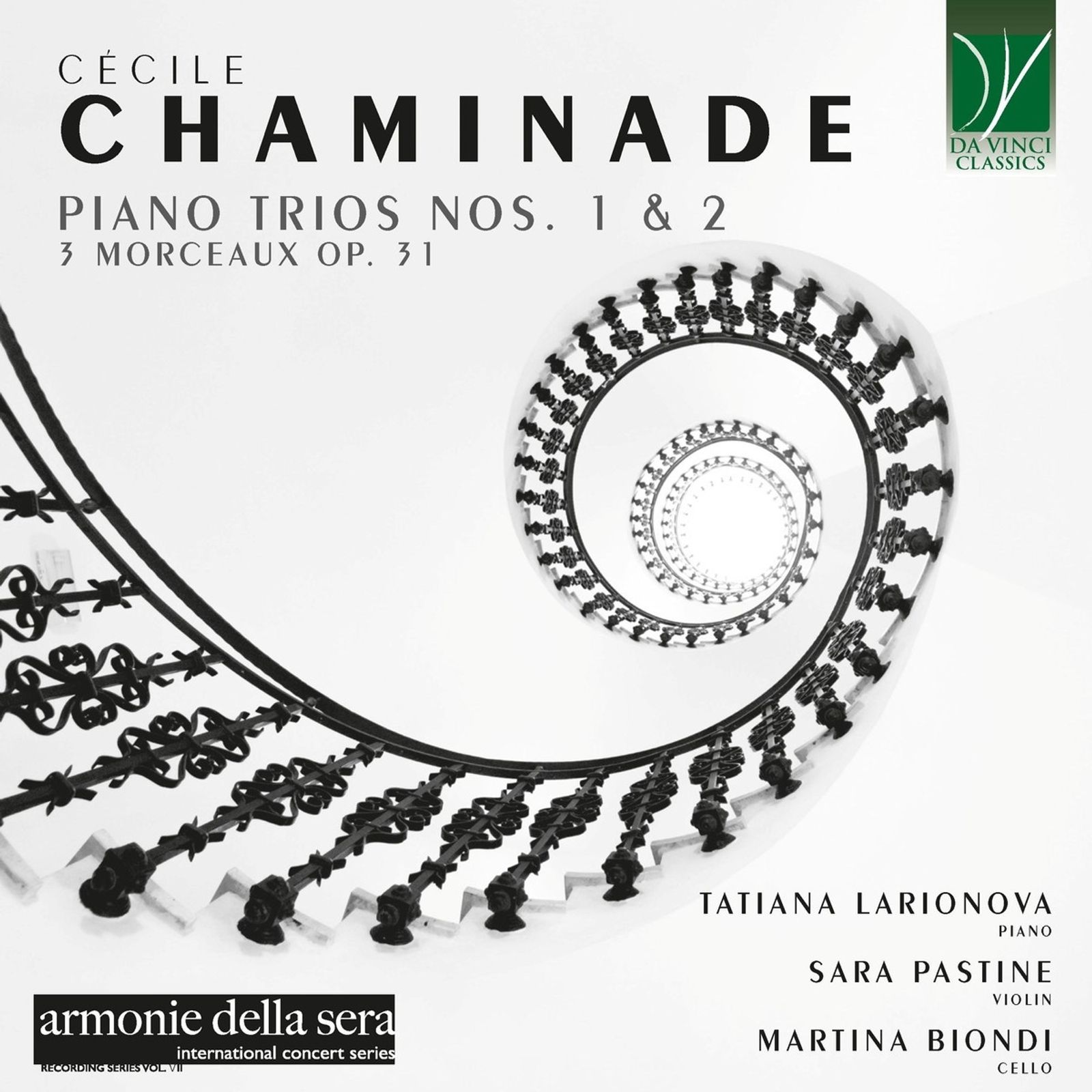
There is still something clinging to the name Cécile Chaminade (1857-1944) that smells of the Parisian salon: of tea services, of bourgeois musical evenings, of elegant character pieces, of music that charms but doesn't really oblige. When you put on the new cd from Da Vinci Classics – Tatiana Larionova (piano), Martina Biondi (cello) and Sara Pastine (violin) with the two piano trios and the 3 Morceaux op. 31 – you hear after just a few measures that this prejudice is built on sand. Chaminade turns out here to be not a composer of nice gestures, but someone who could think in grand forms.
That is no accident. Chaminade's Parisian education – private lessons with teachers connected to the Conservatoire, because her father refused her official enrollment – gave her a craftsmanship that she would maintain her entire life, even when the general public preferred to see her as a writer of graceful miniatures. The Trio No. 1 in G minor op. 11, written when she was barely in her twenties, immediately refutes that image: a powerfully rhythmically profiled main theme, contrasted with a broader sung second idea, built into a harmonic fabric that derives its tension more from subtle shadings than from abrupt contrasts. Larionova plays the piano part with a marked awareness of her function: she does not dominate, she breathes along with the strings and lets Biondi's cello, to which Chaminade often entrusted fine counter-melodies, sing out fully. Pastine and Biondi find each other in a tight string dialogue: where the cello anchors the harmonic depth, Pastine lets the melodic lines breathe with a natural elegance. The recording opts for a natural balance in which the piano is never unnaturally brought forward but sounds as an equal partner in the ensemble.
Between the two trios, the program places the 3 Morceaux op. 31 for violin and piano, three short tableaus (Andantino, Romanza, Bohémienne) that indeed come closer to the chamber music format, but in which Pastine and Larionova show that small scale is not a synonym for limited ambition. Especially the Romanza, the lyrical heart of the triptych, is convincing: not literal repetitions, but a theme that takes on a different harmonic color each time it returns. In the Bohémienne, Pastine skillfully avoids the folkloric cliché; her articulation never becomes caricatural, but remains fluid. Larionova follows her with a light, transparent touch that supports the dancing elegance without emphasizing it.
The real revelation, however, is the Trio No. 2 in A minor op. 34, a more mature and harmonically bolder work in which Chaminade sets two rhetorical attitudes – the energetic, almost hammering opening idea and a melancholic second theme – against each other and moves them toward each other with a steady hand. The trio builds up a contrapuntal density here that you don't yet find in the first trio, with imitations between the parts and register usage of the piano that goes beyond the classical accompaniment formula. In the middle section, the melody becomes almost vocal; Larionova knows how to make the piano resonate here without ever overshadowing the lyricism of Pastine and Biondi – precisely that kind of discretion that this music lives by. It is also striking how naturally Chaminade's melodies nestle in the memory without ever lapsing into sentimentality. The Lento forms the beating heart of the trio: music that does not seek its emotion in grand gestures, but in a melodic breath that slowly unfolds and touches all the more deeply. The chosen tempi also testify to confidence in the score: nowhere is the expression forced, so that the long spans of tension come fully into their own.
What this recording primarily reveals is that Chaminade's reputation owed more to the prejudices of her time than to the quality of her pen. Reviewers around 1900 praised her lyrical pieces as "charming" and "lovely" – feminine virtues – while work with pronounced thematic development quickly came to be seen as "too masculine" for a composer. A century later, that double standard sounds uncomfortably hollow, and precisely for that reason, a recording like this is more than a curiosity: it restores Chaminade to a position that was always rightfully hers.
Larionova, Biondi and Pastine play without embellishment, with a sound balance that does justice to the dialogue structure of this music – none of the three instruments imposes itself, and it is precisely this interplay that makes audible how carefully thought out Chaminade has weighed her voices against each other. Their greatest merit may lie elsewhere: they treat these trios not as a historical curiosity requiring goodwill, but play them with a natural confidence, as if this music had never disappeared from the repertoire. This conviction is contagious: under their hands, these works become not an archaeological find, but living chamber music that asserts its place without reservation. The warm, transparent recording and the solid accompanying essay on Chaminade's position between salon and Conservatoire support this approach. After finishing, the question that lingers is not why Chaminade fell into oblivion, but why it took so long before someone finally gave these two piano trios a convincing voice.