
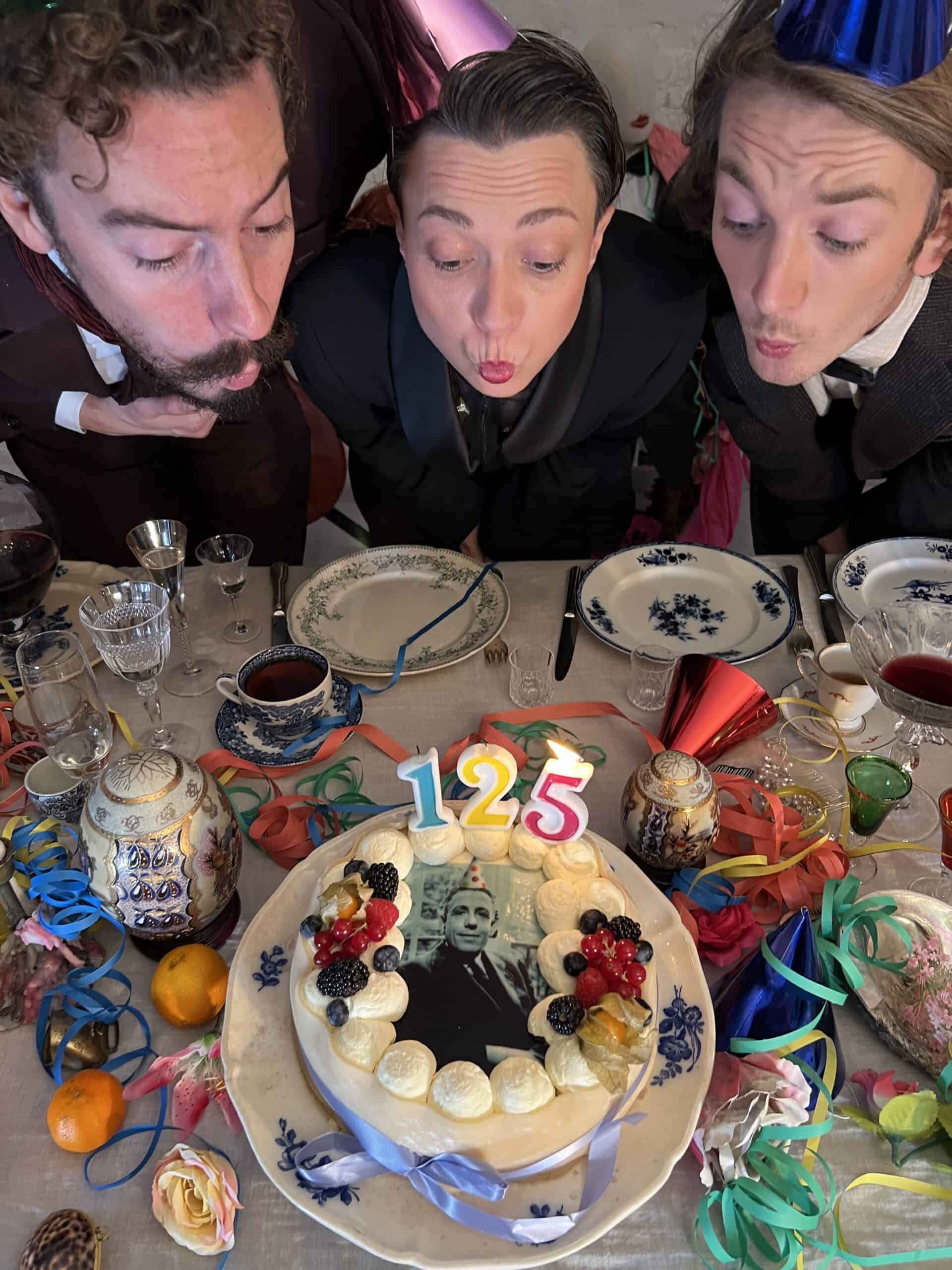
Antwerp 7 January 2024, an intimate birthday party for Francis Poulenc. In an unheated rehearsal room the breath of the guests forms little clouds, but there is candlelight in abundance and the musicians let the champagne flow generously. Soprano Naomi Beeldens sings with a timbre as if she were born in Paris, the guests imagine themselves for a few hours in the circles of Satie, Les Six and Jean Cocteau, at a soirée in Montmartre. After this delightful opening, the music collective Les Âmes Perdues carries its passion for the birthday boy for another year in four salon evenings in which they each highlight a different aspect of the eclectic Poulenc: religion, queerness, poetry and cabaret.
The first salon "Priez pour paix", which takes place in a church on 8 March, they announce as a (eucharist) celebration devoted to Poulenc's religious work. They dream aloud of nuns, homosexuals (or are they oboes?) and habits. Of a lecture on Poulenc's religious epiphany in Rocamadour. Of scenes from Poulenc's legendary opera Dialogues des Carmélites, with the obligatory guillotine and a small chalice of altar wine.
Les Âmes Perdues, it could be the title of a song by Poulenc. How did you choose the name of the collective?
Isaak Duerinck, pianist: No, we chose that name very instinctively following our graduation performance (2018) about the 1920s in Paris. I wrote my thesis on the influence of entertainment music such as jazz, music hall, circus, chanson on the life and work of Poulenc. Naomi graduated with the production La Voix Humaine, which I also worked on. Les Âmes Perdues sounds nostalgic, which suits us well. Ewout Lehouq, Naomi and I feel like old souls in modern, fast, neo-liberal times in which we try to find our way and do not shy away from technological means.
PIANO
Poulenc never set foot inside a conservatory, his mother taught him to play piano and at 16 he received private lessons from Ricardo Viñes. He developed into a very good concert pianist and accompanist who travelled half the world with baritone Pierre Bernac, among others.
Gabriel Tacchino, who only died last year, was the only student Poulenc ever had and you studied with him, Isaak. How did that happen and what do you carry with you from that?
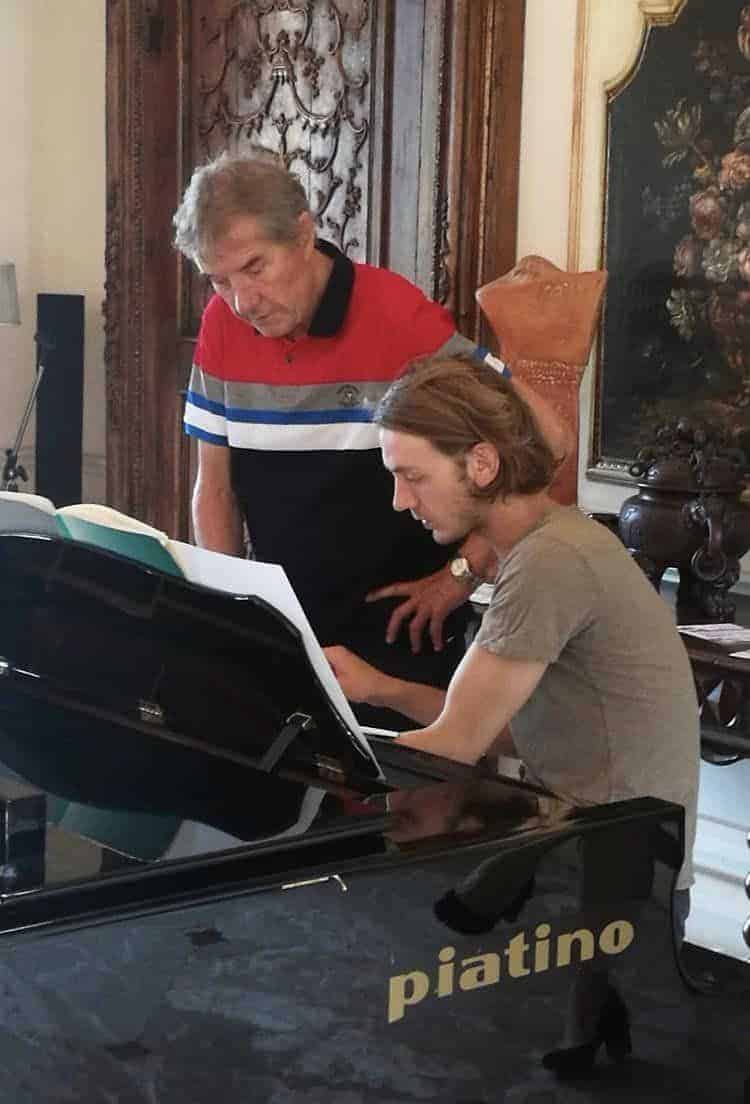
ID: One day, it must have been 2018, I received a Facebook friend request from Gabriel Tacchino who was already over 80 at the time. Perhaps his assistant was trying to expand the network of the old master a bit? I went to audition for him and after a stage in Turin I decided to study with Tacchino for a year at the Schola Cantorum in Paris.
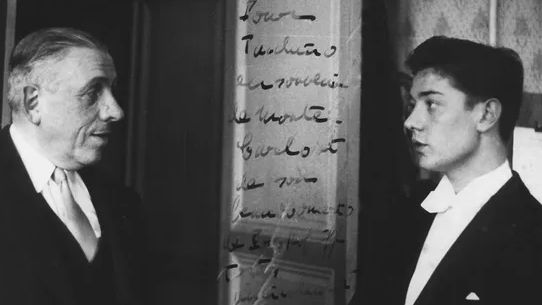 Poulenc had got to know Tacchino when he was the celebrated pianist of the young guard, championed by von Karajan. During his lifetime, Poulenc was already very concerned about who would continue to perform his oeuvre and record it after his death. It was his fervent wish that Tacchino would take this upon himself and therefore he gave him extensive piano lessons and passed on all the secrets of how to perform his music. For me it was absolutely fantastic to be able to get so close to Poulenc himself through Tacchino, pianistically but also through the many stories I heard and through my numerous visits to Parisian cultural life. He taught me about the metronome, fingerings, phrasing, playing straight ahead, clarity and about the pedal, one of Poulenc's obsessions. Mettez du beurre dans la sauce, he said, because for Poulenc there could never be enough pedal. On the one hand he loved la clarté française and his music is relatively clear, the score is never really dense, the chords are clearly audible, on the other hand he wanted the colours and harmonies to blend by immersing them in a halo of pedal. In any case, the lessons with Tacchino made me a better pianist, something I will always be grateful for.
UN MOINE ET UN VOYOU
 Francis was the son of the devout Catholic Émile Poulenc, from the countryside of Aveyron and co-founder of the pharmaceutical company Rhône-Poulenc. His mother Jenny Royer was a lighthearted Parisian who played the piano beautifully and also loved light music, l'adorable mauvaise musique. To music journalist Claude Rostand we owe Poulenc's label "half monk, half rascal".
What would you like to add to those two extremes?
ID: Poulenc always sought the middle of the balance; whenever he was somewhere, he always wanted to leave. He was a city person with a longing for nature. He was a society figure you could meet at salon evenings, among others at la Princesse de Polignac, but then he would get homesick for his country house Le Grand Coteau in Noizay. Once there, he would organize parties because he missed Paris. Poulenc had a very serious side, as will become apparent in our first salon, but his letters show that he had a good sense of humor and could be particularly sharp-witted. He suffered from fears and insecurities. Poulenc was not a modernist, but one of the last composers working in the melodic, romantic tradition, which made him uncertain. Would Boulez, Ligeti and that young guard find him interesting? His taste and style also knew extremes; one day he wrote a religious cantata and the next day a featherlight piece of entertainment. At twenty, he sold a collection of Beethoven music to buy a ticket for a Maurice Chevalier performance. Furthermore, his homosexuality and complex relationships caused much inner tension. He was a hypochondriac Burgundian who ultimately died of a heart attack at 64.
[video width="1280" height="720" mp4="https://klassiek-centraal.be/wp-content/uploads/2024/02/priezpourpaix.mp4"][/video]
PRIEZ POUR PAIX
During a vacation in the Limousin, Poulenc learns of the death of the talented French composer Pierre-Octave Ferroud, who had died horrifically in a car accident in Hungary and was beheaded. The horrific death of his young colleague affects him so deeply that he decides to undertake a pilgrimage to Rocamadour with Pierre Bernac, where La Vierge Noire is venerated, which was not yet a tourist attraction at that time.
"While I was thinking about the fragility of existence, spiritual life suddenly attracted me again. Rocamadour brought me back to the faith of my youth. This holy place, certainly the oldest in France, had everything in it to convert me." Francis Poulenc.
On August 22, 1936, Poulenc has a mystical experience in Rocamadour, after which he intensively searches for his religious roots. From then on, he composes much more choral and religious music.
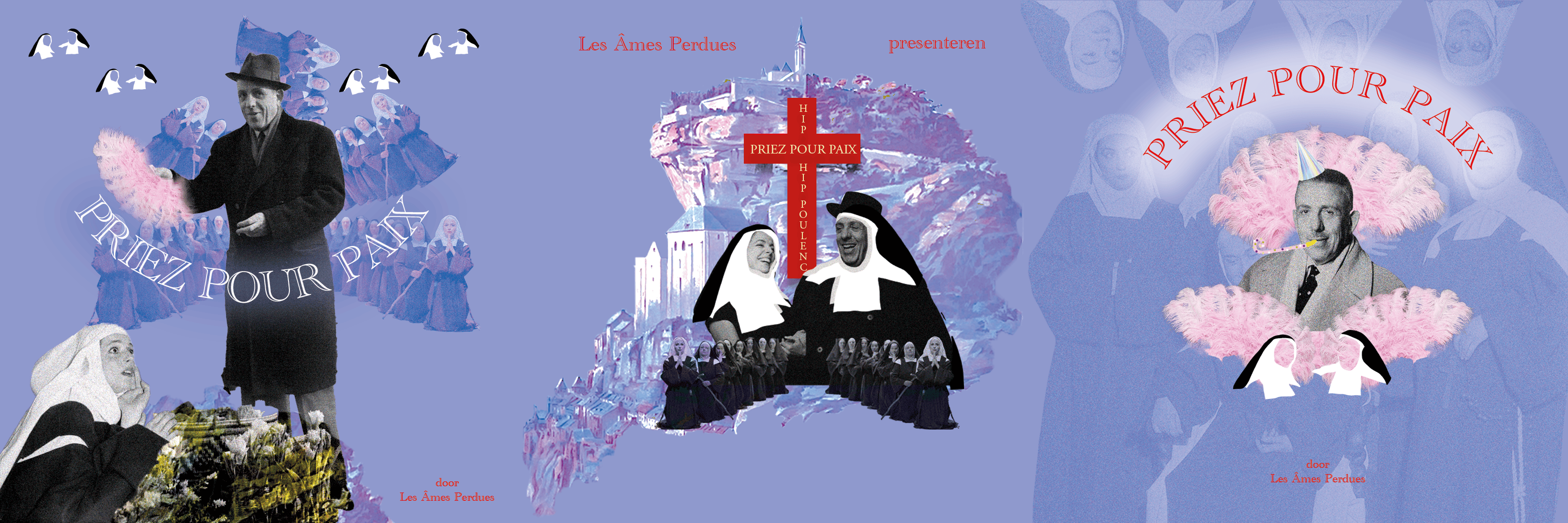
In the first salon, Les Âmes Perdues brings fragments from 'Litanies à la Vierge Noire', a choral work that Poulenc begins sketching the evening after his revelation. He had bought a replica of the wooden statue of the Black Virgin and the text of her litanies, which he set to music. They also perform, of course, some of Poulenc's piano pieces, the three-part motet 'Ave Verum Corpus', fragments from his very last composition, the Sonata for oboe and piano from 1962 in which he quotes himself. Perhaps a quick prayer before death? Les Âmes Perdues dedicate the evening to all victims of the wars currently raging in the world and particularly in Gaza. So the stunningly beautiful 'Priez pour paix' cannot be missing, a song for soprano and piano from 1938, set to a text by the 15th-century poet Charles d' Orléans.
For Isaak Duerinck, the opera 'Dialogues des Carmélites' and especially the final scene belongs to the most beautiful thing ever written.
How will you make the rolling heads sound when the nuns and Blanche are beheaded on the scaffold?
ID: Oh, we're still working on that intensively. Perhaps logistically our first salon is the "most difficult" to bring with a small collective. Of course, we call on friendly singers and musicians to collaborate. We don't have an orchestra at our disposal, but we do use all our imagination, our youthful energy and possibly a synthesizer to experiment with modest means, present large works in reduced form, and thus convey our love for Poulenc. Francis would surely appreciate it.
"Priez pour Paix", Friday, March 8, 2024 at 8:00 p.m. in the Heilige Geestkerk, Mechelsesteenweg 135 in 2018 Antwerpen. Free contribution.
The following salons are on May 10: Francis 'Queer' Poulenc, October 4: Poulenc, the song composer of the poets Apollinaire, Éluard, Max Jacob, Louise de Vilmorin, … and December 6: a closing party in cabaret style.
The core of Les Âmes Perdues consists of ISAAK DUERINCK (°1994) pianist, accordionist, teacher at the Antwerp Conservatory. NAOMI BEELDENS (°1988), soprano, performer with a preference for music theater, contemporary and experimental music, is coach Artistic Final Projects at the Royal Conservatory. EWOUT LEHOUCQ (°1987) performer, cellist, baritone and countertenor.