
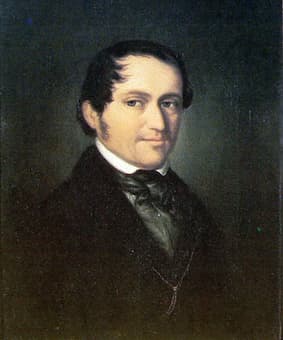
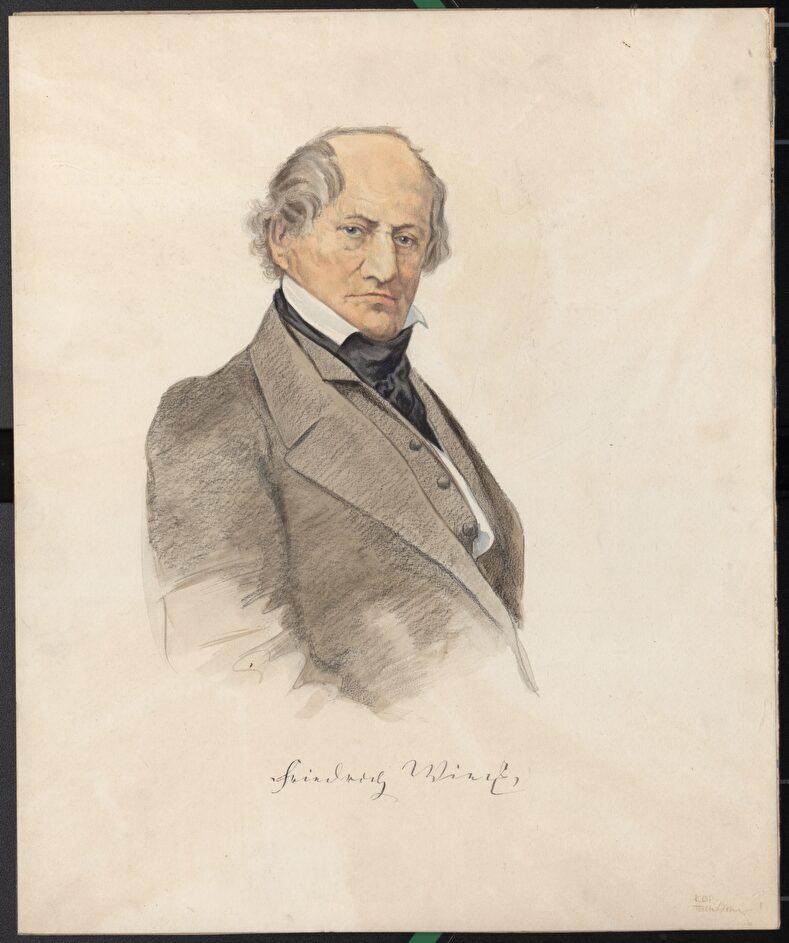
 Friedrich Wieck[/caption]
Friedrich Wieck (1785-1873) is best known as the 'litigious' father of Clara. He did everything to prevent his daughter from marrying Robert Schumann. On the other hand, he was a respected piano teacher. Despite the fact that he had only six hours of piano lessons in his entire life, he independently developed a method to educate one of the greatest pianists of the nineteenth century. Today we examine that method and how Friedrich Wieck trained Clara Wieck Schumann.
The principles of the Wieck method
- First, lessons must take place three times a week.
- Begin by teaching students the musical alphabet. Explain to them how, in music notation, the alphabet goes "C, D, E, F, G, A, B" and then repeats itself, starting again with "C."
- Explain and demonstrate how keys to the right become sharper and higher in pitch and keys to the left become flatter and lower in pitch.
- Train students to hear the differences in pitch and how higher and lower tones sound next to each other.
From the start you begin teaching the visual relationships between the black keys and the white keys. For example, every time you see two black keys together, understand that the white key in the middle of that cluster will always be a D, every time you see a cluster of three black keys together, the white key to the right of it will always be a B, etc.
Introducing Rhythm
"Introduce rhythm by asking the student if they can count 1, 2, 3 out loud at a steady tempo. Begin repeating 1, 2, 3 and simultaneously play a piano key or chord while the child counts." In his book Wieck explained how this process works: "I count 1 of the chords with her and have her count 2 and 3 herself or otherwise I count with her on 2, and have her count 1 and 3 alone, but I make sure that I strike the chord promptly and with precision. Then I strike the chord in eighth notes and have her count 1, 2, 3. In short, I give the chord in different ways to teach her steadfastness in counting and to concentrate her attention. In the same way I teach her to count 1, 2, 1, 2 or 1, 2, 3, 4, 5, 6 while I tell her that music is sometimes counted in three-quarter time and sometimes in 2/4 or 4/4 time."
[embed]https://www.youtube.com/watch?v=rcKpWPW5aPE&t=1s[/embed]Introducing Chords
[caption id="attachment_44181" align="alignleft" width="400"]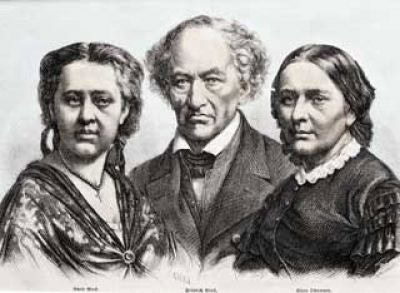 Marie Wieck and Clara Schumann with Friedrich Wieck, c.1880[/caption]
Next, you teach the student the concept of chords. Wieck wrote about how to hear the difference between major and minor chords: "When different tones are struck simultaneously, if they sound well together they make what we call a chord. There are both major and minor chords: the major chord sounds cheerful, lively; the minor, sad, dull, as one might say; the first laughs, the latter weeps."
Wieck encouraged teachers not to have students think too much about the character of chords, trusting in students' instinct for what sounds cheerful or sad. He advised explaining how the difference in these chords comes from "the third, counted upward from the lower note C and depends on whether you take it a half tone higher or lower, E or E-flat." This builds on the previously acquired knowledge of pitch differences and note names.
How to speak about more advanced techniques
Wieck advised regularly referring to more advanced techniques that still needed to be introduced, by telling students things like: "I will explain this better to you later, when you learn about the tonic, the third, the fifth or dominant, the octave, and so on." He writes further: "It is beneficial and psychologically correct to occasionally, in passing, touch on points that will be taught more thoroughly later. It awakens the interest of the student. In this way, the usual technical terms are sometimes used in advance and a necessary, superficial explanation is given."
Clara Wieck Schumann's Opus 3, published in 1833 when she was 13 years old [embed]https://www.youtube.com/watch?v=IxZCUZxQU4Y[/embed]Finger Dexterity
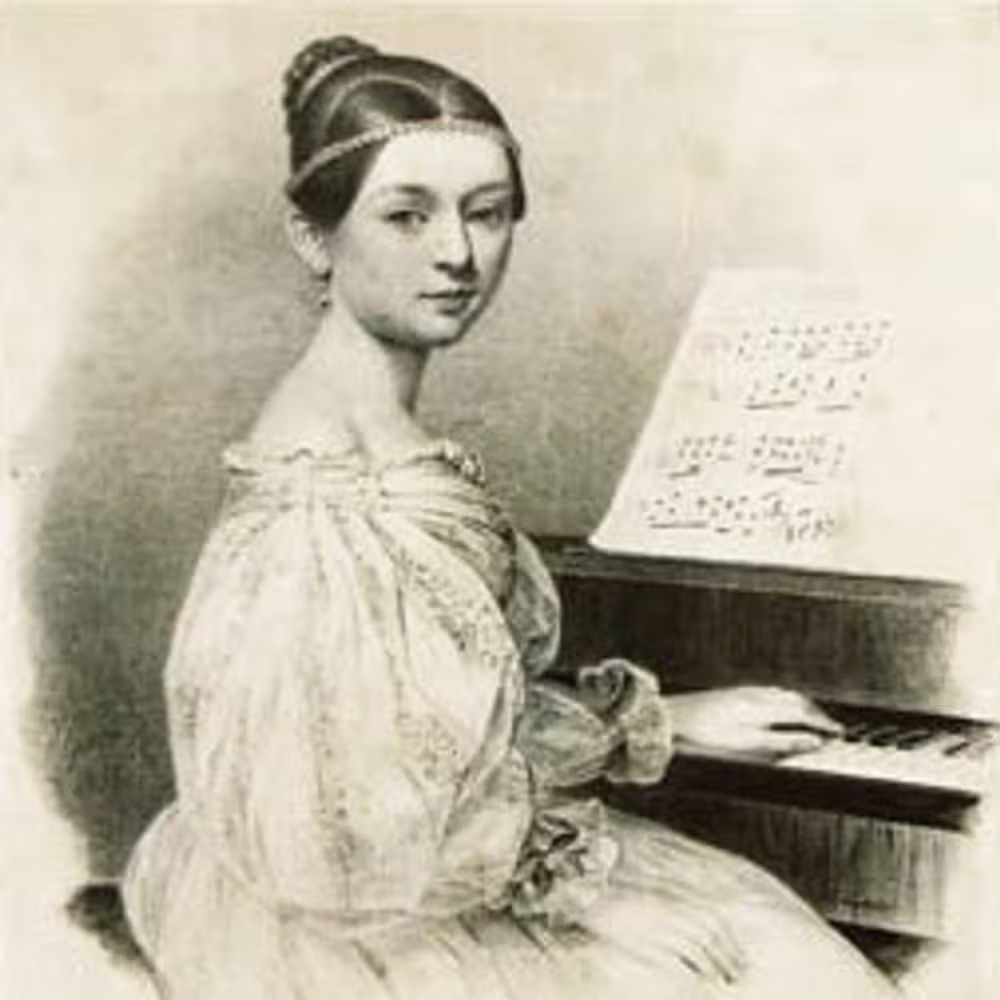
Wieck encouraged teachers to work with students at a table to develop finger dexterity and evenness of movement. "You will learn to move your fingers lightly and loosely and completely independent of the arm, although they will first be weak and you will learn to lift them and drop them well. Besides, we will devise a few exercises to teach you to loosen your wrist, for that must be learned in the beginning to obtain a fine touch on the piano. That is, to make the tones sound as beautifully as possible."
Wieck believed that teachers should immediately dive into more advanced theory. He specifically emphasized teaching the whole-step/half-step patterns of a major scale, starting with C major to demonstrate. He advised that teachers would learn how there are only half steps between E and F, and then B and C. In his words described: "This is quite important for my method, because in this way the different keys can be clearly explained."
Clara Wieck Schumann's Op. 4, published in 1835 when she was 16
[embed]https://www.youtube.com/watch?v=0-PLh-n0alw&t[/embed]Reading Sheet Music
When did Wieck introduce reading sheet music? He believed in teaching this later than one might think: "I perhaps teach the treble clef notes after the first six months or after sixty or eighty lessons, but I teach them in my own peculiar way, so that the spirit of the pupil can be kept constantly active. With my daughters I only learned the treble clef notes at the end of the first year of instruction, the bass clef notes a few months later."
He immediately anticipated a question from the reader: so where should a teacher focus when teaching a student before introducing sheet music reading? Wieck's answer:
- A light touch
- Playing chords from the wrist
- Scales in all keys, performed evenly (first separate hands)
- Cultivating a sense of rhythm
- Dividing measures
- Understanding the relationships between the dominant and subdominant, as well as transposing
Introducing Piano Pieces
After all this Wieck finally began introducing his own composed pieces: "I teach them to play fifty or sixty little pieces that I have written... They are short, rhythmically balanced, pleasant and striking to the ear and are designed to gradually develop increased mechanical skill. I require that they be learned by heart and often transposed into other keys, so that memory - indispensable for piano playing - is unconsciously greatly enhanced. They must be learned perfectly and played well, often, according to the capacity of the pupil, even finely; in strict time (counting aloud is rarely needed) and without stumbling or hesitation; first slowly, then fast, faster, slow again, staccato, legato, piano, forte, crescendo, diminuendo, etc. I always find this teaching method successful, but I do not put the cart before the horse and without prior technical instruction I do not begin my piano lessons with the extremely difficult acquisition of the treble clef and bass clef notes."
His daughter Marie published these studies after his death. You can view them for free here.
Keep Students Interested
Despite his reputation as a tyrant, Wieck believed it was important to engage and entertain the student. In this respect, he actually sounds quite modern. "I never try to teach too much or too little and in teaching each thing, I try to prepare and lay the foundation for other things that will be learned later. I consider it very important not to try to stuff the child's memory full of the teacher's wisdom (as is often done in a crude and harsh way), but I strive to awaken the spirit of the pupil, to interest him, to let him develop himself and not to degrade him to merely a machine. I do not demand the practice of vague, sad, time- and spirit-killing piano rambling. In any way, as I see, your little Susie was forced to learn, but I follow a musical method and do this always with an eye to the individuality and gradual development of the pupil... I constantly keep the formation of good technique in mind, but I do not make piano playing unpleasant for the pupil by urging him or her to pointless and meaningless mechanical 'practicing.'... All this must be done without haste and without tiring the pupil too much with one thing or exhausting the interest which is of the greatest importance."
Clearly Friedrich Wieck's method is very different from most beginning piano methods used today. Perhaps modern teachers can be inspired by elements of his unconventional techniques.
[embed]https://www.youtube.com/watch?v=Xol1DKul984&t[/embed]