
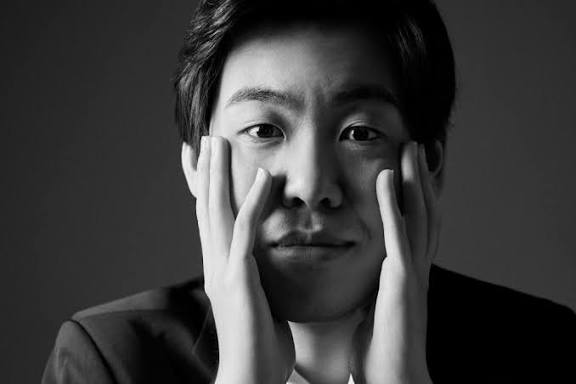
There is a difference between someone who answers and someone who thinks out loud. Pianist Sun Yutong clearly does the latter, and in doing so reveals something more of himself than any polished answer ever could. Werner De Smet spoke with him for Klassiek Centraal, shortly before his concert with the Orchestra of the Zhejiang Conservatory of Music.
Sun Yutong answers thoughtfully, hesitantly, sometimes searching for the right word – and therein lies his charm. He does not seem interested in perfect phrasing, but prefers to think out loud about what music means to him, about the relationship between East and West, about technique and personality and ultimately about the question of what a concert could do with a listener. That openness and honesty made the conversation particularly pleasant: Sun Yutong does not speak from grand theories, but from his own experiences, and precisely because of that his answers take on remarkable depth.
His musical journey took him from Beijing to Boston, where he studied for ten years at the New England Conservatory of Music. He does not see these different worlds as two opposing musical systems, but as experiences that can complement each other. "In the 21st century, it's all about fusion," he says. He understands why some fear that music will lose its originality in the process, but he himself sees the possibilities above all. A musician with an Asian background who plays Western music, or a Western musician who delves into Asian music: for him these are examples of how people from different backgrounds can meet through music. People often say that music is a universal language, and for Sun Yutong that does not mean that everyone must understand music in the same way. On the contrary: different people can approach the same work from a different background and still share it with each other. "We may not agree with each other, but somehow we can accept each other." It is a simple formulation, but it says a lot about his own musical attitude: difference need not mean opposition, but can precisely be a source of enrichment.
His training in Beijing and Boston shaped him in different ways. In China he received solid technical training – not a limitation, but a necessary foundation for progressing later. "Asia is a wonderful place to train your technique," he says. But for him, technique is ultimately only a means. In Boston, another development had more space: that of personality: "After technical training, the most important thing is that you let yourself show through the notes, not that you let your technique show through the notes." It is perhaps one of the most characteristic statements from our conversation, because it clarifies how Sun Yutong views the craft of being a musician. The virtuosity that can be so impressive on the outside is for him never the ultimate goal. It should rather disappear behind what the musician wants to say with the music. That is why he also prefers not to talk about music as something you can ever completely 'learn': "You can never fully learn music. It is about the development of your personality." Making music thus becomes not an endpoint that a pianist reaches after years of study, but a continuous development of the person behind the pianist.
This becomes particularly clear when he speaks about the work of Chinese composer Qigang Chen that he will perform at Young Euro Classic. In this music, Chinese musical traditions come together with a contemporary orchestral language, and it is precisely this combination that makes the work personal for Sun Yutong. He is Chinese, but his pianistic training is largely rooted in Western musical culture. In this composition he encounters both worlds: "I feel a connection to the music because it has a Chinese origin, but through its colour and the Western compositional style I also feel another connection. These two feelings come together, and that feels special." Yet he wants to avoid the public approaching the music exclusively as a cultural curiosity. He says it simply and repeatedly: he does not want listeners to experience the music as "exotic." "I want them to really feel the music. I don't want us to label it as Chinese music." When we hear Beethoven, he says, we sometimes call him a German composer, but ultimately we listen to Beethoven anyway. It should be the same with this music. Not: this is good Chinese music, but simply: this is good music. For him, cultural identity need not disappear at all; it just does not have to stand between the music and the listener.
His collaboration with the young orchestra during Young Euro Classic he experiences from a similar perspective. What strikes him most is the passion with which young musicians make music. He himself is by now older than most orchestra members, he says with a smile, but precisely because of that the encounter is inspiring for him. In young musicians he experiences a spontaneity that is sometimes harder to maintain later in a musical career: "That passion is much purer." Working with them makes him more open to music himself, he says. The experienced pianist brings his knowledge and experience, but is at the same time newly touched by something young musicians possess: the direct, unguarded love of making music. It also fits his view of Young Euro Classic. A festival that brings together young orchestras from different countries is, in his view, more than a series of concerts. At a time when it is often said that classical music is losing its audience, such a festival has a special significance. Sun Yutong does not want to gloss over the problems with big words. "It does not mean that classical music is still alive," he says soberly about Young Euro Classic, but "it means that we are trying to let it live." It is precisely that sobriety that makes his statement powerful: the existence of a festival is for him not proof that all is well with classical music, but a concrete attempt to give it a future.
What does he hope the audience will take home after the concert? He thinks of films. When he watches a bad film, he says, he stands up immediately after the final scene and leaves before the credits are over. But when a film really moves him, he stays seated until the end. Not because he needs to see anything else, but because he needs time to think: what exactly moved him so, what made this film special? That is also what he hopes to achieve with a concert. Not necessarily immediate applause, not just admiration for the virtuosity and not even a clear answer, but rather a listener who leaves with a small doubt or question and perhaps thinks of the music again a day later: "A day later you think back to this concert and you think: wow, I really got something out of it."
When the conversation was already over and the camera had stopped rolling, Sun Yutong lingered for a bit longer. What he said then fit seamlessly with everything that had been said before, as if the conversation itself continued without the pressure of a microphone. He talked about his quest for honesty – not only in music, but in life itself. Music, he said, actually doesn't need words; it speaks for itself, or it doesn't. It's a thought that in retrospect works almost like a key to everything he had said earlier. His reluctance to have his playing labeled as "Chinese music," his conviction that a musician should reveal himself through the notes rather than his technique – it's all a variation on the same desire: that nothing should come between the music and the listener. No label, no explanation, no word too many. Only that honest, somewhat vulnerable encounter between what is being played and who is listening to it.