
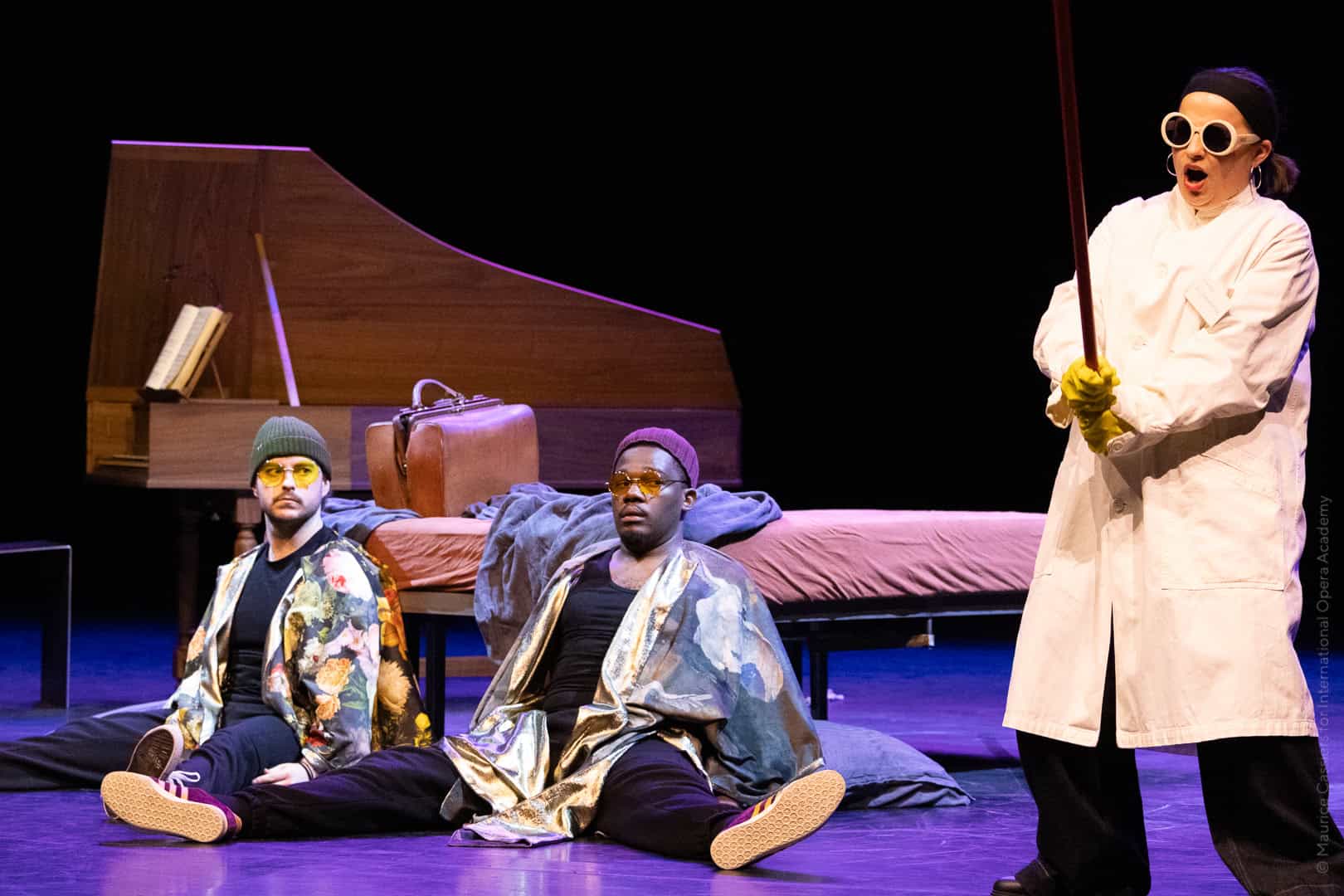
For three days in March, International Opera Academy programmed Così fan tutte, the third Da Ponte opera by Wolfgang Amadeus Mozart (1756-1791). Curious about the continuation of the opera school that Guy Joosten once started with, I wanted to see this Mozart opera with these young artists. The experience was exceptionally positive.
Così fan tutte with the subtitle ossia la scuola degli amanti has many layers, and the production dealt with this in a particularly clever, smart and yet simple way. Così fan tutte is a straightforward story with a limited number of characters, two couples and a scheming duo. The love of the couples Fiordiligi and Guglielmo on the one hand, Dorabella and Ferrando on the other, is put to the test, and what begins as a game becomes cruel truth, albeit with an open ending. In his foreword, Michiel Delanghe, the director of IOA, clearly justifies his choice for this opera. Young people are also continually confronted with making choices in real life, with expectations and whether or not taking freedom. What is the value of loyalty and identity? Thus the game on stage simultaneously becomes a kind of laboratory for real life. The actors absolutely passed this test with this ideological background of the piece, and their realization of it on stage provided a fantastic theatrical experience.
The comic and the ironic, the pseudo-exciting and the at times tragic nature of the intrigue was handled in an intelligent and convincing manner. The staging is kept particularly simple. A bare stage with a bed – rather a mattress on the floor, a few bar stools, a couple of small racks, a low table, a kind of display bust. And especially, a harpsichord. Playing hide-and-seek under a sheet, bar stools as a "notary's office", a broom handle that takes on various functions, and also somewhat of a light-erotic connotation, two cups with the initials F and G. Nothing more was needed to set the imagination going for the various locations and aptly comic allusions. Furthermore, sparse lighting and contemporary, sometimes also funny clothing, such as the kind of Scottish skirt worn by Don Alfonso.
The singers clearly felt at home and mastered their vocal parts admirably well. Although still very young, they all have some opera experience already and that will certainly explain their self-confidence and spontaneity. The farewell aria Soave sia il vento sounded effectively touching, Juliana Cook sang with a beautiful high soprano the fiendishly difficult aria Come scoglio, Sophie Patterson was a touching and playful Dorabella with a delightful E amore un ladroncello. The voices of the sisters also matched nicely in the duets. Despina (Rosa Sparks) is simply a prototype of tongue-in-cheek comedy with a bright soprano timbre. Ferrando and Guglielmo are also well cast with the tender tenor of Yiming Liu and the warm yet powerful baritone of Alex Gibb.
Kris Belligh steals the show as Don Alfonso. He completely gets into the skin of the schemer and clearly enjoys it! He is almost constantly on stage, always finds a meaningful posture and moreover he has a beautiful baritone that can convey both soft slyness and authority. A perfect Don Alfonso!
The harpsichord on stage of course provides the accompaniment to the recitatives but at the same time becomes almost part of the whole, certainly with a subtle harpsichordist like Job Clement, who also conducts himself in an engaged manner toward the story. An excellent idea.
Nabil Shehata conducted the Flanders Conservatory Orchestra, which in the brochure is presented as a premiere for this production. For the first time, students from three conservatories Antwerp, Gent and Brussels play together in one formation. It produced an exciting and moving Mozart opera, with playfulness, nuance and good support for the voices. Here and there an oboe or bassoon not sounding quite correct is nitpicking in this context.
The performance received exuberant applause which should certainly serve as encouragement to pursue this objective further: "A unique collaboration that not only carries this production, but also helps build the future of our operatic landscape". I cite this quote from the program booklet which is in English only. Perhaps a suggestion for the future: contributions also in Dutch? Because IOA certainly deserves the best for the future.