
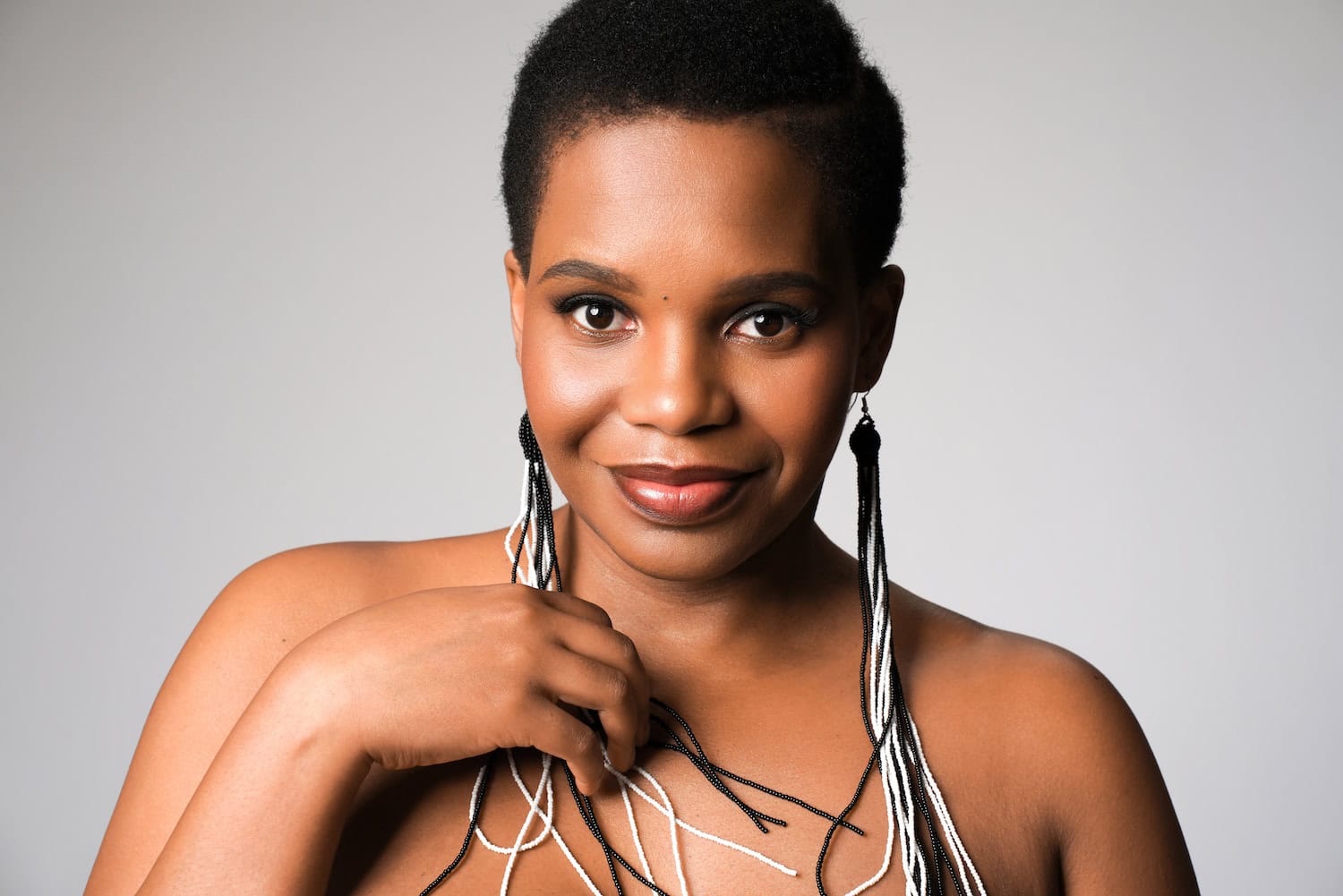
Her name alone sounds like music to the ears, an arpeggio of sounds. Born in 1979, Tutu Puoane grew up in a township in South Africa. She studied at the University of Cape Town in Cape Town. In her early twenties, she ventured out into the wide world and continued her studies in The Hague while establishing herself independently. In 2004 she moved to Antwerpen. She found a new homeland here and a partner in-live-and-in-crime.
With her husband and keyboard virtuoso Ewout Pierreux, she forms a unique partnership. Jazz singers are not thick on the ground in the Low Countries. Tutu Puoane knows how to use her voice as an instrument full of refinement. With her perfect timing, she makes every concert a musical celebration, sings the stars from the sky and immerses the audience in her stylistic vocabulary.
As a performer, she has built an iron-strong reputation. In her lyrics, she gave not only sadness and grimness but also joy a broader dimension. She received standing ovations and rave reviews. An artistic career is an uncertain adventure. It is only the white ravens that can sing it out for a lifetime.
As a jazz singer, she stands alone at the top. The magic of her voice, the passionate text, the compelling music and her stage presence make her unique. She loves life in fire, in love, in all times. She brings her own songs that are both accessible and adventurous. Each song showcases her carrying, warm timbre. With the year-end in sight, it becomes a matter of enjoying family, but in 2025 she will once again take the stage without hesitation, including in the foyer of the Fakkeltheater. In this interview you will get a picture of a strong and warm woman.
Her husband occasionally steps up to the plate as well.
- You built a singing career. Who were your role models?
Tutu: Dianna Reeves first and foremost, and then Nathalie Cole and her father Nat King Cole. In South Africa, Sibongile Khumalo, a woman I greatly admired. - Do you come from a musical family?
Tutu: My grandfather was a pianist and my mother sang in choirs. Not professionally but with great dedication. My grandfather actually had the greatest musical influence on me. He undoubtedly planted the seed in me. - After your studies in your home country, did you continue studying in the Netherlands?
Tutu: I grew up in a jazz-minded environment. My mother and uncle were completely into jazz. On Sunday afternoons, people would just sit on the steps and start playing jazz records. That special vibe caught on with me. In Cape Town, the best music schools are for classical training, but I went to the conservatory in The Hague to follow a specific jazz program. - You performed in programs that paid tribute to greats like Billie Holiday and Nina Simone.
Tutu: They are singers of renown and fame. It was not my idea, but I was asked for those concerts. Reviving their repertoire was an honor. - If I ask you to describe your personality…
Tutu: Twenty years ago I was very ambitious. A lot has happened since then. I got married, had children. Then priorities shift a bit. Now that I am a grown woman, I try to cultivate that ambition again. I have a wonderful passion for my work.
Ewout: Tutu is no dreamer. She also has no star airs. She remains down to earth under all circumstances and is close to people, her audience. - What is pleasant about jazz—a license to experiment? To adapt to sounds, rhythms and instruments?
Tutu: Absolutely. That's why I love it so much. Jazz singing is synonymous with timing, phrasing and improvisation. You can sing the same song for twenty years and yet it will always sound different. Especially when you are surrounded by good musicians, and I am lucky to have that with my band. In the moment, in the act together with each other and the audience, communicating… You have to be open to what the musicians around you are doing and pick up on that. You can't shut yourself off from it. It is an intense part of what is happening. It arises on the spot, happens almost instinctively. It is a very organic process, a cross-pollination. Then you start to speak a language with the people who stand with you on the stage. - You almost earned a certificate in technically difficult songs.
Tutu: It is a language that is not well understood from some quarters. Jazz improvisations often revolve around vocals, scats. Ella Fitzgerald was a master at that, for example. Paraphrasing was her thing. Highly impressive. I only want to perform with live musicians. That keeps it spontaneous. I don't work with backing tracks. Standing among the people and reacting to what happens keeps it lively. If someone coughs in the middle of a note, for example, I play with that sound and integrate it into my singing. Jazz is not static but fluid. - Last year you made a beautiful album 'Wrapped in Rhythm' with work by your compatriot Lebogang Mashile, among others. What appeals to you about it?
Tutu: Her poetry. She has a story to tell. I recognize so much in her work. I appreciate how she expresses it. - Layered text material?
Tutu: I feel in my bones what she writes about. We have a lot in common. She was born in the United States. As a teenager she moved to South Africa. I was born and raised there and moved to the Low Countries around my twenties. I recognize the feeling of living in two different places and cultures. Also how she writes about the community I grew up in. I see the township and the people. Our neighbor brewed beer. In the mornings, men would go down to her place and drink themselves stupid looking for forgetfulness. When I read her poems, I see it all before my eyes. - Art is also a powerful weapon to survive the banal and raw sides of this existence.
Tutu: Her engaged poetry, giving it strength through music, is a beautiful bond. To capture the tragedy without becoming overly sentimental. In these postmodern times, everything is sacrificed on the altar of superficial pleasure. People forget that misery and injustice are part of life. - You have been living here for quite a while now. Do you miss South Africa?
Tutu: Every day, and especially at this time of year. It's cold, dark and grey, and people can be quite cold too. In South Africa the temperature is wonderful and people interact with each other in a warm and spontaneous way. - A man who stands at your side both privately and professionally—what is the secret of the chemistry between you two?
Tutu: We met each other on stage and have now been together for well over 20 years. We have grown together as individuals and as musicians. Our bond is a blessing. Many people grow in a relationship, but grow apart and away from each other. We grow more and more toward each other. Our musical bond has become stronger and stronger. It is a great blessing that you can do and experience that with your partner. It is not always easy, but happiness must be cherished and cultivated. We also have two beautiful children. A wonderful family. - You are giving four concerts in the foyer of the Fakkeltheater. One concert is already behind you and was a resounding success. Three more evenings follow, with programs of musical variety and warmth.
Tutu: The foyer of the Fakkel is an ideal stage for me. It has the intimacy of a jazz cellar. I have a regular band that functions in a certain way. I work with my own material and my own sound. I love those musicians. But it is also nice and a challenge to share the stage with other musicians. They are all internationally renowned jazz musicians who pass through. They know the repertoire: the Great American Songbook. It is nice to play with different lineups without too much rehearsal. I love the culture of playing together, jam sessions. Ewout: You build a career with your own material, but alongside that, the fire keeps burning of a jazz musician who likes to play with people he has never been on stage with before. In the perfect combination of feeling, heart and technique. Fill the space with pulsating energy. The Fakkel sessions are the opportunity to do that alongside the other work. - That is actually the essence of jazz.
Ewout: Voilà. A melting pot of talent, experience and expertise. Just in a very pleasant and relaxed way, without much rehearsal, bring different combinations of musicians together and let the music spontaneously bubble and fizz for an evening. - You have already realized quite a few wonderful things—are there still dreams?
Tutu: Always. Like a child, I keep dreaming. That doesn't stop. Some dreams are the fuel to do what we do… - A quote from George Bernard Shaw fits nicely there: "We don't stop playing because we grow old…. We grow old because we stop playing and dreaming… "
Tutu: Exactly. - Why should people come to the Fakkeltheater?
Ewout: It is very cozy and there is great interaction with the audience. The foyer of the Fakkel also simply refers back to the original intention of jazz music: a small club where people, so to speak, sit on the lap of the musicians. That is part of the charm and part of the communication. That is also what jazz musicians like to do best. - Are there nice projects in the pipeline for 2025?
Tutu: Yes, in 2025 comes volume two of 'Wrapped in Rhythm'. That will be a grand project with the Dutch Metropole Orkest. Besides that, I want to make a dream come true: bring a book to the market with all my songs. Regularly I get requests from Cape Town and Johannesburg from students: I have an exam soon, can I sing a song of yours and can you provide me with the score? I'm going to make it my work to compile those in a nice book.