
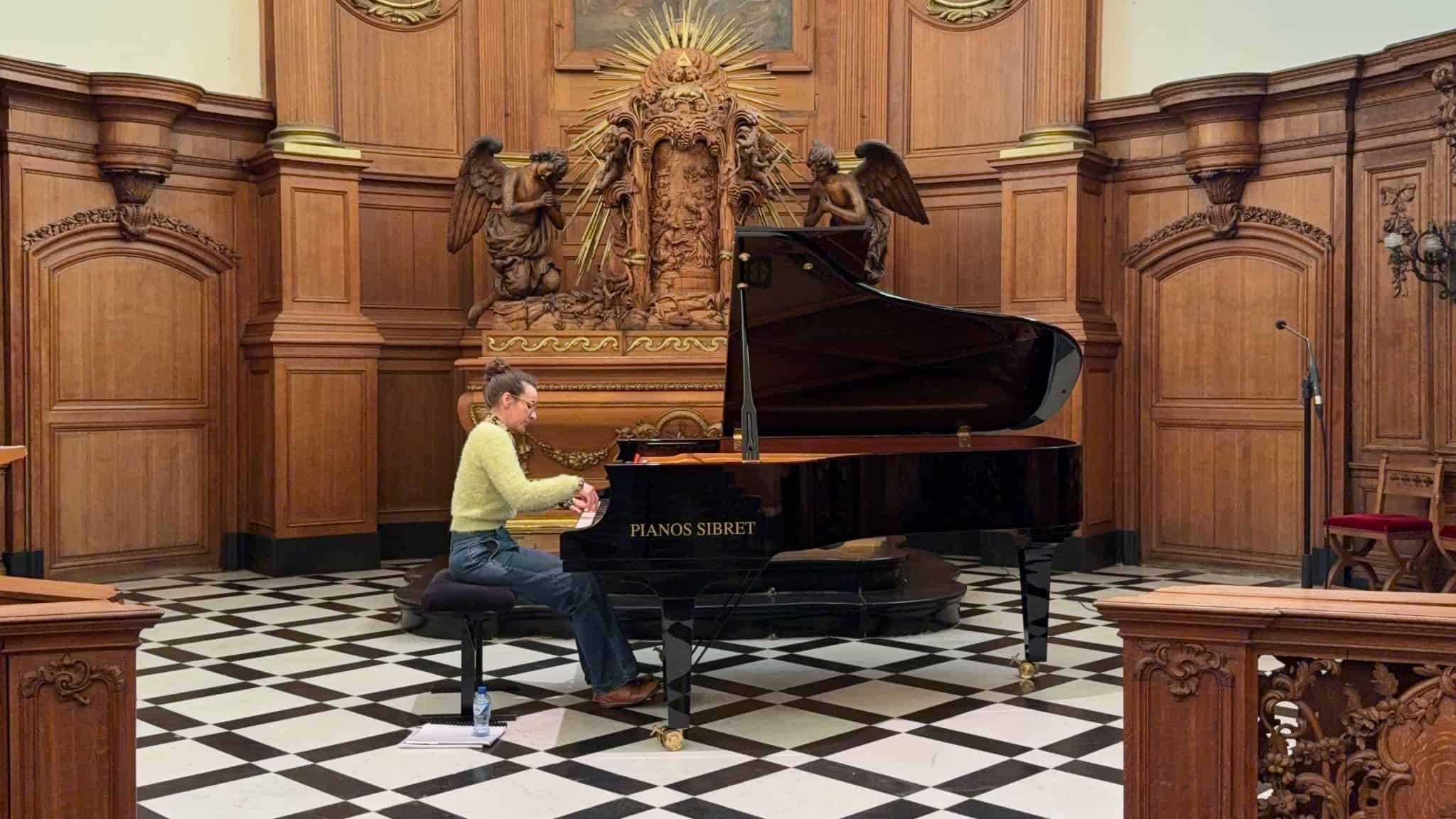
The concert by Isil Bengi on Sunday, January 18 left a deep and lasting impression. The afternoon took place in the Sint-Rochuskapel, located in Mariadal in Hoegaarden, and was organized by Klassiek in de Kapel. In this intimate and acoustically warm space, a carefully constructed musical journey unfolded, in which water served as a connecting image: flow and stillness, power and vulnerability.
From the first notes it became clear that this was no loosely strung-together recital, but a programme with strong inner coherence. In works such as Alkan's Chanson de la folle au bord de la mer and Massenet's Eau dormante, water resonated as a metaphor for inner movement and stillness. This atmosphere was deepened further in the understated soundworld of Brahms' Intermezzi and Mussorgsky's Une larme. The silence in the chapel was palpable and sustained the listening, allowing every nuance to stand out sharply in the space.
At the beginning of the concert, Isil Bengi herself gave a brief introduction to the programme. In doing so, she referred among other things to the tragic figure of Julian Scriabin, whose life ended abruptly when his body was found in the Dnepr at the age of eleven. As a tribute to this promising but too early deceased composer, she had deliberately included one of his works in the programme. This context gave the subsequent listening an added depth, in which fragility and intensity went hand in hand.
What followed was a concert carried by concentration, nuance and strong inner tension. Kara Toprak by Fazıl Say, which Isil had deliberately placed earlier in the programme, made an immediate and profound impression. The physical presence of the music, combined with her enormous technical mastery, held the audience completely in its grip from the first measures. It was music that not only sounded, but became tangible, and in which tension and energy continued to bubble beneath the surface.
In less well-known repertoire too, such as the miniatures by Ulvi Cemal Erkin and the short pieces by Komitas, Isil Bengi was able to trace a clear musical course. Her playing remained consistently focused and devoted to the music, with an evident control over sound, timing and dynamics. The audience followed that line attentively and visibly captivated.
As the concert progressed, it became increasingly clear how strongly Isil Bengi commanded the instrument, not as an end in itself, but as a means to build and let a soundworld breathe. In the closing piece, The Tides of Manaunaun by Henry Cowell, everything came together. The massive sound fields and undulating movements were presented with impressive certainty, and once again the audience was fascinated by the combination of physical power and absolute control. Yet it was above all her focus and her intense involvement that lingered: a playing that took the listener completely into the breath and movement of the music.
The silence after the final note spoke volumes, even before it was broken by prolonged applause that culminated in a standing ovation. In the understated space of the Sint-Rochuskapel, in Mariadal in Hoegaarden, that moment became a shared final chord. It was clear that for many this concert had been more than a musical event alone: an experience that had built up slowly and that, once past, continued to resonate for a long time.