
Young God
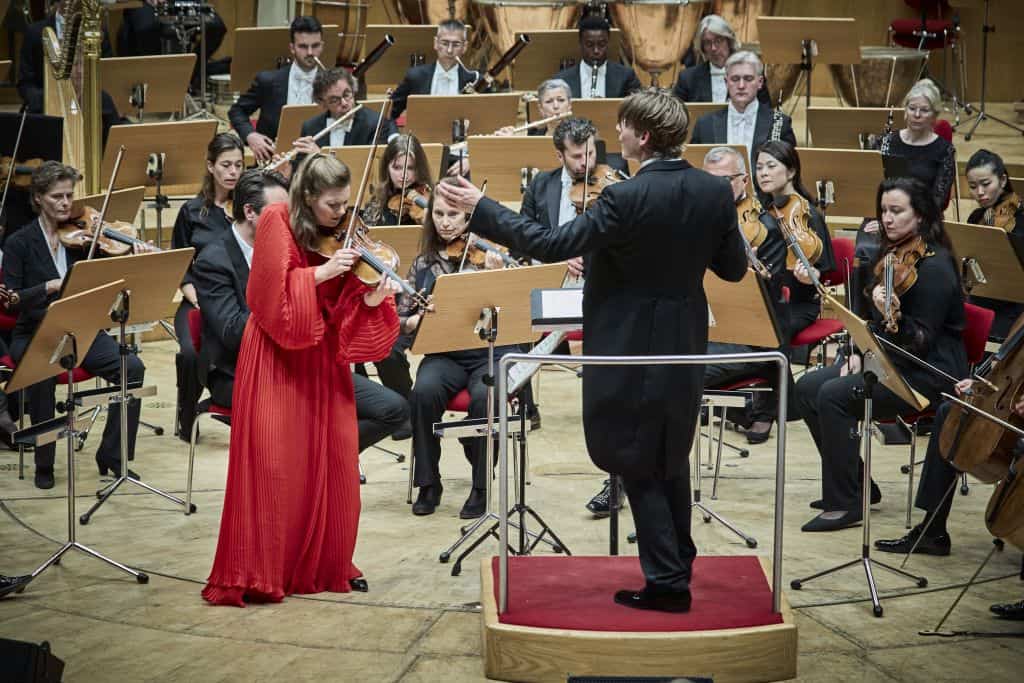
What makes someone a top conductor? In Mäkelä's case it is not decades of experience. Conducting is communication and persuasiveness and of course a conductor must know the score inside and out. At the Concertgebouw it is especially the musicians themselves who want him as their new chief. He also comes from a musical family and was actually on his way to building a solo career as a cellist. As a conductor too, he remains a musician among musicians. As a young god, Mäkelä is of course also marketed in classical music management like a fashion model. Mozart wrote his Paris symphony in 1778 on commission for the Paris Concerts Spirituels, one of the first public concert societies. For the Parisian public it must not be too profound and had to make a lot of noise. From the very first chords the hall is filled with the rich sound of the Amsterdam Concertgebouworkest, with the Berliner and the Wiener one of the best orchestras in the world. Perhaps they could do this without a conductor, but Mäkelä does add some surprising accents and nuances. Masterly The Dutch violinist Janine Jansen has been at the top for almost twenty years. She has also recorded Prokofiev's first violin concerto with Mäkelä and his Oslo Philharmonic. She plays beautifully dreamy and pleading in the first movement, briskly and frantically in the second. I thought Jansen might come across as perhaps too expressive and dramatic, but here everything was in balance in a masterly performance. Béla Bartók's Concerto for Orchestra is one of the most remarkable masterpieces for orchestra of the twentieth century. He was already ill, suffering from leukemia when he received the commission from Serge Koussevitsky to write an orchestral work. His last great work is not a symphony but a concerto, in which he lets groups of instruments in the orchestra perform in concert with each other. Virtually everything of Bartók is in it: irregular rhythms, mysterious night music, rousing motifs etc. Mäkelä and the Amsterdam Concertgebouworkest make something grand out of it. Golden Sound Here and there there is also something I have never heard in other performances of Bartók's Concerto for Orchestra. At the reprise of the theme in the bassoons in the second movement (from bar 165) the conductor does not let the third bassoon accompany, but its part becomes the main line. On the other hand, the nervous accents of viola cello bass (from bar 57) in the same movement were barely audible. Their syncopations (accent on the second sixteenth of the measure) are a sort of raw nerve in that section, but this hardly came across. In the fourth movement the oboe solo sounded rather dragging, the tempo of that section as a whole not tight enough. Enough criticism, the final chord made up for everything, a splendid golden sound with which this opening concert of the Kölner Philharmonie was beautifully concluded. The encore was a lovely epilogue after Bartók, a section from the Dances of Galánta by Zoltán Kodály.Janine Jansen and Concertgebouworkest Amsterdam as guests at Kölner Philharmonie
W
By
Willem Erauw
· 4 min read
The Kölner Philharmonie is one of the most remarkable concert halls in our region. Together with the Museum Ludwig it was designed by architects Busman and Haberer and opened in 1986. It stands in the heart of Cologne, close to the cathedral and central station. The modern amphitheatre, where the audience sits around the stage, accommodates more than 2000 listeners. It has two resident orchestras (Gürzenich and WDR orchestras), but it is especially the big names and orchestras that visit season after season and draw audiences.
Comet
On Friday, August 22, there was the opening concert of the 25/26 season of the Kölner Philharmonie. I came especially to hear and see the young conductor Klaus Mäkelä live at work. At this concert he conducts the Amsterdam Concertgebouworkest in Mozart's Paris symphony (the 31st) and Béla Bartók's Concerto for Orchestra. The Dutch star violinist Janine Jansen is soloist in Sergei Prokofiev's first violin concerto.
Conductor Klaus Mäkelä has broken through like a comet in recent years. Just five years ago, at age 24, he was appointed chief of the Oslo Philharmonic. After that things went very quickly. He was already guest conductor and partner of quite a few world-famous orchestras. In 2027 he will become the new chief conductor of both the Amsterdam Concertgebouworkest and the Chicago Symphony Orchestra. In 2027 he will be only 31 years old. It is exceptional that an orchestra with such a long tradition as Amsterdam's Concertgebouw appoints such a young conductor as its new chief.