
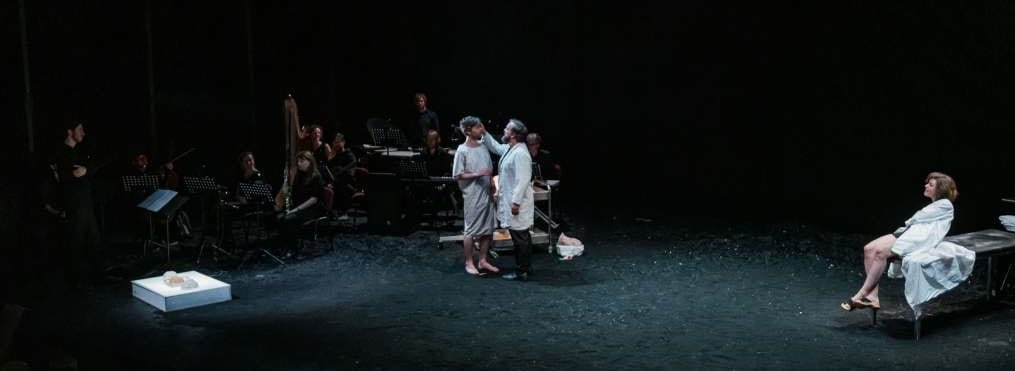
The 30-year-old Ars Musica and the Théatre de la Balsamine – a former small factory in Schaarbeek that is virtually unknown to Flemings – welcomed in its premiere the chamber opera 'Ce qui vit en nous'.
It is a new opera, part of a trilogy, that is full of a sort of hilarious dream of living and thus dead (or vice versa?) states as Hergé or Jacques Tati might have told them.
In short, you could describe this opera by Stéphane Arcas (libretto) and Baudouin de Jaer (music) as follows: bizarre, surrealistic unreal reality of life that is actually dead. The story is interspersed with humour, drama, absurdity, macabre confusion: all of this combined in music that fits the avant-garde, but is comprehensible and lyrical where the story requires it. Baudouin uses an unusual small orchestra, but knows precisely how to dose the drama and create dreamlike atmospheres where the story demands it. The singers – nameless extras who happen to get caught up in the story – have a hard time of it, especially the mezzo and the baritone (sung by a dramatic tenor) their roles are demanding for the voice, for getting into the character of the role and for musicality. Similar demands are placed on the tenor role, which is more that of a baritone, but it is a shorter role, so the singer has less of a hard time of it.
We are for a moment in the 18th and 19th centuries, but also in the present and the future. A living person turns out to be dead while he sketches an entire situation with another 'living still-living' person. The living person is a nurse but suddenly she turns out not to be, yet to be her mother. Everything takes place on an island, but that doesn't matter because it is in space. And so it continues with complicated jumping from pillar to post in an overture that does not even consist of music, but of spoken text by the two main opponents: the male figure and the young lady who may or may not be a nurse. She disappears behind the curtain, the male person talks on and enters into discussion with a voice from a megaphone. Then he too disappears and the music sets in with thunderous force.
The curtain opens. On stage we see the orchestra sitting to the side and further on there apparently lies a couple of brains on a scale at the front of the stage, just slightly in front of the orchestra. On a table lies a body under a white sheet. It is macabre because it is the autopsy room of a research institution. It is the dream of a project manager who hasn't been paid for five years finally to connect the brains via wireless connections. He still needs a third person's brains that are not older than 24 days in the dead because after that the dead is truly dead – and so these are the brains of that dead person under the white sheet. The confused scholar gets into an even more confused conversation with the nurse who is indeed definitely a nurse. It's about the project and that they haven't been paid for five years and now would finally like the director of the institution to visit them. He has never shown himself to them…
The dead man pulls the sheet off himself – it is the male figure – and looks around in wonder. What is he doing on that table? Is he then dead? Aha… He is naked (not shocking at all) and puts on an operating gown.
Before the Vietnam War, in the 1970s of the last century, the scholar suddenly managed to make silver through clumsy experiments – is he a sort of Doctor Mengele? – In the French text, there is a play on the word 'argent' which means both silver and money. Translated into Dutch, this comes across less clearly, but that doesn't matter much given the absurdity of the whole situation.
The actor and the singers throw themselves magnificently into their unusual roles and know how to elicit laughter from the audience countless times. And behold, suddenly there is the director, after five years he finally shows up. Does he now pay his employees? Is the project finished? Is it approved? We don't know. The conductor seems to have had enough and goes to stand among the audience to conduct. That's difficult because that way he can't follow his score… He goes back to his podium, but where, on which page are the musicians now? He looks at their scores, but there's nothing to do, he's lost his bearings. Angrily he walks back into the audience and breaks his baton. This way conductor and orchestra become involved in the surrealism of the story.
The orchestra continues to play for a bit, the singers and actor disappear from the stage and so do almost all the musicians, one by one… This is how an unusual chamber opera ends that I can recommend to everyone. A laugh and a tear, a moment of meditation (a very subtle guitar solo very beautifully performed), fine harp, almost frightening percussion, keyboards and strings, a flute and saxophone… They make this opera what it is: a masterpiece that gives meaning to 'meaningless nonsense'. You do indeed get a story, musically and scenically rounded off. This work has a future!
- WHAT: chamber opera Ce qui vit en nous – premiere
- LIBRETTO, DIRECTION & SCENOGRAPHY: Stéphane Arcas
- MUSIC: Baudouin de Jaer
- MUSICAL DIRECTION: Martijn Dendievel
- SINGERS & ACTORS: Sarah Théry (mezzo-soprano), Xavier de Lignerolles (tenor) Nicolas Luçon (actor), Thomas Van Caekenberghe (baritone)
- ORCHESTRA: Ensemble Besides
- PHOTOS: © Hichem Dahes