
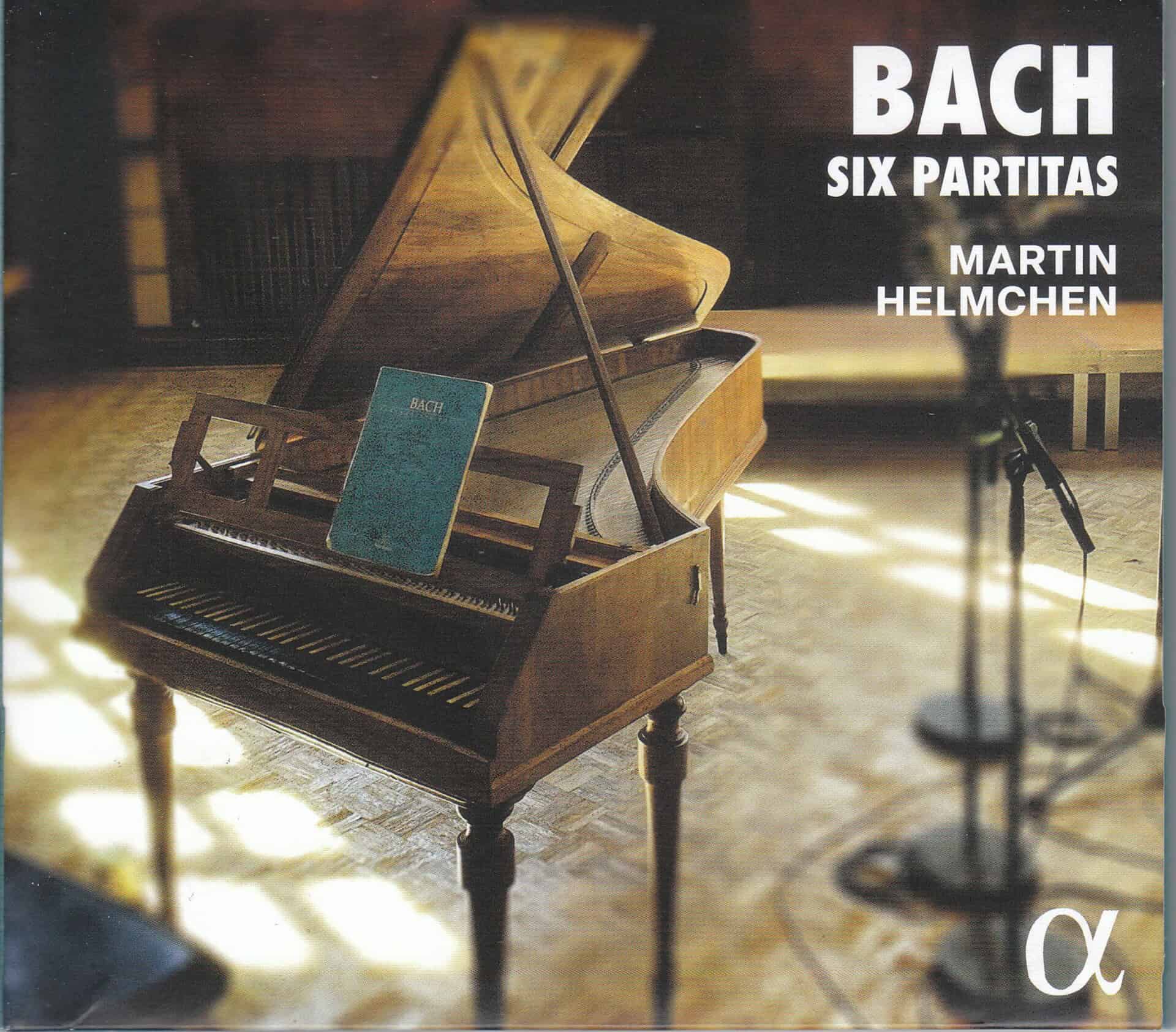
Bach's six Partitas BWV 825-830, originally intended for harpsichord, are heard this time for a change on a tangent piano from 1790 by the Späth & Schmahl, based in the German Regensburg. A very special piano indeed, with an equally distinctive sound, whose design has affinities with both the harpsichord, the early(est) fortepiano and the harp, depending on the register. The strings are made to sound with the help of narrow wooden tangents. The instrument played by Helmchen is one of the few that has survived the ravages of time - after restoration, of course.
The most important builder of tangent pianos in the second half of the eighteenth century was Franz Jacob Späth, also a renowned manufacturer of fortepianos, harpsichords, clavichords and organs. As early as 1751 he built a tangent piano for the Prince-Elector of Bonn. Once his business was flourishing, he made his son-in-law, Christoph Friedrich Schmahl, his full partner. Their tangent pianos were admired everywhere, including by many top musicians. One of them, Wolfgang Amadeus Mozart, referred to the tangent piano in 1777 as 'Späthisches Klavier'. About 10 instruments by Späth and Schmahl have survived, dated between 1780 and 1801. They all have the same mechanism and a range of 5 octaves: FF – f3. They vary in length from 184 to 222 cm.
[caption id="attachment_37381" align="alignleft" width="640"]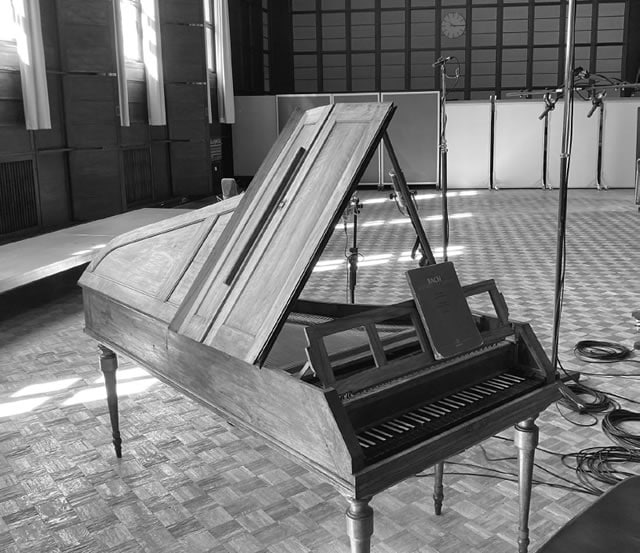 The tangent piano by Späth & Schmahl (Regensburg, 1790) played by Martin Helmchen[/caption]
Bach certainly had a thing for partitas: from 1726 onwards he composed at least one partita a year, while he was already busy enough on a completely different front, having been appointed cantor of the four most important churches in Leipzig three years earlier and the Thomasschule located there also made considerable demands on him. But Bach undoubtedly wanted to combine the two: composing and playing himself, with the joy that resulted from it.
Bach composed these six partitas between 1726 and 1731 and they are recorded as his first 'official' essay in the genre: they appeared as his first opus 1 (which he had written above it himself) in print. A publication, moreover, that he had paid for entirely out of his own pocket.
In the introduction Bach wrote:
'Da der Hochf[ürst]l. Anhalt-Cöthensche Capell-Meister und Direktor Chori Musici Lipsiensis, Herr Johann Sebastian Bach ein Opus Clavier Suiten zu ediren willens, auch mit der ersten Partiae den Anfang gemacht hat, und solches nach und nach, bis das Opus fertig, zu continuiren gesonnen; so wird solches den Liebhabern des Claviers wissend gemacht. Wobey denn zur Nachricht dienet, daß der Autor von diesen Wercke selbst Verleger sey.'
In the CD booklet, Helmchen justifies his choice of the tangent piano: that the instrument [offers] him more colour possibilities compared to the harpsichord, clavichord and the early (forte)piano, but also that the polyphonic texture comes into its own better on the tangent piano than on harpsichord or even the modern piano.
The partitas raise few questions regarding tempo choice: after all, they are mostly the well-known Baroque dance forms that give the pieces their first 'visual face' in this respect, or otherwise concrete indications such as sinfonia, capriccio, fantasia, rondeau, burlesca or aria that help the performer on their way. While it is up to the performer to model phrasing, ornamentation, articulation and punctuation according to their own judgment. Enough freedom, then, to distinguish oneself sufficiently in this regard as well. With the further note that only the musical notation is objective on balance, and what is derived from it is subjective.
The sound difference alone between harpsichord and tangent piano is considerable, and this requires above all from the performer a well-considered determination of his playing field. Some will do this more generously than others, but the valid starting point should be that of historicizing rhetoric, because otherwise a distorted image arises for the listener that – depending on the extent to which – becomes far or less far removed from eighteenth-century performance practice (insofar as we consider ourselves sufficiently informed about this).
Martin Helmchen (Berlin, 1982) has been intensively engaged with historical instruments for several decades, their playing technical (im)possibilities and the associated performance practice, which has given him the wealth of knowledge and experience that continuously radiates from his interpretation of these six partitas. But beyond that - and this is no less important - there is his dedication, his strong engagement with these works, the extremely lively character of his playing and the precision with which he has coaxed both the sublime rhythmic and harmonic building blocks from this beautifully sounding instrument. Also moving is the lyricism that unfolds in the slow movements almost singing, cantabile, and the ornamentation that gives the repetitions such an irresistible profile.
And the work structure? Each movement stands strictly on its own, receives its own unique atmosphere, yet proves to be masterfully integrated within the entire partita. Masterfully because it is a masterpiece, if only through the irresistible 'feeling' that creeps up on the listener that this playing points in the only right direction.
So much instrumental and interpretative brilliance, so much clarity and liveliness, so much detailed workmanship: it would have had less significance if the recording quality had not substantially contributed to this fascinating recital. But rest assured: the registration is, in a word, equally brilliant. Really not to be missed, these explorations filled with pure beauty, also as a formidable exposition of Bach's unique mastery in this field as well.