
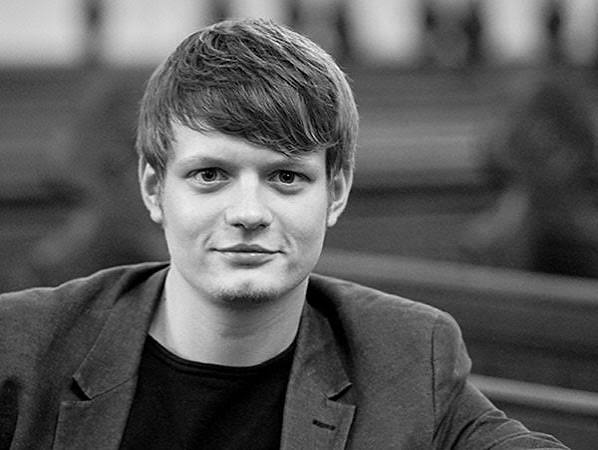
If you cross the Alexanderplatz in Berlin, you may unknowingly walk past one of the oldest places in the city. Just below the Fernsehturm, between the skyscrapers and tourist crowds, stands the Marienkirche: Berlin's oldest still-functioning church, with an organ inside that has been sounding for more than three hundred years. The person in charge of it is remarkably young. Xaver Schult has been organist of the Marienkirche since he was twenty-five, and that was almost seven years ago. I met him during an organ tour that I already reported on at Klassiek Centraal in April. Reason enough to speak with him at greater length.
An organ to touch
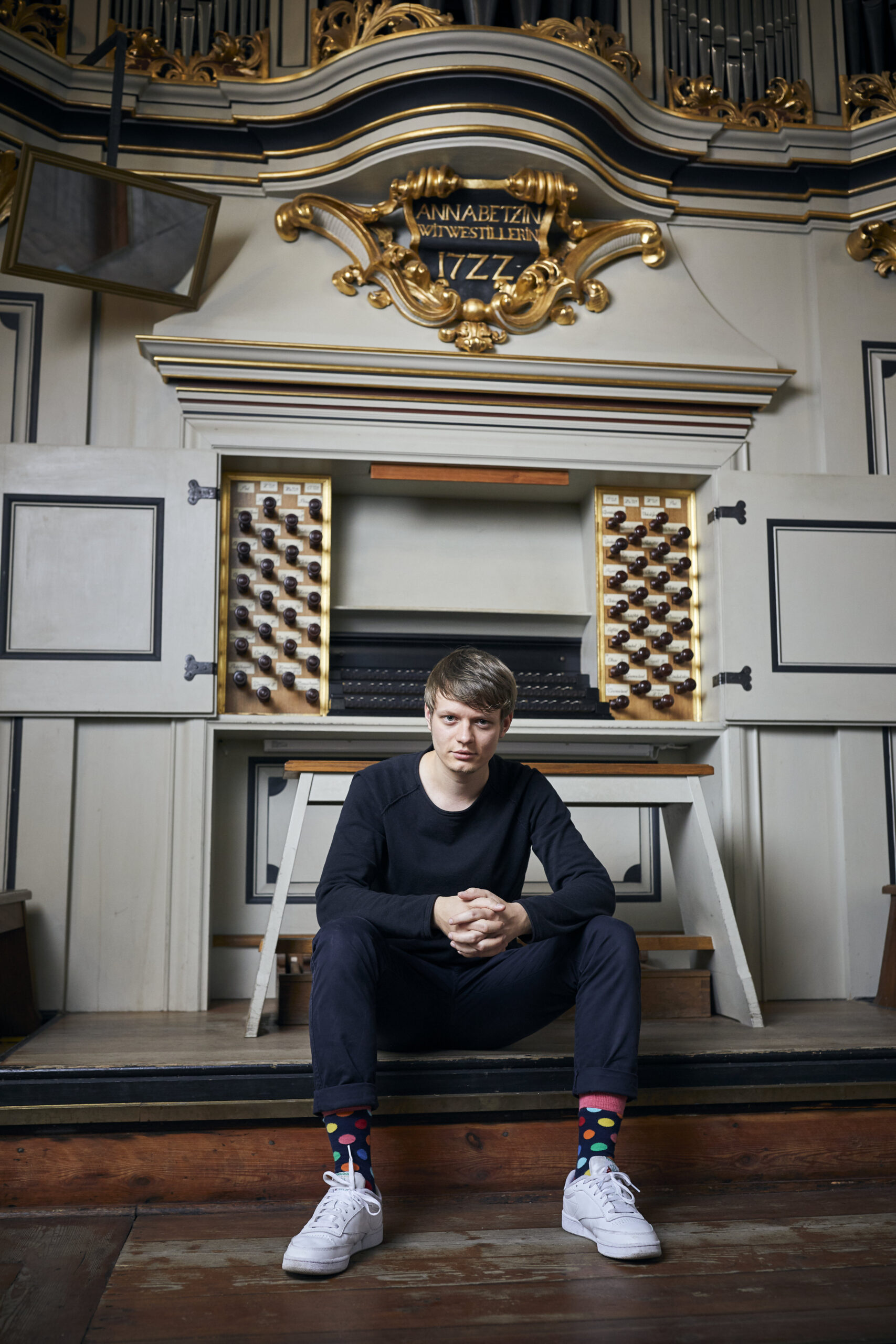 Every Thursday from April to October, anyone can come in for free and without an appointment for a tour of the Marienkirche's organ. For Schult, those moments are more than just a fixed task on the agenda. "The organ has fascinated me since my earliest childhood," he says. Where exactly that fascination comes from, he finds difficult to explain in hindsight: "The fascination for the organ was there first; I would have to search for an explanation for it afterwards." He also finds other instruments wonderful – "I just unfortunately can't play them."
At a tour, most of the public have never seen an organ up close, and they discover only then how versatile the instrument is: "It pleases me when my enthusiasm rubs off on the audience, and they experience the organ differently from that moment on." What exactly he shows depends on who stands before him. "Is the audience more interested in history? Or in the technique? Or do people mainly want to hear music?" Often the impression is greatest when visitors get to see the inside of the instrument, or are allowed to operate the bellows themselves.
From Northern Germany to the Alexanderplatz
According to Schult himself, the question of who Xaver Schult is can be answered in multiple ways. "Locally: I was born and raised in Northern Germany. Ecclesiastically: I grew up in the Evangelical Lutheran tradition. Musically: early music is my true home." According to him, many more backgrounds could be mentioned. He grew up in a musical family: his parents and siblings all play instruments and sing. Becoming an organist was not a later discovery, but a childhood wish that he realized almost straightforwardly: "I wanted to be an organist, for as long as I can remember. It was my great childhood dream."
Decisive was his time at the Dom of Schwerin, where Jan Ernst was not only his first organ teacher but also his choir director, later one of his professors at the Hochschule in Hamburg, and to this day friend, colleague, and sounding board. After graduating from Schwerin, Schult moved to Hamburg to study church music, with Wolfgang Zerer as his main organ teacher – he is also a great role model for him, musically and personally. After graduating, he spent another four years studying improvisation in Berlin with Wolfgang Seifen and Dirk Elsemann, parallel to his appointment at the Marienkirche.
His inspiration comes not only from musicians, though. People from different generations can inspire him in very different ways: musically, personally, or philosophically. Outside the organ, cooking is a growing passion, alongside a broad interest in technology – trains, airplanes, ships – and in graphic design and architecture.
Being young in a centuries-old tradition
When the position of organist at the Marienkirche was advertised, Schult was still in the middle of his final exams. "I was just twenty-five. I tried, and it worked out." An assistantship during his studies at Hamburg's Hauptkirche St. Katharinen – "a wonderful place to work" – certainly helped him with that.
Schult notices little tension between his age and the centuries-old tradition he represents: "Maybe it's even the opposite: the younger you start, the more natural your relationship with that old tradition becomes." In a time that seems quite turbulent to him, he experiences the centuries-long – sometimes even thousand-year-old – background of the tradition more as a reassuring anchor. That his generation relates to organ and church music differently than earlier generations, he does believe, though he adds matter-of-factly that every new generation is simply different from the previous one.
He continues to encounter surprised reactions to his age, though he puts that in perspective himself: "After almost seven years in office, I'm not exactly young anymore either. I'm just younger than the image many people apparently have of an organist in such a position." What the position actually demands of him – reliability, organizational talent, creativity, musicality – is according to him independent of age. Concretely, being an organist at the Marienkirche means much more than playing the instrument: Schult is also responsible for the care and maintenance of the organ, organizes concert series, engages in music mediation, and handles much behind the scenes. Collaboration and networking with other partners in the city are also part of his work.
Early music, living improvisation
As a musician, Schult has been primarily shaped by early music, played on historical instruments. He values differentiated, polyphonic articulation that responds to text and speech syllables. There are works that he has been playing for half his life and that still "make him fall in love anew every time." Improvisation forms an essential part of his work: most of what sounds from the organ during a church service is improvised. "With improvisation, you can respond with extreme precision to a situation and influence how words are interpreted." In concerts, however, he improvises less often.
An organ from 1721
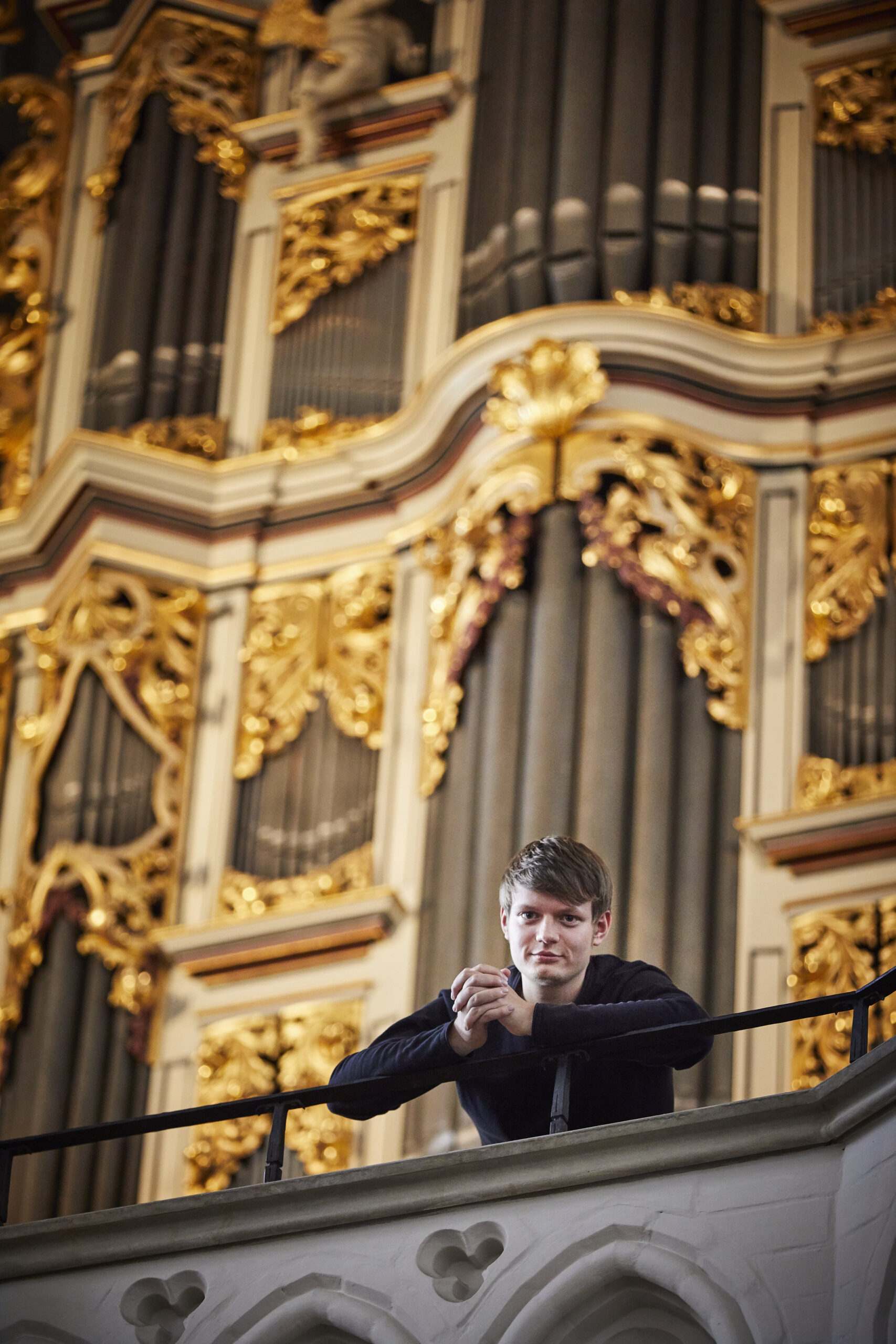 The Marienkirche organ was built in 1721 by Joachim Wagner – strictly speaking, only officially approved in 1723, though the inauguration took place earlier. It was Wagner's very first organ, the beginning of a long organ-building career. His style is regularly associated with Johann Sebastian Bach, who actually found the organs of Gottfried Silbermann old-fashioned and preferred builders from his school, such as Zacharias Hildebrandt and thus Joachim Wagner.
Over more than three centuries, the instrument has naturally changed, but it now stands, with a few exceptions, close to the original of 1721. It is particularly remarkable that the front pipes are still authentic – a stroke of luck that many historical organs did not have, because their front pipes had to be surrendered for the war industry during the First World War.
Playing on an instrument with so much historical and symbolic significance, in a church with such a turbulent past, could be intimidating. Schult fortunately does not experience that at the Marienkirche: "On the contrary, it lets me play with freedom and bring my own personality into the way I shape my work." The Marienkirche has important stories to tell, and they carry even more weight because Berlin has few places with central historical significance before the nineteenth century, "but it also doesn't have the weight of a Thomaskerk in Leipzig."
Berlin as a cultural city
On an ordinary weekday evening, there are an estimated two thousand events taking place in Berlin – an enormous offering, in which an organ concert is just one of many. According to Schult, this makes it difficult to reach the audience, but that same diversity is precisely what makes the city so attractive.
Yet the Marienkirche has something that is lacking elsewhere in Berlin: an organ from 1721, in the oldest church in the city, in the most central location imaginable, at the Alexanderplatz, just below the Fernsehturm: "We offer culture at prices that as many people as possible can afford, and at a very high level. And we try never to lose sight of the people who visit us and to remain accessible."
The organ remains a musical niche in any case, and Berlin is not necessarily more progressive in that regard than other cities. Moreover, the city is so large that he himself is often not even aware of what colleagues on the other side of Berlin are doing.
A new audience, without social media
Bringing young people – and by that Schult means not his own generation, but babies, children, teenagers – into contact with music, he calls essential. Learning music, for him, does not simply mean being able to read a staff, but developing skills and a relationship to yourself, your body, your soul, and the world. He finds it problematic that young people miss this opportunity because music, art, theater, or sports education falls away at schools, or because a family cannot afford a music school.
For the organ audience of the Marienkirche itself, he prefers not to focus on a single age group, but wants to be there for people of all ages. He hopes that concerts at a high level, with human involvement and reliable planning, will inspire people with a love of music – "maybe they'll come back someday, maybe they'll go to a concert somewhere else, maybe forty years from now they'll remember that they once heard beautiful organ music in the Marienkirche."
For those who find organ music "difficult" or "distant," he has all understanding: "The organ stands far away, you see no movement or human action, you are thrown back on pure listening." Organ compositions also differ fundamentally from orchestral or piano music: the organ was never a parlor instrument and is not naturally accessible.
Remarkable for someone of his generation: recordings and social media play no role whatsoever in his work: "I don't value social media, and neither the recording of transient art like music." He also listens to little recorded music in private – at most with a specific purpose, to look something up or find inspiration.
Looking ahead
At the moment, Schult is working on the annual planning for the coming two seasons – "drawing the first outlines in a new, blank notebook," as he calls it. In addition, a major task awaits: the organ of the Marienkirche will soon need to be cleaned and restored. A lot of work, but also an opportunity to get to know the instrument even more intimately – and that is precisely what makes the project something he is very much looking forward to.
As for the future of the church organ, he prefers not to make bold predictions. "If I knew that, life would be simpler in some respects." Still, he notices week after week how much enthusiasm the instrument can still arouse: "The church organ will probably be around for a long time to come."
He is reluctant to give advice to young colleagues – "don't such pieces of advice have much to do with ourselves and our own biography?" – but he speaks generously about his own life and experiences, hoping that someone will recognize themselves in part of it. He himself would, after all these years on magnificent historical instruments, like to spend more time with French symphonic organs – a field that has somewhat come up short in his career so far.
As the Fernsehturm casts its shadow over an Alexanderplatz that is constantly changing, an organ from 1721 continues to sound in the Marienkirche – played by someone who is just at the beginning of what promises to be a long organist's life. Xaver Schult is writing that story with as much love for tradition as for the still-blank pages that lie before him. Being young need not be a contradiction to a centuries-old tradition. On the contrary, it can be its most natural continuation.