
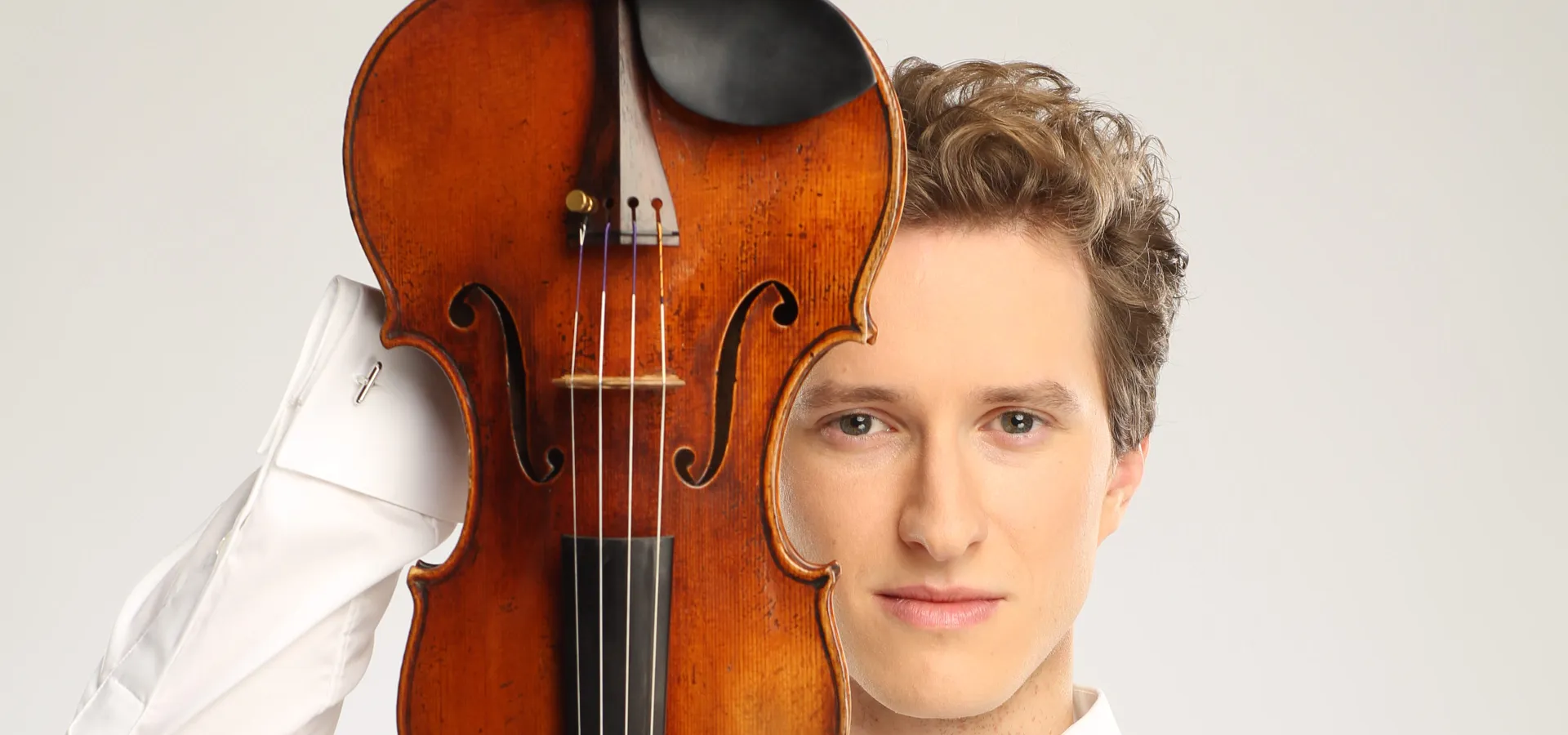
Czech star violinist Josef Špaček is on a Belgian tour. Thursday he was in Brugge, later also in Antwerp's Elisabethzaal and the Bozar. Tonight he performs at De Bijloke in Gent. On this stage he demonstrated his flawless mastery in Tschaikowsky four years ago, tonight Bartók's second violin concerto is on the programme.
De Bijloke's house orchestra is not under the baton of its chief conductor Poska, but tonight Czech conductor Jiři Rožeň holds the baton. And he does so with his left hand, which always takes some getting used to, both for the orchestra and the audience. A programme with treasures from Central Europe, the heart of classical music in the nineteenth and first half of the twentieth century, when that heart of Europe had not yet been divided by the Iron Curtain.
Before Špaček takes the stage, there is the overture to The Bartered Bride by Bedřich Smetana. Smetana is often overshadowed by his compatriot Dvořak but can claim an equally original, sometimes even more revolutionary idiom. This overture is frequently performed. A virtuosic orchestral work in which all facets of the orchestra come into play. After the lively theme it continues pianissimo with all string sections. First the second violins, tiny staccato notes like little birds in the Bohemian forest. The strings of the Symfonieorkest Vlaanderen can not only sing and hum beautifully, they can also play with meticulous precision together, as this passage proves. Delightful Slavic accents, stresses against the flow of the phrase, but that's how it is written in the score. Some woodwinds sound somewhat out of balance here and there. Perhaps they still want to lower the price to sell the bride faster...
Trained
With his tall, slender stature Špaček reminds one of a spade. A weak pun, because when after the orchestra's short introduction he launches into Bartók's devilish second violin concerto, the stiff spade transforms into a supple, almost elastic body. Four years ago I already wrote the same thing. Špaček sometimes bends slightly at the knees, with his head slightly forward his body forms an elongated S-shape. A graceful torero who defies all dangers in the virtuosic passages. The spade becomes a kind of snake-charmer who outsmarts every obstacle, effortlessly navigates every curve and sidesteps the pitfalls.
In the rhetoric and verbosity of his playing you can tell he trained for a while under the wings of Itzhak Perlman. Trained is the word, because this tall well-trained man plays like an athlete. If he were a horse, he would win all the races, I think. Were it not that it was Bartók who said that music competitions make no sense because competitions were invented not for musicians but for horses. Speaking of competitions, Špaček is one of those violinists who didn't make it to the top six in the Elisabathcompetition, but who nonetheless make a great career, while the winners are often quickly forgotten. Špaček was a finalist in 2012. Since then he conquers the great stages, but where is the winner from back then? Where is Andrej Baranov, that chubby Russian, that blonde teddy bear who reminded us all of David Oistrakh in 2012?
He bites his way flawlessly through the incredibly difficult piece, the long final note sounds like a low rumble, the foghorn of a steamship entering the harbor. Is there then nothing critical to write about this athlete? Well yes. His vibrato I found too little nuanced, often too broad, it gave a somewhat wobbly feeling. Too smaltzy, as if there's too much sauce on your steak. It detracts from the purity, the serenity and the resignation in some passages of this grand music.
Hope for improvement
After so much virtuosity it's time for the intermission. For the reviewer a good moment to listen in on what the others thought. Then I always feel like a spy behind enemy lines. Diagonally behind me a gentleman is talking to an older couple, who turn out to be his parents. I only learn that these are his parents after I've spoken to him. First he gives his audience, his parents that is, his opinion of the Bartok, then he reassures the oldsters that it will be more pleasant with Brahms than with that dreadful Bartok. Too many notes, he says, Špaček plays it too extremely, he assaults us.
The oldsters sit with their heads somewhat bowed. When he leaves the two for a moment I hear the old father groan: "where is the melody?". As if he has heard this, he quickly sits back down, with the message that in 1938, when Bartók wrote the piece, melody was something from a long-gone time. But there is hope for improvement, because "at the end of the first symphony by Brahms", which is on the programme after the intermission, "we hear hope overcoming despair". The oldsters look up, a glimmer in their eyes. Will it then still be a lovely evening after all?
The man enjoys the impact his words have on the two. He looks like a mature forty-something who hasn't had time to find a wife because he has to initiate his parents into the secrets of classical music every day of their old age. Before we go back into the hall I tell him he'll get a role in my story. He startles a bit, but then regains his composure and the steady gait with which he gently leads the oldsters back into the hall, towards Brahms' first symphony.
Critical
In the symphony Brahms reports on his struggle against fate. That fate whispered to him that after Beethoven's nine symphonies he would do better not to compose any more. He had already written quite an oeuvre, but never a symphony. With fateful timpani strokes and a massive tutti from the orchestra, Brahms opens his symphony, of which he could not then suspect that it would be his first. As if he is erecting a wall, a wall between Beethoven and himself. A wall that he will tear down over the next forty minutes, to celebrate his own triumph at the end. The fast tempo diminishes the threatening atmosphere that many orchestras want to express in the first movement. The brisk short three descending notes, the cell that is developed in this section in a truly Beethovenian manner, also passes too quickly and is insufficiently pronounced. But the strings are there again, a great warm compact sound, masterfully led by Polish concertmaster Jan Orawiec, also from Central Europe. Woodwinds and brass players are always soloists in an orchestra. The reed of a clarinet or an oboe can sometimes be stubborn. In the second movement the oboe plays its rising melody. Four notes, but the fourth is too low, painfully too low. Was it the reed? I don't know, but such things can happen. The wind players do not have the same quality as the strings, but as a group the latter are certainly top-notch.
I think of the man during the intermission, when the finale and hope are in sight, or in hearing, I should write. Has the oboe already dropped a stitch, something sounds strange with a horn solo. A nasal tone, something between shrieking and croaking, as if there were a duck in the horn... I remain somewhat unsatisfied as to the interpretation of the entire symphony. Also in the last movement. When it finally comes time for the redeeming sounds of hope, which will sweep away despair, it lacks generosity, broad phrases, some notes are cut short too quickly.
I am still lost in my thoughts about that hopeful melody where I heard too little hope and redemption, when the applause has died down and a lovely woman next to me says something. "That last melody sounds a bit like the Ode an die Freude". I nod, she is right, he learned it from Beethoven, expressing hope with musical notes. But it is as if she shakes me awake, because only then am I back in this world and I see again who she is, my own wife with whom I have been married for twenty-five years, the most hopeful person in my life. When we step out into the sluggish evening air, I see the good man with his parents again. "How did you like it?" "Splendid! Beautiful interpretation!", he answers quickly and triumphantly. My wife also heard it: "you see, sometimes you have to be a little less critical"...