
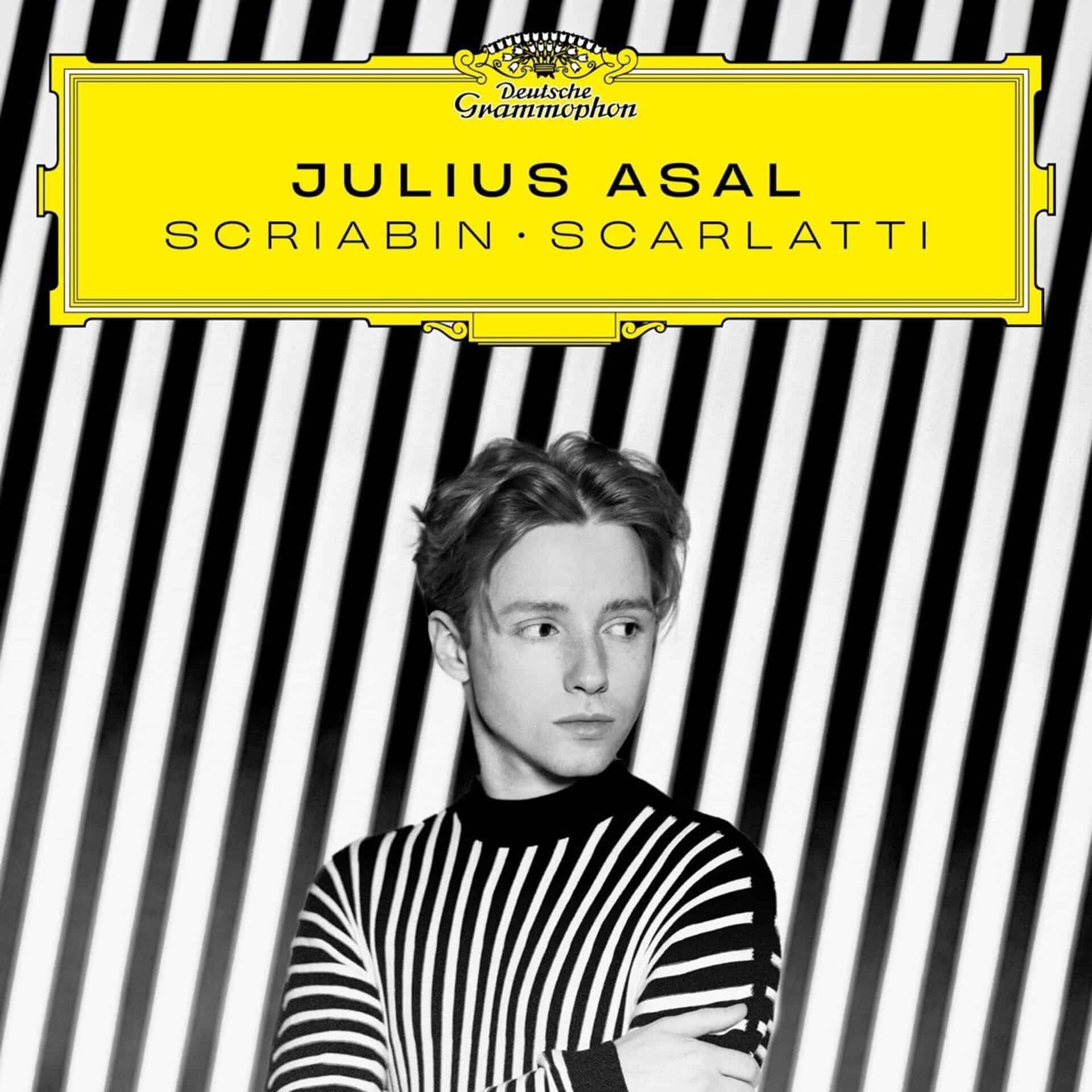
At first glance, it seems like a strange combination, with the interwoven piano works of Domenico Scarlatti and Aleksandr Scriabin, but of course the German pianist Julius Asal (*1997) has given it careful thought for his debut album. He has—it is crystal clear—brought these two totally different worlds together in an inventive as well as unique way in an unrivaled manner. What flows both from the refinedly chosen structure and from—to the ear—two concert grand pianos that sound quite different from each other, the choice depending on what the pianist has in hand here: Scriabin (darker, with more sonority) or Scarlatti (lighter, more transparent in tone). In the notes, however, strangely enough, I was not able to read anything about it.
The opening and closing fragment on this cd is not, as I read elsewhere in a review, the fourth movement from Scriabin's Piano Sonata in f, op. 6, but only the short 'Quasi niente' from it, here in the dual role of prologue (shaped somewhat differently by Asal with respect to the original shown below) and epilogue (according to the printed score).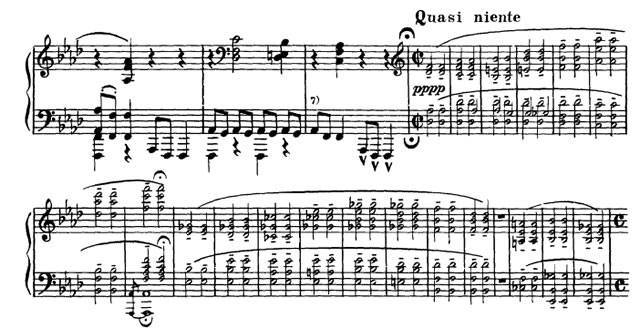
This 'almost nothing' should be played as softly as possible: pppp. It returns again, but now without Asal's intervention, in the middle section of this recital, forming part of the final section in the fully performed sonata (1. Allegro con fuoco; 2. [Adagio]; 3. Presto; 4. Funebre).
A connecting and logical element are the keys, with the 'transitions' designed by the pianist himself serving to bridge those places where the transition between the pieces would have led to a considerable and unwanted gap in style or emotion.
Asal wanted to 'mold' the program as a whole in a seamless manner. It also explains why the varying characteristics of these pieces not only provide the necessary additional contrast, but also that they are both naturally embedded and have an adventurous execution: alternately contemplative, furious, warm-lyrical, dance-like, rhythmically pregnant, yes even mystical. In short, this is a performance of considerable stature from this young pianist.
This manner of programming (or rather: interwoven with each other) means that the pieces individually continuously reinforce each other, with the exquisite transitions designed by Asal serving as bridging intermezzi. The equally magnificent piano playing fits in all respects: Asal proves himself not only a great virtuoso, but also a magnificent interpreter who seems to have assumed the role of an extremely musical storyteller with ease and in full conviction. The recording is equally brilliant.
A very special recital that deserves emulation, if only because it breaks through the so firmly established conventions in the programming of concerts and music carriers. Of course, it must then be assembled in an equally ingenious way!